
Finance
Loans, mortgages, savings growth, and long-term planning — with transparent formulas.
Whether you're comparing mortgage scenarios, stress-testing an early retirement plan, or just need a fast tip split — our finance calculators turn spreadsheet logic into clear inputs and outputs. Each tool shows the core relationship (payment, rate, time, or return) so you understand the number, not only the bottom line. Personal finance is personal; use these results alongside your own goals and, when needed, a qualified professional.
Loans & payments
Principal, interest rate, and term combine into a monthly payment. See how extra payments shorten the payoff path.
Compound interest
Returns earn returns when they stay invested. Small rate and time differences compound into large outcome gaps.
Retirement & FIRE
Translate spending and savings rates into portfolio targets—often discussed using withdrawal-rate rules of thumb.
Net worth & ROI
Assets minus liabilities for a balance-sheet view; ROI compares gain to what you put in.
Calculators
View all finance toolsCar Affordability
Estimate an affordable vehicle payment from income and typical lender caps—pair with interest and term assumptions.
College Savings (529)
Project a 529 or education fund balance from ongoing contributions, expected return, and years until school.
Compound Interest
Future value with compounding—adjust principal, APR, compounding frequency, and time to compare scenarios.
Extra Mortgage Payment
See how additional monthly principal cuts total interest and loan term on your amortization schedule.
FIRE Calculator
Ballpark “financial independence” targets using spending and the common 4% starting-point rule—then refine with your plan.
Home Affordability
Relate income, debts, down payment, and rate to a sensible purchase price using classic housing-debt ratios.
Hourly to Salary
Convert an hourly wage to annual income using hours per week and working weeks per year.
Loan Payment
Standard amortizing payment from principal, periodic rate, and number of payments—core logic for most installment loans.
Micro-Retirement Simulator
Run compact retirement projections—contributions, growth, and draw phases—to compare “what if” settings.
Mortgage Payment
Estimate monthly housing cost including principal, interest, taxes, and insurance where you enter them.
Net Worth
Add what you own, subtract what you owe—get a simple snapshot of household net worth.
ROI Calculator
Percentage return on an investment or project from starting value and ending value (or gain).
Retirement Savings
Project retirement balances from contributions, employer match, growth rate, and years to retirement.
Salary to Hourly
Break an annual salary into an equivalent hourly rate for comparison or negotiation context.
Savings Goal
Solve for required monthly savings—or time—to reach a target balance at a given interest rate.
Tip Calculator
Split checks with tip and per-person totals—handy for restaurants and shared bills.
Guides & Articles
View all Finance articles
The Role of Financial Modeling in Business Decisions
Discover the crucial role of financial modeling in driving strategic business decisions. Learn to leverage models for success today!

The Honest Downsides: Risks, Regrets & Coming Back to Work
The risks, regrets, and psychological challenges most mini retirement content glosses over — including what people wish they'd known, and how to come back.

How to Plan a Mini Retirement: The Complete Logistics Guide
Everything you need to actually execute a mini retirement — duration, health insurance, taxes, Social Security, timing by age, and whether to take one long break or several short ones.

Calculate Home Equity: A Guide for Homeowners
Unlock your financial potential with our comprehensive calculate home equity guide. Learn how to confidently determine your home's equity today!

Will a Mini Retirement Hurt Your Career?
The honest answer on career gaps, re-employment odds, how to explain time off to employers, and whether to tell your current company.

How Much Money Do You Actually Need for a Mini Retirement?
The real math behind funding a mini retirement — runway calculations, the $1,000/month rule, budgeting by location, and whether you can do it on a low salary or with debt.

What Is a Mini Retirement? And Is It the Same as a Sabbatical?
The complete guide to mini retirements — what they are, how they differ from sabbaticals, real examples, and how they connect to Coast FIRE.

The Role of Interest Formulas in Personal Finance
Discover the critical role of interest formulas in personal finance. Transform how you save and invest with expert insights today!

Understanding Mortgage Statements: a Homeowner's Guide
Unlock the secrets of your mortgage with our guide to understanding mortgage statements. Stay informed, catch errors, and take control!

Mortgage insurance premiums: what every homebuyer must know
Discover the role of mortgage insurance premium and how it impacts your homebuying journey. Make informed decisions to secure your mortgage!

How to calculate your mortgage payment the smart way
Learn how to calculate mortgage payments confidently! Our smart guide simplifies the process, so you make informed financing decisions.

Best finance calculators for homeowners: Smart choices
Discover the top finance calculators for homeowners to ensure accurate budgeting. Avoid costly mistakes and choose wisely for your financial future!

The Costco Hot Dog Combo Just Changed for the First Time in 40 Years. Here's the Full Financial Breakdown of the Greatest Pricing Stand in Retail History.
Costco keeps the $1.50 hot dog combo while adding a bottled-water option. Inflation math, ~$710M implied subsidy at 245M combos/year, membership economics, nutrition facts, and the compound-interest case for the loss leader.

Compound interest calculator benefits for your savings
Discover the compound interest calculator benefits for your savings! Visualize your financial future and boost your savings effortlessly.

Calculating Compound Interest: A Step-by-Step Beginner's Guide
Learn how to calculate compound interest easily with our step-by-step guide. Boost your savings and maximize your earnings with simple methods!

How to calculate loan payments: a step-by-step guide
Learn how to calculate loan payments confidently with our step-by-step guide. Avoid financial pitfalls and make informed borrowing decisions today!

The Capital One $425 Million Settlement Just Got Final Approval. Here's Exactly How Much You'll Get.
Final court approval April 20, 2026: who qualifies for the Capital One 360 Savings class action, how payouts are calculated from the $425M fund, automatic payments around July 2026, and what to do about your address and taxes.

The NFL Draft Is This Week. Here's What Pick #1 Actually Takes Home.
The #1 overall rookie contract is worth over $54.5 million guaranteed - but take-home pay is a different story. Here's the full breakdown: agent fees, federal tax, state tax by team, advisor costs, best vs. worst case, jock tax, and compound growth.

Your Flight Is Delayed or Cancelled. Here's Exactly What You're Owed.
US and European rules are completely different - and the gap is enormous. Plain-English guide to DOT refunds, EU261 cash compensation, UK261, credit card chargebacks, and how to claim.

Rory McIlroy Won $4.5 Million at The Masters. Here's What He Actually Keeps.
The headline number is what goes on the trophy. The real number - after the caddie, the agent, three tax jurisdictions, and a transatlantic tax treaty - is quite different.

Spirit Airlines Is Going Out of Business. Here's What Could Happen to Your Tickets, Miles, and Money.
Spirit could liquidate this week. Here's the plain-English guide to what that means for every dollar you've given them - and what history says about what you'll get back.

Tax Deadline 2026: April 15 Is Here. Here's Exactly What Happens If You Miss It.
Tax Day 2026 is here. Two completely different situations - one where missing the tax filing deadline is costly, one where it barely matters. Most people don't know which one they're in.

Renting vs. Buying in 2026: We Did the Full Math So You Don't Have To
Side-by-side numbers for a $400,000 home vs renting: year-one cash flow, 10-year net worth, break-even timing, and what usually gets left out of the debate.

The True Cost of Your Mortgage in Year One Will Shock You
How a $400,000 home loan actually works - and what your bank does not lead with. Year-one payment split, hidden costs, amortization crossover, and what one extra payment can save.

What To Do With Your Tax Refund in 2026: The Smart, the Dumb, and the Math
Average refunds are up in 2026. Here is how to prioritize debt, investing, and emergency savings - with the math behind each choice.

Should I Pay Off My Mortgage Early or Invest? (Complete Analysis 2026)
Compare paying extra on your mortgage versus investing the difference. Real math, tax impact, and a decision framework so you can choose the right strategy for your situation.

How to Buy a Car on a $50,000 Salary: The Complete 2026 Guide
Making $50K a year? Learn exactly what car you can afford, realistic monthly payments, and the best vehicles in your budget. Includes calculator and real examples.
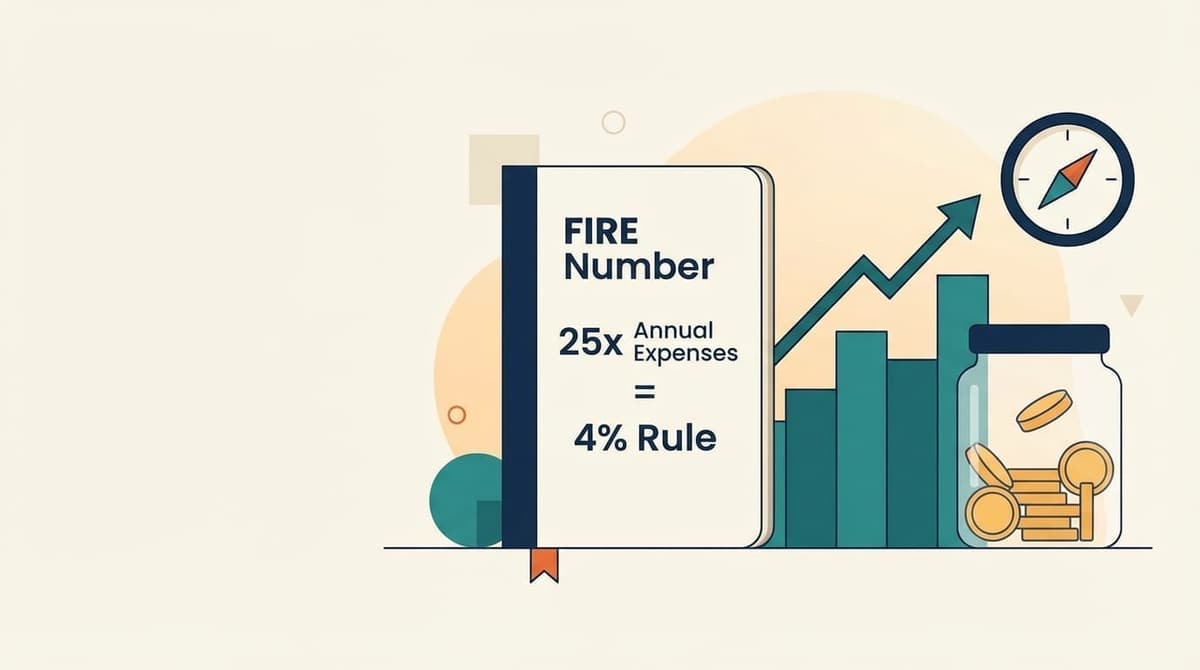
What Is My FIRE Number? (And How Do I Calculate It?)
Learn what your FIRE number means, how the 25x rule works, and how to calculate your target in minutes.

Can You Really Retire at 40? The Math Behind Early Retirement
See the savings rates, timelines, and tradeoffs that make retiring at 40 realistic or not.
Formula Quick Reference
Core relationships behind these calculators—typically dollars, rates as decimals or percentages, and years or payment counts depending on the tool.
| Formula | Equation | Variables | Result unit | Calculator |
|---|---|---|---|---|
| Compound growth | A = P(1 + r/n)^(nt) | P = principal, r = annual rate, n = periods/year, t = years | $ (future value) | Use calculator → |
| Loan / mortgage payment | M = P × [r(1+r)^n] / [(1+r)^n − 1] | P = principal, r = rate per period, n = number of payments | $ / period | Use calculator → |
| Return on investment | ROI = (V₁ − V₀) / V₀ × 100% | V₀ = start value, V₁ = end value | % | Use calculator → |
| Net worth | NW = Σ assets − Σ liabilities | cash, investments, property minus debts | $ | Use calculator → |
| FIRE rule of thumb | FI ≈ annual spend × 25 | based on ~4% initial withdrawal discussion | $ (target) | Use calculator → |
| Hourly → annual | annual = hourly × hours/week × weeks/year | adjust weeks for unpaid time off | $ / year | Use calculator → |
| Salary → hourly | hourly = salary ÷ (hours/week × weeks/year) | same hours/week assumption as conversion | $ / hour | Use calculator → |
| Tip total | total = bill × (1 + tip%) | before split among diners | $ | Use calculator → |
Watch & Learn
Short lessons on interest, saving, and how loan balances evolve—useful context before you plug numbers into the calculators.
Introduction to interest | Interest and debt | Finance & Capital Markets
Simple vs compound interest—foundation for savings growth and the logic behind our compound interest calculator.
The rule of 72 for compound interest | Interest and debt
Quick mental math for doubling time—pairs well with long-term savings and retirement scenarios.
Amortization and depreciation | Finance & Capital Markets
How loan balances decline over scheduled payments—context for mortgage and loan payment tools.
Frequently Asked Questions
Common questions about loans, growth, and planning—answered directly.