

Key Takeaways
| Point | Details |
|---|---|
| Always gather key details | You need the loan amount, interest rate, and term to calculate payments accurately. |
| Know the formula | The standard loan payment formula works for most amortizing loans and is easy to use with the right numbers. |
| Extra payments save money | Paying extra toward principal early can dramatically cut interest costs and shorten your loan term. |
| Compare before you commit | Look at both monthly payments and total interest to find the best loan for you. |
What you need before you start calculating
Now that the importance of understanding loan payments is clear, let's clarify what information you have to gather before doing any calculations.
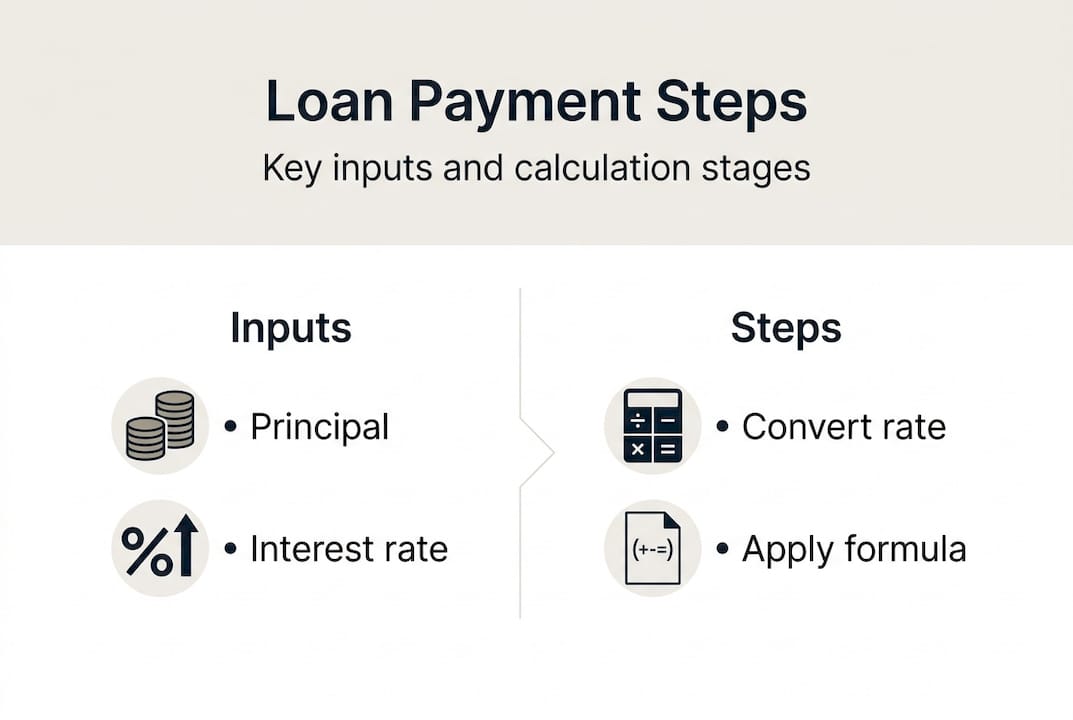
Every loan payment calculation depends on three core inputs. Without all three, the math simply will not work. Here is what you need:
| Input | What it means | Sample value |
|---|---|---|
| Principal (P) | Amount borrowed | $15,000 |
| Annual interest rate (APR) | Yearly borrowing cost | 8% |
| Loan term | Repayment period | 4 years (48 months) |
| Monthly interest rate (r) | APR divided by 12 | 0.667% or 0.00667 |
| Number of payments (n) | Term converted to months | 48 |
Notice the last two rows. Before you plug numbers into any formula, you need to convert your inputs. Divide the APR by 12 to get the monthly interest rate. So 8% APR becomes 0.08 / 12 = 0.00667. Then convert your loan term from years to months by multiplying by 12. Four years becomes 48 months. These conversions are essential because the standard loan payment formula M = P × [r(1+r)^n] / [(1+r)^n - 1] operates on monthly figures, not annual ones.
Why does each input matter so much? The principal determines the base amount interest is calculated on. A higher principal means more total interest paid, even if the rate is the same. The interest rate directly controls how expensive borrowing is. A difference of just 2% on a $20,000 loan can mean hundreds of dollars in extra interest over the life of the loan. The loan term affects both the monthly payment size and the total interest cost. Longer terms mean smaller monthly payments but significantly more interest paid overall.
To put current rates in context, average personal loan rates in 2026 run approximately 12 to 17% APR for most borrowers. Your actual rate depends on your credit score, income, and the lender you choose. Borrowers with excellent credit may qualify for rates at the lower end or even below that range.
This guide focuses on fixed-rate amortizing loans. These are the most common loan type for personal loans, auto loans, and mortgages. With a fixed-rate loan, your interest rate does not change, and each monthly payment is the same amount from start to finish. You can also use our loan payment calculator to check your inputs before running the formula manually.
- •Principal (P): The total amount you are borrowing, before any interest.
- •Annual interest rate (APR): The yearly cost of borrowing, expressed as a percentage. APR stands for Annual Percentage Rate.
- •Loan term (n): The total length of time you have to repay the loan, usually expressed in years or months.
The table below shows what these inputs look like with sample values, so you can see exactly what you will be working with:
Step-by-step: Calculating your monthly loan payment
With your loan details in hand, you are ready to calculate. Here is how to do it, step by step.
The standard formula for an amortizing loan is:
M = P × [r(1+r)^n] / [(1+r)^n - 1]
Where:
Calculation steps
- •Convert APR to a monthly rate. Divide 6% by 12: 0.06 / 12 = 0.005.
- •Convert the loan term to months. 5 years × 12 = 60 months.
- •Calculate (1 + r)^n. That is (1 + 0.005)^60 = (1.005)^60 ≈ 1.3489.
- •Multiply P by r(1+r)^n. So 20,000 × (0.005 × 1.3489) = 20,000 × 0.006745 = 134.89.
- •Calculate the denominator: (1+r)^n - 1. That is 1.3489 - 1 = 0.3489.
- •Divide step 4 by step 5. 134.89 / 0.3489 ≈ $386.66.
| Method | Time required | Risk of error | Best for |
|---|---|---|---|
| Manual formula | 5 to 10 minutes | Higher (input mistakes) | Learning the math |
| Online calculator | Under 1 minute | Lower (automated) | Quick comparisons |
For mortgages specifically, a mortgage payment calculator handles the extra complexity of property taxes and insurance. If you want to see how interest compounds on savings or investments alongside your loan, the compound interest calculator offers useful side-by-side context.
Understanding each step of the formula gives you something an online tool alone cannot: the ability to spot errors, ask smarter questions, and verify that a lender's quoted payment actually matches the terms they are offering.
- •M = monthly payment
- •P = principal (loan amount)
- •r = monthly interest rate (APR divided by 12)
- •n = total number of monthly payments
Let's work through a real example. Suppose you borrow $20,000 at 6% APR over 5 years (60 months).
That means over the full 5 years, you will pay a total of $387 × 60 = $23,220. The interest cost alone is $3,220 on top of the $20,000 you borrowed. That number is worth knowing before you sign anything.
Pro Tip: Before you finalize your calculation, double-check that you entered the interest rate as a decimal, not a percentage. Entering 6 instead of 0.005 for the monthly rate is one of the most common errors and will produce a wildly incorrect payment figure.
Here is a quick comparison of doing this manually versus using an online tool:
Inside your loan payment: Understanding amortization
Once you know your monthly payment, it is helpful to see where your money is actually going each month.
Amortization is the process of spreading loan payments over time so that each payment covers both interest and a portion of the principal. The key insight is that the split between interest and principal is not even. As the amortization schedule shows, each monthly payment first covers interest on the current balance, with the remainder reducing the principal.
| Month | Payment | Interest portion | Principal portion | Remaining balance |
|---|---|---|---|---|
| 1 | $387 | $100.00 | $287.00 | $19,713 |
| 30 | $387 | $57.20 | $329.80 | $11,369 |
| 60 | $387 | $1.93 | $385.07 | $0 |
Look at month 1 versus month 60. In the first month, $100 of your $387 payment goes to interest and only $287 reduces your balance. By month 60, nearly the entire payment goes to principal. This gradual shift is what "amortization" means in practice.
What happens when you make extra or irregular payments? Several things:
- •Your remaining balance drops faster than scheduled.
- •Future interest charges are calculated on a lower balance, so they are smaller.
- •You may pay off the loan earlier than the original term.
- •The total interest you pay over the life of the loan decreases, sometimes significantly.
Extra payments early in the loan save the most interest because they reduce the balance when interest charges are at their highest. A single extra payment in month 3 saves more than the same extra payment made in month 50. This is a concrete, actionable fact that most borrowers never learn.
Pro Tip: When making extra payments, always specify in writing or through your lender's payment portal that the extra amount should be applied to principal only. Without that instruction, some lenders apply it to the next scheduled payment instead, which does not reduce your balance as quickly.
For homeowners, an extra mortgage payment tool can show you exactly how much interest you save and how many months you shave off your term by paying a little more each month.
Reviewing your full amortization schedule, which lists every payment from month 1 to the final month, gives you a clear picture of your loan's true cost and helps you plan extra payments strategically.
This matters because in the early months of a loan, you are paying down very little of what you actually owe. Most of your payment goes straight to the lender as interest. Here is how that plays out on the $20,000 loan example from the previous section:

Beyond basics: Special loan types and edge cases
Not all loans work exactly the same. Understanding special cases can save you from surprises.
The formula covered so far applies to fixed-rate amortizing loans. But several other loan structures exist, and each changes how your payment is calculated.
Interest-only loans require you to pay only the interest each month for a set period, usually 5 to 10 years. Your principal does not decrease during that time. After the interest-only period ends, your payments jump significantly because you now have to repay the full principal over the remaining term. This jump is called payment shock, and it catches many borrowers off guard.
Equal-principal loans split the principal into equal portions across all payments. Each month, you pay the same principal amount plus interest on the remaining balance. Because the balance drops steadily, your total payment decreases each month. This structure results in less total interest than a standard amortizing loan, but your early payments are higher.
Adjustable-rate mortgages (ARMs) start with a fixed rate for an initial period, then adjust periodically based on a market index. Amortization assumes fixed rates, so when an ARM adjusts, your monthly payment recalculates entirely. If rates rise, your payment rises. If the new payment does not cover the interest owed, negative amortization occurs, meaning your balance actually increases instead of decreasing.
Here is a side-by-side comparison of amortizing versus interest-only loans using the same $20,000 at 6% APR:
| Feature | Amortizing loan | Interest-only loan (5 years) |
|---|---|---|
| Monthly payment (years 1 to 5) | $387 | $100 |
| Monthly payment (after year 5) | $387 | $387+ (higher) |
| Balance after 5 years | ~$11,369 | $20,000 (unchanged) |
| Total interest paid | ~$3,220 | Higher overall |
| Best for | Predictable budgeting | Short-term cash flow |
Additional edge cases to watch for include:
- •Zero-interest loans: When the rate is 0%, the monthly payment is simply the loan amount divided by the number of months. No formula needed.
- •Prepayment penalties: Some lenders charge a fee if you pay off the loan early. These are rare but worth checking in your loan agreement before making extra payments.
- •Loan recasting: After a large lump-sum payment, some lenders will recalculate your monthly payment based on the new lower balance while keeping the original end date. This lowers your monthly obligation without refinancing.
- •Negative amortization: If your payment is less than the interest owed, the shortfall adds to your principal. This can happen with certain ARMs or graduated payment loans.
Knowing these variations helps you ask the right questions when comparing loan offers and avoid structures that look attractive upfront but cost more in the long run.
Why understanding loan payments is your strongest financial tool
Most financial advice tells you to shop for the lowest monthly payment. That sounds reasonable, but it is often the wrong goal. A lower monthly payment almost always means a longer loan term, and a longer term means more total interest paid. A borrower who stretches a $20,000 loan from 3 years to 6 years might save $150 per month but pay $2,000 more in total interest. That is not a good trade.
Knowing how to calculate your own payments gives you real negotiating power. You can verify whether a lender's quoted payment matches the rate and term they advertised. You can compare two loan offers not just by monthly cost but by total cost. You can identify when a lender is quietly extending your term to make a higher-rate loan look affordable.
Running your own numbers also helps you spot misleading promotional offers. A "low payment" offer might hide a balloon payment at the end, an adjustable rate that will spike, or fees rolled into the principal that inflate the true cost. When you understand the formula, none of those tricks work on you.
The most powerful move you can make is to use a loan payment calculator to model multiple scenarios before you commit. Compare a 3-year term versus a 5-year term. See what happens if you make one extra payment per year. Run the numbers at 10% APR versus 14% APR. This kind of scenario planning takes minutes and can save thousands of dollars over the life of a loan.
Quick, accurate tools for loan payment calculations
Now that you have the basics and the math, here is how to calculate loan payments even faster and stay on top of your finances.
HelpCalculate.com offers a full suite of free finance calculators designed to handle everything covered in this article and more. Whether you need to check a monthly payment, model an amortization schedule, or compare loan scenarios side by side, the tools are ready to use with no sign-up required.
If you run a website or blog and want to offer these tools to your own audience, HelpCalculate also provides embeddable finance calculator widgets that you can add to any page. Every calculator is built for accuracy and ease of use, so your readers get reliable results without needing a finance background.

FAQ
What formula do I use to calculate loan payments?
Use M = P × [r(1+r)^n] / [(1+r)^n - 1], where P is your principal, r is the monthly interest rate (APR divided by 12), and n is the total number of monthly payments.
How does making extra payments affect my loan?
Extra payments reduce your balance sooner, which cuts the total interest you pay and can shorten the loan term, sometimes by months or even years.
What are current average interest rates for personal loans?
In 2026, personal loan rates average 12 to 17% APR, though borrowers with strong credit and shorter terms can often qualify for rates below that range.
What if my loan has a zero interest rate?
With zero interest, your monthly payment is simply the loan amount divided by the number of payments, with no formula needed for interest.
Can I use an online calculator instead of calculating manually?
Yes, online calculators give fast and accurate results, but always verify that your inputs, especially the interest rate and loan term, are entered correctly before trusting the output.
Recommended
- •Loan payment calculator - monthly payment & interest | Help Calculate
- •Mortgage payment calculator - estimate PITI & monthly cost | Help Calculate
- •Extra mortgage payment - interest saved & payoff date | Help Calculate
- •Compound interest calculator - growth & contributions | Help Calculate