

TL;DR:
- Financial modeling translates business assumptions into projected financial statements to assist valuation, investment, and strategic decisions.
- Its foundation lies in linking the three core statements through well-structured, assumption-driven models, enabling scenario and sensitivity analyses.
- Effective models communicate clearly, support decision-making, and avoid common errors like hard-coded assumptions and disconnected schedules.
Financial modeling is defined as the process of translating business assumptions into projected financial statements that guide valuation, investment decisions, and strategic planning. For business students and finance professionals, understanding this process is the difference between reading numbers and actually using them. The role of financial modeling spans three-statement forecasting, discounted cash flow (DCF) analysis, scenario planning, and capital budgeting. Tools like Microsoft Excel, Workday Adaptive Planning, and Oracle’s planning suite are the standard environments where these models live. This article explains how financial modeling works, where it applies, and what separates a reliable model from a misleading one.
What is the role of financial modeling in business?
Financial modeling converts assumptions about revenue growth, operating costs, and financing into quantifiable projections across the income statement, balance sheet, and cash flow statement. The output is not a prediction. It is a structured framework that lets decision-makers test “what if” questions with financial rigor. A private equity analyst uses a leveraged buyout model to evaluate whether an acquisition generates sufficient returns. A corporate finance team at a company like Capital One uses linked P&L and cash flow models to support senior leadership reporting and real-time strategic decisions.

The importance of financial modeling lies in its ability to make uncertainty manageable. Without a model, a business decision rests on intuition. With one, it rests on documented assumptions that can be challenged, revised, and stress-tested. That distinction matters enormously when capital is at stake.
How does financial modeling project and link core financial statements?
The foundation of most financial models is the three-statement model, which integrates the income statement, balance sheet, and cash flow statement into a single, internally consistent structure. Each statement feeds the others. Net income flows from the income statement into retained earnings on the balance sheet. Changes in working capital and capital expenditures flow from the balance sheet into the cash flow statement. When these links are correct, adjusting one assumption, such as revenue growth rate, ripples logically through every output.
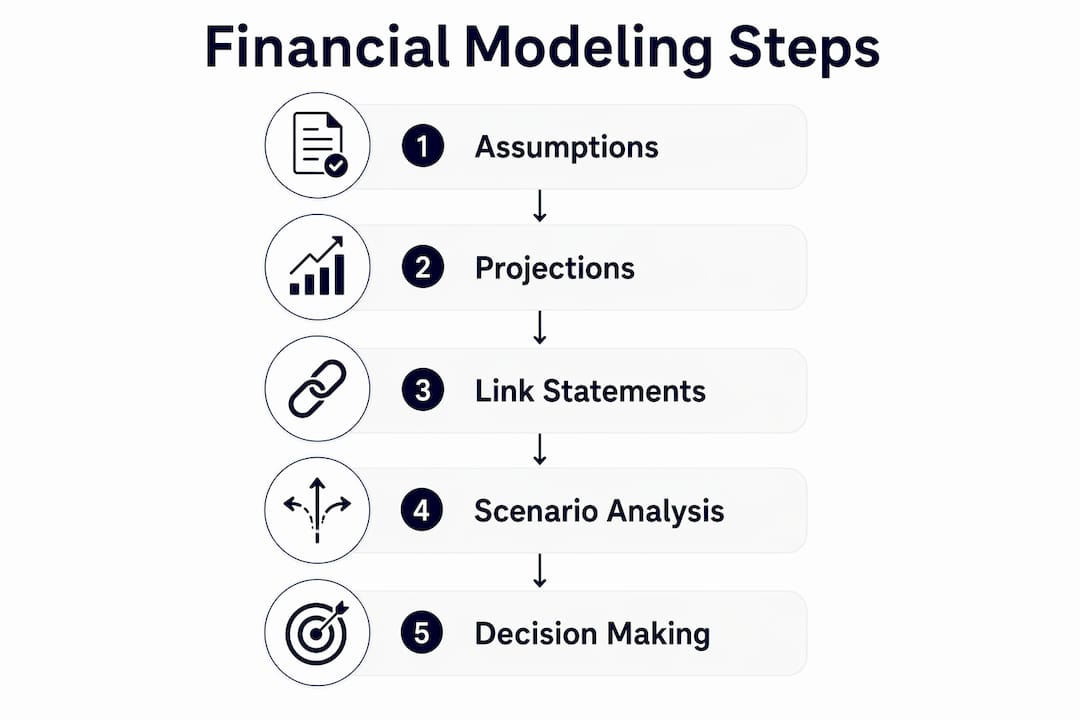
Building this structure requires clear separation between inputs and calculations. The standard practice is to place all assumptions, such as growth rates, tax rates, and margin targets, in a dedicated input section. Calculations then reference those inputs rather than hard-coded numbers. This separation is what makes a model auditable and maintainable over time.
Key elements of a well-structured three-statement model include:
- Revenue drivers: Unit volume, pricing, and mix assumptions that feed the top line
- Cost structure: Fixed versus variable cost splits tied to revenue or operational metrics
- Working capital schedules: Days sales outstanding, days payable outstanding, and inventory days that link the income statement to the balance sheet
- Debt and interest schedules: Loan balances, repayment terms, and interest expense that connect financing to both the income statement and balance sheet
- Capex and depreciation: Capital spending plans that affect both the cash flow statement and fixed asset balances
Pro Tip: Always build a dedicated assumptions tab and color-code hard-coded inputs in blue. This single habit makes your model auditable in minutes rather than hours.
Model quality directly affects the reliability of every valuation output the model produces. Disconnects between schedules, such as a depreciation figure that does not match the capex schedule, can invalidate conclusions even when the underlying logic is sound.
What are the primary applications of financial modeling in investment and business decisions?
Financial modeling in business serves several distinct purposes depending on the context. The most common applications fall into three categories: valuation, capital budgeting, and corporate development.
-
Valuation analysis. DCF models discount projected free cash flows back to present value using a weighted average cost of capital (WACC). The output is an intrinsic value estimate for a business or asset. Investment banks, private equity firms, and corporate development teams use DCF as a primary valuation tool alongside comparable company analysis and precedent transactions.
-
Capital budgeting. NPV and IRR are the standard metrics for evaluating capital projects. A positive NPV means the project generates more value than it costs in present value terms. IRR is the discount rate at which NPV equals zero. Both metrics rely on time value of money principles and require a financial model to calculate accurately across multi-year project timelines.
-
Mergers and acquisitions. M&A models assess whether an acquisition is accretive or dilutive to earnings per share, how much debt a target can support, and what synergies are required to justify a purchase price. These models combine elements of three-statement modeling, DCF, and leveraged buyout analysis.
The table below compares these three core applications by purpose, key metric, and primary user:
| Application | Primary purpose | Key metric | Typical user |
|---|---|---|---|
| DCF valuation | Estimate intrinsic value | Enterprise value, equity value | Investment banking, PE |
| Capital budgeting | Evaluate project returns | NPV, IRR | Corporate finance, FP&A |
| M&A modeling | Assess deal economics | Accretion/dilution, synergies | Corporate development |
Financial models support valuation and comparison of firms, scenario testing, and quantifying the profit and cost impacts of specific decisions. Each application demands a different model structure, but all share the same foundation: documented assumptions linked through consistent financial statements.
How scenario planning and sensitivity analysis enhance financial modeling
Forecasting estimates a single expected outcome. Financial modeling, by contrast, evaluates how specific decisions and external events affect financial outcomes through structured logic. Scenario planning takes this further by building multiple internally consistent versions of the future.
The standard structure for scenario planning uses 3 to 5 distinct scenarios: a base case carrying roughly 50 to 60 percent probability, an upside case at 15 to 20 percent, a downside case at 15 to 20 percent, and an optional stress case at around 5 percent. Each scenario holds its own set of assumptions about revenue growth, cost inflation, interest rates, and other key drivers. The value is not in predicting which scenario occurs. The value is in knowing what the financial outcomes look like across the range of plausible futures.
The table below illustrates how scenario assumptions and outputs differ across a simple three-scenario model:
| Scenario | Revenue growth | EBITDA margin | Free cash flow |
|---|---|---|---|
| Base case | 8% | 22% | $4.2M |
| Upside case | 14% | 25% | $6.8M |
| Downside case | 2% | 18% | $1.1M |
Sensitivity analysis complements scenario planning by isolating the impact of a single variable while holding all others constant. A sensitivity table in Excel, for example, might show how enterprise value changes as WACC moves from 8 to 12 percent and terminal growth rate moves from 1 to 4 percent. This identifies which assumptions drive the most value, and therefore which ones deserve the most scrutiny.
Monte Carlo simulation goes further still. Monte Carlo methods assign probability distributions to uncertain inputs rather than swapping fixed assumptions, generating hundreds of simulated outcomes. The result is a probability distribution of possible financial outcomes rather than a single point estimate. This approach is particularly useful for long-duration projects where input uncertainty compounds over time.
Pro Tip: Link your scenario outputs directly to decision triggers. For example, define in advance that the downside case triggers a cost reduction review. This turns scenario analysis from a static exercise into an operational planning tool.
Effective scenario analysis links modeled scenarios to contingency plans, making them operational tools rather than static artifacts. That is the difference between a model that informs decisions and one that simply documents assumptions.
What makes financial modeling effective: best practices and common pitfalls
A technically correct model that no one can audit or maintain is a liability, not an asset. The benefits of financial modeling depend entirely on model quality, and quality has specific, measurable characteristics.
The most common pitfalls in financial modeling include:
- Hard-coded numbers scattered through calculations. When assumptions are embedded inside formulas rather than isolated in an input section, changing them requires hunting through hundreds of cells. This creates errors and wastes time.
- Inconsistent schedules. Disconnects in working capital, capex timing, taxes, and financing assumptions across the three statements can invalidate valuation conclusions even when individual calculations appear correct.
- Undocumented assumptions. A model without clear assumption documentation becomes a black box. Undocumented models pose operational risks because no one can verify, challenge, or update the logic without reverse-engineering the entire structure.
- No version control. Models evolve through multiple iterations. Without a clear versioning system, earlier assumptions get overwritten and the audit trail disappears.
- Circular references without controls. Interest expense calculations that depend on debt balances, which in turn depend on cash flows, which depend on interest expense, create circular references. These require deliberate handling through iteration settings or manual break switches.
The best-practice response to each of these risks is straightforward. Separate data inputs from calculations. Centralize assumptions on a dedicated tab. Document every non-obvious assumption with a cell comment or a separate notes column. Use validation checks, such as a balance sheet that confirms assets equal liabilities plus equity, to catch errors before they reach a presentation.
Key takeaways
Financial modeling is the primary quantitative tool for translating business assumptions into investment and strategic decisions, and its value depends on model integrity, documented assumptions, and scenario-driven analysis.
| Point | Details |
|---|---|
| Core function | Financial models convert assumptions into projected income, cash flow, and balance sheet outputs. |
| Three-statement foundation | Linking the income statement, balance sheet, and cash flow statement creates a coherent, auditable forecast. |
| Investment applications | DCF, NPV, and IRR are the standard metrics for valuation and capital budgeting decisions. |
| Scenario and sensitivity analysis | Building 3 to 5 scenarios and running sensitivity tables identifies key value drivers and quantifies risk. |
| Model quality | Separating inputs from calculations and documenting assumptions prevents black-box models and errors. |
Why financial modeling is more than spreadsheet building
I have reviewed hundreds of financial models over the years, and the ones that actually influence decisions share one quality that has nothing to do with formula complexity. They communicate clearly. The analysts who built them understood that the model’s job is not to produce a number. Its job is to support a judgment call by a person who has to defend that call to a board, a lender, or an investment committee.
The conventional view treats financial modeling as a technical skill, something you learn in a course and apply mechanically. That framing misses the point. As professionals mature, they move from building models to making decisions based on model outputs. The modeling skill that matters most at a senior level is knowing which assumptions to challenge and which outputs to trust. A junior analyst who can build a flawless DCF model but cannot explain why the terminal value drives 80 percent of the result is not yet using the model effectively.
The most underrated application of financial modeling is internal communication. A well-structured scenario model presented to a CFO or a credit committee does not just answer “what is this worth?” It answers “what has to be true for this to work, and what happens if it is not?” That is the question every decision-maker actually needs answered. If you build models with that question in mind, you will produce work that gets used rather than filed.
— Michael
Practical finance calculators to complement your modeling work
Building financial models requires a strong grasp of the underlying calculations, and having quick reference tools at hand speeds up both learning and verification. Helpcalculate offers a free suite of finance calculators covering compound interest, loan payments, mortgage affordability, and investment returns. These tools are particularly useful for checking DCF inputs, validating loan schedules, and running quick scenario comparisons without opening a full spreadsheet. For teams and educators who want to embed these tools directly into a course page or internal resource, Helpcalculate’s embeddable finance widgets are free and require no technical setup. They complement financial modeling skills by making core calculations immediately accessible.
FAQ
What is financial modeling in simple terms?
Financial modeling is the process of building a structured spreadsheet that translates business assumptions, such as revenue growth and cost levels, into projected financial statements. The output supports decisions about valuation, investment, and strategy.
How does a DCF model work in financial modeling?
A DCF model projects a company's free cash flows over a forecast period, then discounts them back to present value using a required rate of return. A positive net present value indicates the investment generates more value than its cost.
What is the difference between forecasting and financial modeling?
Forecasting estimates a single expected future outcome based on historical trends. Financial modeling evaluates how specific decisions and external events affect financial outcomes through structured, scenario-driven logic.
Why is scenario analysis important in financial modeling?
Scenario analysis builds multiple internally consistent versions of the future, typically a base, upside, and downside case, so decision-makers understand the range of possible outcomes rather than relying on a single point forecast.
What are the most common financial modeling mistakes?
The most common mistakes are hard-coding assumptions inside formulas, failing to document inputs, and allowing inconsistencies between the income statement, balance sheet, and cash flow statement schedules.