

TL;DR
- •Most people underestimate the power of interest formulas, which significantly affect savings growth and debt costs.
- •Compound interest accelerates wealth and debt exponentially, with frequency greatly impacting returns, so understanding these calculations is essential.
- •Applying formulas like the Rule of 72 or comparing APYs helps you make smarter financial decisions and avoid costly mistakes.
Most people assume interest is just a percentage tacked onto a balance. That assumption costs them thousands of dollars over a lifetime. The role of interest formulas goes far deeper than a simple rate calculation. These formulas determine how fast savings grow, how quickly debt compounds, and whether an investment actually beats inflation after taxes. Whether you are a student building your first budget or a finance professional advising clients, understanding interest formulas is the difference between making informed decisions and accepting whatever a lender or bank hands you.
Model compound growth with your own numbers
See how principal, rate, compounding frequency, and time change your balance using the same formulas in this guide.
Open Compound Interest calculatorKey takeaways
| Point | Details |
|---|---|
| Simple vs. compound interest | Simple interest grows linearly; compound interest accelerates exponentially and applies to most savings products and debts. |
| Compounding frequency matters | Moving from annual to daily compounding on a 5% rate raises effective yield from 5.000% to 5.127%, altering long-term returns measurably. |
| The Rule of 72 | Divide 72 by your interest rate to estimate how many years it takes your money to double, a reliable mental shortcut for quick planning. |
| APY beats nominal rate | Always compare savings products using APY, not the stated rate, to get an accurate picture of true annual earnings. |
| Real returns can be negative | After taxes and inflation, a positive nominal rate can produce a negative real return, a reality many savers overlook. |
The role of interest formulas: simple interest explained
Simple interest is the starting point for understanding interest formulas work in practice. The formula is straightforward: Interest = Principal × Rate × Time. If you borrow $10,000 at 6% per year for three years, you owe $1,800 in interest. The total repayment is $11,800. No surprises.
Simple interest grows in a straight line. Each period adds the same fixed amount to the balance, regardless of how much interest has already accumulated. That predictability is exactly why certain financial products use it.
Common financial products that use simple interest include:
- •Auto loans: Monthly payments are calculated on the original principal, making payoff schedules easy to follow.
- •Short-term personal loans: Many fintech lenders apply simple interest for loans under two years.
- •Treasury bills: The U.S. government calculates returns on T-bills using a simple interest method.
- •Installment loans: Fixed-term loans with equal payments often use simple interest as the base calculation.
The simple vs. compound difference becomes significant over long periods. On a $100,000 deposit at 5% for 10 years, simple interest generates $50,000 in interest. Compound interest with monthly compounding generates roughly $64,700. That $14,700 gap comes from one structural difference: compound interest charges or pays interest on previously accumulated interest.
Pro Tip: If you are paying off a simple interest loan, making payments early reduces the principal faster and directly cuts the total interest you owe, since interest is calculated only on the outstanding balance.
Simple interest is transparent, but it does not reflect how most financial products actually work. Once you move into savings accounts, mortgages, credit cards, or investment accounts, compound interest takes over.
How compound interest formulas work and why they matter
Compound interest is where the importance of interest formulas becomes genuinely consequential. The formula is: A = P(1 + r/n)^(nt), where P is the principal, r is the annual interest rate, n is the number of compounding periods per year, and t is time in years. Each compounding period adds interest to the existing balance, including all previously earned interest.
Here is how to walk through a real example step by step:
| Compounding frequency | Nominal rate | Effective APY |
|---|---|---|
| Annual | 5.000% | 5.000% |
| Monthly | 5.000% | 5.116% |
| Daily | 5.000% | 5.127% |
The difference looks small in year one. Over 30 years, it translates to thousands of dollars in additional earnings on the same deposit. This is why APY is the benchmark for comparing savings accounts, not the advertised nominal rate.
Compound interest appears in savings accounts, certificates of deposit, mortgages, retirement accounts, and credit cards. The same mechanism that builds your savings can escalate your debt. Compound interest benefits savers and investors by accelerating growth, but it can deeply harm borrowers who do not manage payments strategically.
Pro Tip: When evaluating a savings account or CD, always ask for the APY, not the interest rate. The APY accounts for compounding and gives you the true annual return for direct comparison.
The compounding frequency has a direct impact on outcomes. More frequent compounding yields higher effective returns. At 5% nominal interest, here is how the Annual Percentage Yield (APY) changes:
- Start with a $10,000 deposit at 5% annual interest, compounded monthly.
- n = 12 (monthly compounding), t = 10 years.
- Calculate: A = 10,000 × (1 + 0.05/12)^(12×10)
- Solve the exponent: (1.004167)^120 ≈ 1.6470
- Final amount: $16,470. Total interest earned: $6,470 versus $5,000 with simple interest.

Advanced interest calculations you need to know
Beyond the core formulas, several advanced concepts directly affect your financial decisions. Understanding interest formulas at this level separates informed financial decision-making from guesswork.
Continuous compounding is the theoretical limit of compounding frequency. The formula is A = Pe^(rt), where e is Euler's number (approximately 2.71828). While no standard consumer product compounds continuously, this formula appears in finance theory, options pricing, and some high-frequency trading models. At 5% continuously compounded over 10 years, $10,000 grows to $16,487, marginally above daily compounding.
The daily periodic rate is what credit card companies actually use. They take the APR and divide by 365 to get the daily rate, then apply it to your average daily balance. With a 24.99% APR credit card, a $3,000 average daily balance generates $61.62 in interest in a single 30-day billing cycle. That is $739 per year on a balance you might assume is manageable.
The impact of credit card compounding is especially damaging when cardholders pay only the minimum. The daily interest charge gets added to the balance, which increases next month's interest calculation. Balances compounding at 20% to 29% APR can double in under four years.
Key facts about advanced interest calculations:
- •The Rule of 72 estimates doubling time by dividing 72 by the annual interest rate. At 6% interest, your investment doubles in approximately 12 years. At 4%, it takes 18 years. At 9%, just 8 years.
- •Daily periodic rate formula: APR ÷ 365 × average daily balance × number of days in billing cycle.
- •Continuous compounding is expressed as A = Pe^(rt) and represents maximum possible growth at a given rate.
- •APR vs. APY on debt: Credit card APR does not reflect true annual cost when compounding is daily. The actual cost is higher.
The practical impact of compounding frequency on debts often diverges sharply from simplified annual formulas. This is a core reason credit card balances escalate unexpectedly, even when cardholders believe they are staying current.
Applying interest formulas to real financial decisions
Understanding interest formulas is one thing. Applying them to your financial life is where the knowledge pays off. The impact of interest rates plays out across every major money decision you will make, from choosing a savings account to evaluating a mortgage.
Building wealth through compound interest requires starting early and staying consistent. Long-term compounding back-loads gains: the final years of a multi-decade investment strategy produce more interest than all the earlier years combined. A 25-year-old investing $5,000 annually at 7% reaches roughly $1.1 million by age 65. The same person starting at 35 reaches about $540,000. Ten years of delay costs more than half the final balance.
Managing debt with compound interest working against you requires a different approach. Paying only the minimum on high-interest debt is one of the costliest financial habits possible. Every dollar above the minimum payment reduces the principal directly, cutting future interest charges.
Real returns after taxes and inflation often disappoint. A 5% nominal return with a 40% tax rate and 3.5% inflation produces a real return of negative 0.50%. Your money technically grew, but its purchasing power shrank. Knowing this formula forces smarter decisions about where to hold savings.
Practical strategies for applying interest formulas:
- •Compare APY, not the nominal rate, when shopping savings accounts or CDs. The difference across institutions on a $10,000 deposit can be as wide as 174 times for identical risk profiles.
- •Use the Rule of 72 to quickly evaluate whether an investment meets your goals before running full calculations.
- •Model loan scenarios by calculating total interest paid at different term lengths. A 30-year mortgage at 7% costs roughly 2.4 times the original loan in total payments.
- •For students: use compound interest calculators to see how student loan interest capitalizes during a deferment period, which can add thousands to the balance before repayment begins.
Pro Tip: When comparing APR and APY on financial products, many consumers mistakenly assume the nominal rate reflects actual earnings or costs. Always request both figures from any lender or savings institution before committing.
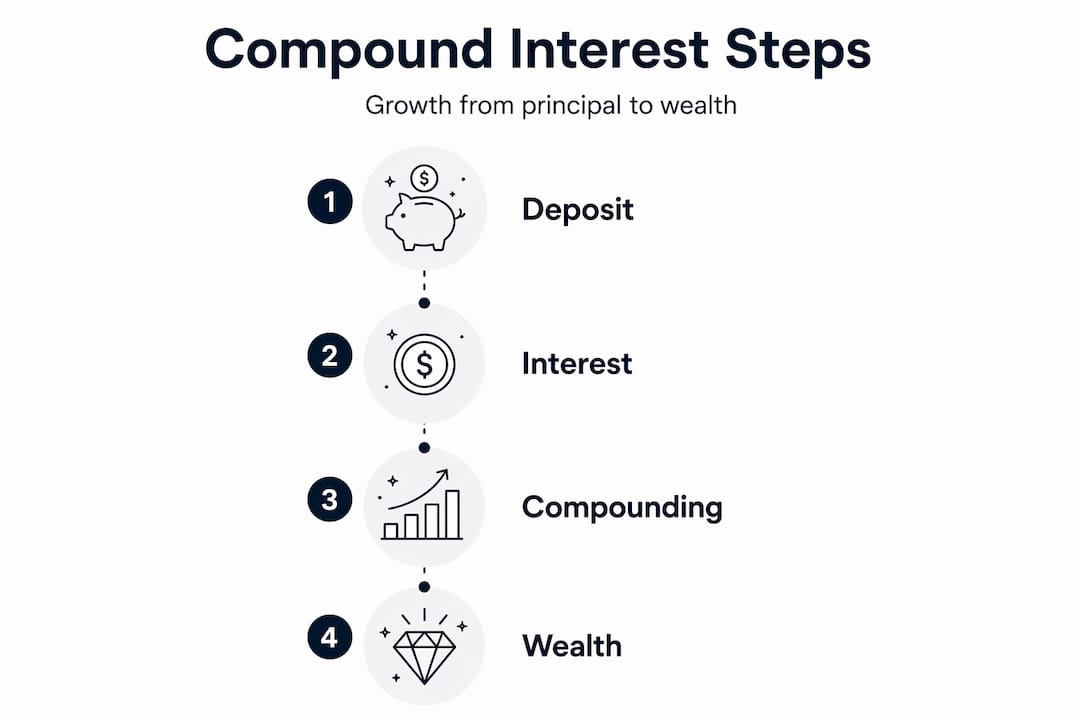
My perspective on what most people get wrong about interest
I have worked with interest calculations long enough to recognize a pattern. Most people treat interest as background noise. They see a rate, accept it, and move on. That passivity is expensive.
What I find most striking is how few people recognize the asymmetry in compounding. The same mechanism that quietly builds a retirement account is aggressively working against you on a credit card balance. The math does not care about your intentions. It responds only to the principal, the rate, and the time you allow it to run.
The detail that tends to produce the most dramatic realizations is compounding frequency. I have watched students calculate their savings growth using an annual compounding assumption, then see the revised number with daily or monthly compounding. The difference over 20 years is not trivial. It changes the conversation entirely.
There is also the issue of small differences between institutions appearing irrelevant. A 0.5% rate difference on a $50,000 investment over 20 years can represent $8,000 to $12,000 in total returns. That is not a rounding error. It is a real financial outcome that stems entirely from understanding interest formulas well enough to compare options carefully.
My strongest recommendation is this: do not accept a financial product without running the numbers yourself. The formulas are not complicated. The calculation takes five minutes. The payoff from that five minutes can be measured in thousands of dollars.
— Michael
Calculate interest scenarios with Helpcalculate
Helpcalculate offers a suite of free financial calculators that put these formulas to work instantly. Whether you want to model compound growth over 30 years, compare loan repayment scenarios, or estimate how different compounding intervals affect your savings account, the tools are built for exactly that purpose.
The finance calculators on Helpcalculate cover compound interest, loan payments, mortgage affordability, and retirement savings, with clear outputs that make abstract formulas concrete and comparable. For educators and finance professionals, the free embeddable finance widgets allow you to place working calculators directly in course materials, client portals, or financial planning content. No software required. Just accurate, accessible tools that help you apply what you now understand about interest formulas to real numbers and real decisions.

FAQ
What is the role of interest formulas in personal finance?
Interest formulas determine how savings grow, how loan costs accumulate, and how debt compounds over time. They form the mathematical foundation of every financial product involving money over a period of time.
How does compound interest differ from simple interest?
Simple interest calculates returns on the original principal only, producing linear growth. Compound interest applies to the principal plus all accumulated interest, generating exponential growth that accelerates over time.
Why does compounding frequency affect the outcome?
More frequent compounding means interest is calculated and added to the balance more often, which increases the base for future interest calculations. Daily compounding at 5% produces an APY of 5.127%, versus 5.000% for annual compounding.
What is the Rule of 72 and how do you use it?
The Rule of 72 estimates how long it takes an investment to double by dividing 72 by the annual interest rate. At 6% annual interest, money doubles in approximately 12 years.
How do taxes and inflation affect real interest returns?
Real return equals the nominal rate minus taxes and inflation adjustments. A 5% nominal rate with a 40% tax rate and 3.5% inflation can produce a real return of negative 0.50%, meaning purchasing power actually declines despite positive nominal growth.