
Run Your FIRE Numbers Instantly
See your FIRE number, timeline, and savings rate in minutes.
Open FIRE calculatorWhat Does FIRE Mean?
FIRE stands for Financial Independence, Retire Early.
The goal is simple: save and invest enough money so your investments can cover your living expenses indefinitely.
Instead of working for money, your money works for you.
Once your investments generate enough income to cover your expenses, you have reached financial independence. Retirement becomes optional.
The key question becomes: how much money do I need invested to make that happen? That number is your FIRE number.
The 25x Rule (The Foundation of Your FIRE Number)
The most common way to calculate your FIRE number is using the 25x rule.
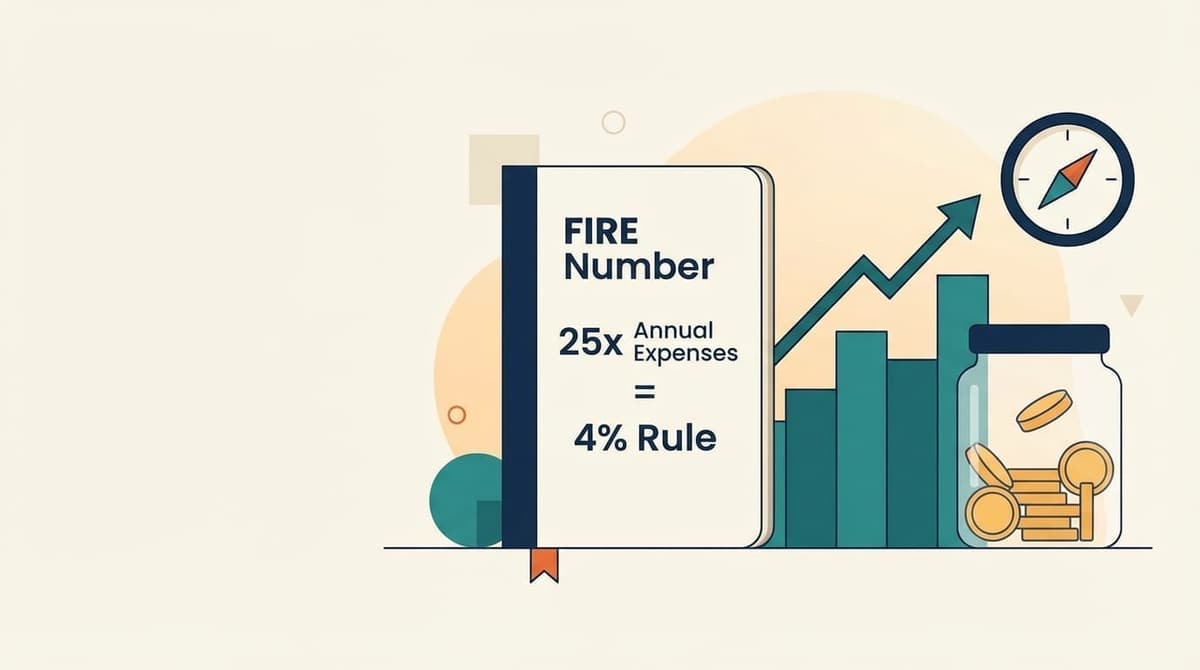
Formula: Your FIRE Number = Annual Expenses x 25.
Why 25? It comes from the 4% rule, based on research from Trinity University, often called the Trinity Study.
The research found that historically you could withdraw 4% per year, adjust for inflation, and your money would likely last 30+ years.
If you withdraw 4%, that means you need 1 ÷ 0.04 = 25. So you need 25 times your annual expenses invested.
How to Calculate Your FIRE Number (Step-by-Step)
Step 1: Calculate your annual expenses. This is the most important step.
Not your income. Not what you think you spend. Your actual yearly expenses.
- •Housing
- •Utilities
- •Food
- •Transportation
- •Insurance
- •Healthcare
- •Travel
- •Entertainment
- •Taxes
Example Calculation
If you spend $60,000 per year, your FIRE number would be: $60,000 x 25 = $1,500,000.
Your FIRE number is $1.5 million.
Example Calculations by Lifestyle
Here is how it looks across different lifestyles:
| Annual Expenses | FIRE Number (x25) |
|---|---|
| $40,000 | $1,000,000 |
| $50,000 | $1,250,000 |
| $60,000 | $1,500,000 |
| $75,000 | $1,875,000 |
| $100,000 | $2,500,000 |
Every extra $10,000 in annual spending adds $250,000 to your FIRE number.
What About Lean FIRE, Fat FIRE, and Coast FIRE?
As you research "what is my FIRE number," you will see different variations.
Lean FIRE uses lower annual expenses and a smaller FIRE number.
Fat FIRE assumes a higher spending lifestyle and a larger FIRE number.
Coast FIRE means you have invested enough that it will grow to your FIRE number without further contributions.
Each version changes the math slightly but the foundation is still the 25x rule.
Common Mistakes When Calculating Your FIRE Number
1. Using income instead of expenses. Your FIRE number is based on what you spend, not what you earn.
2. Forgetting taxes. Investment withdrawals may be taxable based on account types.
3. Ignoring healthcare. Healthcare costs before Medicare can significantly impact early retirees.
4. Assuming 4% always works. It is historical guidance, not a guarantee.
If you want a safer estimate, use Annual Expenses ÷ 0.035 = FIRE Number.
Example: $60,000 ÷ 0.035 = $1,714,285.
5. Not adjusting for lifestyle changes. Travel, location, and mortgage changes can shift expenses.
How Long Will It Take to Reach My FIRE Number?
Your timeline depends on savings rate, investment returns, current portfolio value, and annual contributions.
This is where most people guess instead of calculate. The math matters.
The Fastest Way to Find Your FIRE Number
You can calculate it manually, or you can run the numbers instantly and see your FIRE number, years to financial independence, required savings rate, and projected portfolio growth.
Key takeaways
- •Your FIRE number is based on annual expenses, not income.
- •The 25x rule comes from the 4% withdrawal guideline.
- •Small spending changes can dramatically shift your target.
- •Use a lower withdrawal rate for a more conservative plan.
Conclusion
If you have been wondering, "What is my FIRE number?" now you know how to find it.
Calculate your annual expenses, multiply by 25, and adjust for your risk tolerance.
Financial independence is not about guessing. It is about knowing your number and building a plan to reach it.
Ready to find yours? Use the FIRE calculator and see exactly where you stand today.
FAQ
What is a FIRE number?
Your FIRE number is the amount invested that can cover your annual expenses using a safe withdrawal rate.
What if I want to be more conservative than 4%?
Use a lower withdrawal rate like 3.5% or 3% and divide expenses by that rate instead of 0.04.
Do I use my income or my expenses?
Use your actual annual expenses. Your FIRE number is based on what you spend, not what you earn.