

TL;DR:
- There are four main categories of math calculations: arithmetic, geometric, trigonometric, and statistical, each used for different problem types.
- Recognizing which calculation type to apply is essential for solving problems accurately across various fields.
- Mastery of these categories, along with the order of operations and unit management, is crucial for effective and error-free problem-solving.
Types of math calculations are defined as distinct categories of mathematical operations used to solve problems, classified into four primary domains: arithmetic, geometric, trigonometric, and statistical calculations. This four-type taxonomy covers the full range of calculation needs across academic study, professional practice, and everyday problem-solving. Whether you are balancing a budget, designing a structure, navigating by GPS, or interpreting clinical trial data, one of these four categories applies. Understanding which type of calculation a problem requires is the first step toward solving it correctly and efficiently.
1. What are the types of math calculations?
The four types of math calculations are arithmetic, geometric, trigonometric, and statistical. Each operates on different inputs, uses different formulas, and produces different kinds of answers. Arithmetic handles numbers and basic operations. Geometry handles shapes and space. Trigonometry handles angles and wave relationships. Statistics handles data sets and probability. Knowing which category your problem belongs to tells you which tools and methods to reach for.
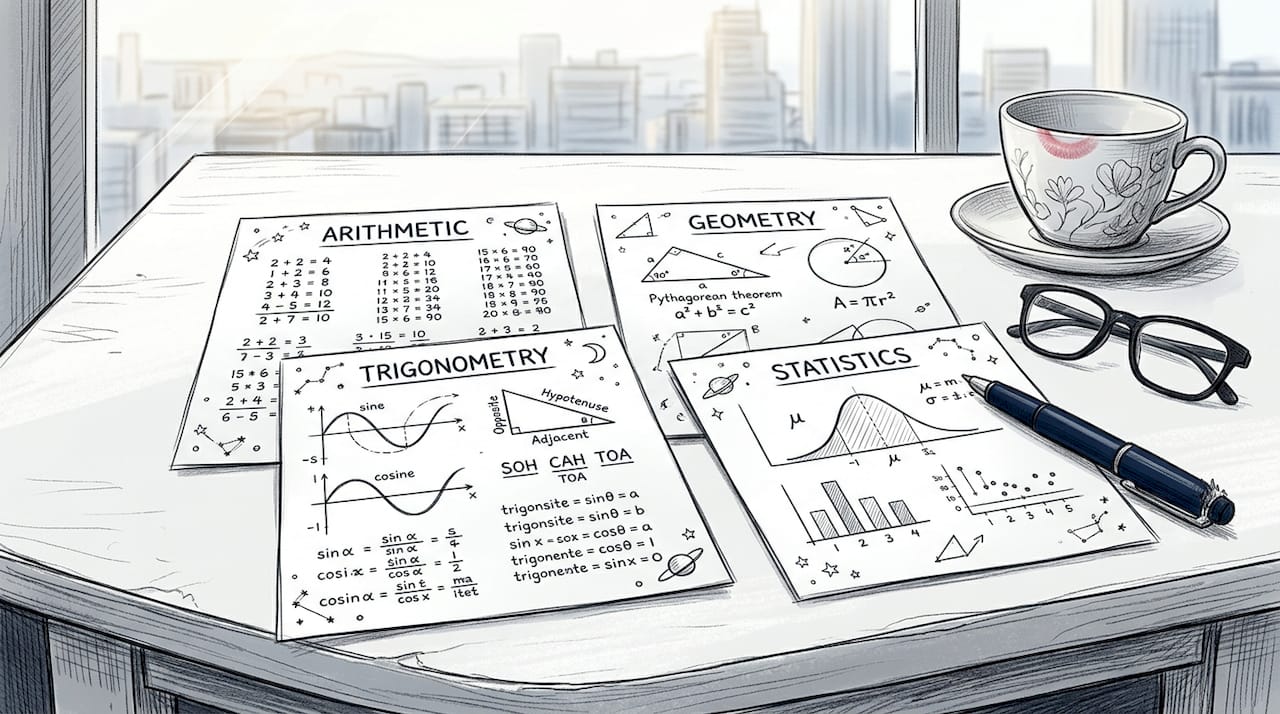
These categories are not rigid silos. A structural engineer calculating load distribution uses arithmetic inside a geometric formula. A data scientist calculating risk uses statistical methods grounded in arithmetic. The categories define the primary operation domain, not the only math involved.
2. Arithmetic calculations: the foundation of all math
Arithmetic calculations are the four basic operations of addition, subtraction, multiplication, and division applied to numbers. Every other type of math calculation builds on these operations. You use arithmetic when calculating a restaurant tip, splitting a bill, or figuring out how many hours remain in a workday.
The critical rule governing arithmetic is the order of operations, known by the acronym BEDMAS: Brackets, Exponents, Division, Multiplication, Addition, Subtraction. Without a standardized precedence rule, the same expression produces different answers depending on who evaluates it. For example, 3 + 4 × 2 equals 11 when BEDMAS is applied correctly, not 14.
Common arithmetic applications include:
- Budgeting and finance: Adding income, subtracting expenses, multiplying tax rates
- Academic scoring: Calculating grade point averages and weighted scores
- Unit pricing: Dividing total cost by quantity to find cost per unit
- Percentage calculations: Finding discounts, interest rates, and growth rates
Pro Tip: When evaluating a complex expression, rewrite it step by step, resolving brackets first, then exponents, then multiplication and division from left to right, and finally addition and subtraction. This prevents the most common arithmetic errors.
Arithmetic also underpins financial tools like compound interest calculators, where repeated multiplication and addition over time produce exponential growth results that are easy to miscalculate by hand.
3. How geometric calculations work and where they are applied
Geometric calculations involve measuring and computing properties of shapes, sizes, and spatial relationships. The three most common outputs are area, perimeter, and volume. These calculations appear in architecture, construction, interior design, manufacturing, and any field where physical space matters.
Here are the most frequently used geometric formulas:
- Area of a rectangle: length × width (used in flooring, land measurement)
- Perimeter of a rectangle: 2 × (length + width) (used in fencing, framing)
- Area of a circle: π × radius² (used in pipe sizing, wheel design)
- Volume of a cylinder: π × radius² × height (used in tank capacity, packaging)
- Surface area of a sphere: 4 × π × radius² (used in coating, material estimation)
Spatial reasoning is the cognitive skill that makes geometric calculations meaningful. A contractor who can visualize a three-dimensional space and translate it into formulas makes fewer material waste errors than one who works purely from numbers on a page. Geometry is where abstract math meets physical reality.
A common mistake in geometric problem-solving is confusing area with perimeter. Area measures the space inside a shape (expressed in square units), while perimeter measures the boundary around it (expressed in linear units). Mixing these up leads to ordering the wrong amount of material or misquoting a project cost.
4. What role trigonometric calculations play
Trigonometric calculations are defined as computations involving the relationships between angles and side lengths in triangles, extended to wave and oscillation patterns in physics and engineering. The three primary functions are sine (sin), cosine (cos), and tangent (tan), each expressing a ratio between two sides of a right triangle relative to a given angle.
Core applications of trigonometric calculations include:
- Finding unknown heights: A surveyor measuring a building’s height from a known distance and angle uses the tangent function: height = distance × tan(angle).
- Navigation and GPS: Calculating position using triangulation relies on sine and cosine relationships across multiple reference points.
- Physics and engineering: Wave frequency, signal processing, and alternating current analysis all use trigonometric functions to model periodic behavior.
- Architecture: Roof pitch calculations and load angle analysis depend on right triangle trigonometry.
The right triangle is the entry point for most trigonometric problems. In a right triangle, sin(angle) = opposite/hypotenuse, cos(angle) = adjacent/hypotenuse, and tan(angle) = opposite/adjacent. These three ratios are the building blocks for every more complex trigonometric calculation you will encounter in physics, calculus, or engineering coursework.
Trigonometry is also where many students first encounter the idea that math describes the physical world directly. The angle of a ramp, the trajectory of a projectile, and the pitch of a sound wave are all trigonometric problems in disguise.
5. How statistical calculations are used to analyze data
Statistical calculations are defined as methods for extracting estimates, patterns, and inferences from data sets, distinct from the deterministic outputs of arithmetic or geometry. Where arithmetic gives you one exact answer, statistical methods give you a range, a probability, or a measure of confidence. This distinction matters enormously in medicine, business, and social science.
The most common statistical measures are:
| Measure | Definition | Practical use |
|---|---|---|
| Mean | Sum of values divided by count | Average salary, test score averages |
| Median | Middle value in an ordered data set | Household income reporting, real estate pricing |
| Mode | Most frequently occurring value | Consumer preference surveys, inventory demand |
| Standard deviation | Spread of values around the mean | Quality control, investment risk assessment |
| Range | Difference between maximum and minimum values | Temperature variation, performance benchmarking |
Statistical calculations require both arithmetic skill and the ability to interpret uncertain or variable data, meaning they serve as a connection between math and real-world decision-making. A mean salary figure without a standard deviation tells you almost nothing about whether a specific salary offer is competitive. Context and spread matter as much as the central value.
In medicine, statistical calculations determine whether a drug trial result is significant or occurred by chance. In business, they inform demand forecasting and risk modeling. For students, mastering statistics means being able to read and critically evaluate research, not just perform calculations.
6. How dimensional analysis enhances applied math calculations
Dimensional analysis is defined as a calculation method that tracks and cancels units throughout a multi-step problem to produce a result in the correct unit. It is not just a teaching tool. Dimensional analysis is a practical error prevention method used in nursing, chemistry, engineering, and physics to catch mistakes before they cause real harm.
The method works by constructing a chain of fractions where unwanted units cancel out and the desired unit remains. In nursing dosage calculations, for example, a weight-based dose might require converting a patient’s weight in kilograms to milligrams of medication, then to milliliters of solution, then to an infusion rate in mL/hr. Each conversion is written as a fraction, and units that appear in both numerator and denominator cancel.
Key applications of dimensional analysis include:
- Nursing dosage calculations: Converting mg/kg body weight to mL/hr infusion rates
- Engineering unit conversions: Translating between metric and imperial measurements in design specifications
- Chemistry stoichiometry: Calculating molar quantities from mass measurements
- Physics problem-solving: Converting between units of force, energy, and pressure
A critical error in IV flow rate calculations is confusing mL/hr with gtt/min. Pump settings use mL/hr, while gravity drip sets use gtt/min, and each requires a different conversion factor based on the tubing drop factor. Mixing these up produces a dosing error that dimensional analysis, applied correctly, prevents.
Pro Tip: Always complete the full unit cancellation chain before rounding. Rounding intermediate steps introduces compounding errors. Round only the final answer, and always to the nearest whole number when the result is a drop rate or tablet count.
For students and professionals who work with unit conversions regularly, Helpcalculate’s unit conversion tools cover length, weight, and data conversions with instant, accurate results.
Key takeaways
Mastering the four types of math calculations, arithmetic, geometric, trigonometric, and statistical, gives you a structured framework for solving virtually any quantitative problem in academics or professional practice.
| Point | Details |
|---|---|
| Four primary calculation types | Arithmetic, geometric, trigonometric, and statistical calculations cover all major math domains. |
| BEDMAS governs arithmetic | Applying the correct order of operations prevents errors in every arithmetic expression. |
| Geometry requires unit clarity | Confusing area (square units) with perimeter (linear units) causes costly real-world mistakes. |
| Statistics interpret uncertainty | Mean and standard deviation together give a complete picture; neither alone is sufficient. |
| Dimensional analysis prevents errors | Building full unit cancellation chains before rounding is the standard for professional accuracy. |
Why math fluency across all four types actually matters
I have worked with enough students and professionals to say this plainly: the single biggest gap I see is not inability to calculate. It is not knowing which type of calculation a problem requires. Someone who can execute arithmetic perfectly will still get the wrong answer if they apply an arithmetic approach to a problem that requires statistical reasoning.
The most undervalued skill in math education is category recognition. Before you write a single number, ask yourself: is this a shape problem, a data problem, an angle problem, or a basic operations problem? That question alone eliminates most errors before they start.
I also think statistical literacy is the most neglected of the four types, especially for professionals outside of research. Reading a business report, evaluating a health study, or assessing investment risk all require you to interpret mean, variance, and confidence intervals. You do not need to run the calculations yourself, but you need to understand what they mean. The professionals who advance fastest are the ones who can sit in a meeting, look at a data table, and immediately know whether the numbers tell a complete story.
Geometric and trigonometric calculations tend to intimidate people who do not work with them daily. My advice: keep a reference sheet of the ten most common formulas. You do not need to memorize them. You need to recognize when to use them and how to apply them without error. That is a much more achievable goal, and it is the one that actually translates to job performance.
— Michael
Put your math calculations to work with Helpcalculate
Understanding the different calculation methods is the first step. Applying them accurately is where Helpcalculate helps. The platform offers over 60 free calculators covering math, averages, fractions, and percentages, as well as finance tools for loans, investing, and mortgages. Whether you are a student checking your work, a professional verifying a unit conversion, or someone planning a financial decision, Helpcalculate delivers fast, accurate results without specialized software. Every calculator is free, browser-based, and built for practical use.
FAQ
What are the four types of math calculations?
The four primary types are arithmetic, geometric, trigonometric, and statistical calculations. Each type addresses a different category of problem, from basic number operations to data analysis.
What is the order of operations in arithmetic?
The order of operations is governed by BEDMAS: Brackets, Exponents, Division, Multiplication, Addition, Subtraction. This rule ensures that every person evaluating the same expression reaches the same answer.
How is dimensional analysis different from basic arithmetic?
Dimensional analysis tracks and cancels units across multiple conversion steps, while basic arithmetic operates on numbers alone. It is used in professional fields like nursing and engineering to prevent unit-based calculation errors.
When should you use statistical calculations instead of arithmetic?
Use statistical calculations when your problem involves a data set with variability, uncertainty, or the need for inference. Arithmetic gives one exact answer; statistical methods give measures like mean, median, and standard deviation that describe patterns across many values.
What is the most common mistake in geometric calculations?
The most common mistake is confusing area with perimeter. Area is measured in square units and describes the space inside a shape, while perimeter is measured in linear units and describes the boundary around it.