

At a glance
- •The Pythagorean theorem is widely used in construction, navigation, engineering, and technology.
- •It applies only to right-angled triangles in flat Euclidean geometry, not curved surfaces.
- •Recognizing Pythagorean triples allows quick solutions without heavy calculation.
Key takeaways
| Point | Details |
|---|---|
| Essential formula | The Pythagorean theorem states that a² + b² = c² for right triangles. |
| Works only for right triangles | The theorem applies to right-angled triangles in flat (Euclidean) geometry, not all triangle types. |
| Real-life use | You can solve everyday problems in construction, navigation, and tech by applying this theorem. |
| Pythagorean triples boost speed | Recognizing common triples can help you solve problems faster, especially on tests. |
| Infinite approaches | There are many proofs and deep concepts behind the theorem, showing its power beyond classrooms. |
What is the Pythagorean theorem?
With the theorem's practical importance established, let's clarify exactly what it says and how to use it.
The Pythagorean theorem states that in a right-angled triangle, the square of the hypotenuse equals the sum of the squares of the other two sides: a² + b² = c². This is the foundation of most distance-based calculations in geometry and beyond.
Here's what each variable means: a and b are the two shorter sides, called the legs of the triangle. They form the right angle (90°) between them. c is the hypotenuse, the longest side. It always sits opposite the right angle.
You use the theorem whenever you know two sides of a right triangle and need to find the third. For example, if a = 3 and b = 4, then c² = 9 + 16 = 25, so c = 5. That's the classic 3-4-5 triangle, one of the most recognized patterns in all of mathematics.
The theorem also works in reverse. This is called the converse: if you plug three side lengths into the formula and a² + b² = c² holds true, then the triangle must be right-angled. This is useful when you need to verify whether a shape has a true 90° corner without using a protractor.
| Side a | Side b | c² = a² + b² | Side c |
|---|---|---|---|
| 3 | 4 | 9 + 16 = 25 | 5 |
| 5 | 12 | 25 + 144 = 169 | 13 |
| 8 | 15 | 64 + 225 = 289 | 17 |
| 6 | 8 | 36 + 64 = 100 | 10 |
You can explore more foundational concepts like this across the math basics section, which covers geometry, algebra, and more.
One important clarification: the theorem applies only to right triangles. If a triangle has no 90° angle, the formula does not apply directly. Knowing this boundary is as important as knowing the formula itself.
How do you prove the Pythagorean theorem?
Now that you know what the Pythagorean theorem is, understanding why it works deepens your mastery.
Proofs matter in mathematics because they confirm that a rule is always true, not just true in specific examples. The Pythagorean theorem has an extraordinary distinction: it has over 370 known proofs, more than almost any other theorem in mathematics. That variety reflects how deeply the theorem is embedded in geometric logic.
One of the most elegant proofs uses similar triangles. Here's how it works step by step:
1. Start with a right triangle with legs a and b and hypotenuse c.
2. Drop a perpendicular line from the right angle vertex down to the hypotenuse. This divides the original triangle into two smaller triangles.
3. Each smaller triangle is similar to the original triangle (same angles, proportional sides).
4. Because the triangles are similar, you can write proportional relationships between their sides.
5. Combining those proportions algebraically gives you a² + b² = c².
This proof is clean because it relies only on the concept of similarity, which is something you already understand if you've studied basic geometry.
"The similar triangles proof shows that the Pythagorean theorem is not an isolated fact but a natural consequence of how angles and proportions behave in flat space."
Another widely taught proof uses area rearrangement: you arrange four identical right triangles inside a square and show that the remaining area equals c², which also equals a² + b². Both approaches lead to the same result from different directions.
| Proof type | Core concept | Difficulty |
|---|---|---|
| Similar triangles | Proportional sides in similar figures | Moderate |
| Area rearrangement | Geometric area manipulation | Beginner-friendly |
Interestingly, the theorem was known and used by Babylonian and Chinese mathematicians long before Pythagoras was born, around 1800 BCE in Babylon. Pythagoras, or his school, is credited with formalizing the first general proof.
Pro Tip: Use the converse of the theorem as a quick triangle type check. If a² + b² = c², it's right-angled. If a² + b² > c², it's acute. If a² + b² < c², it's obtuse. You can verify this in seconds with any three side lengths.
You'll find more context and worked examples in our math articles section if you want to go deeper on proof strategies.
When does the Pythagorean theorem apply?
Understanding the proof is essential, but knowing when the theorem actually works is just as important.
The theorem applies specifically to right triangles in Euclidean geometry, which is the standard flat-surface geometry you use in everyday calculations. The moment you move to curved surfaces, such as the surface of a sphere or a saddle-shaped space, the formula no longer holds. This is why non-Euclidean geometries like spherical or hyperbolic geometry require different distance formulas entirely.
For practical purposes in school and most real-world applications, you're working in flat Euclidean space, so the theorem is valid. But it's worth knowing the boundary.
Here's how to classify any triangle using side lengths. Label the longest side c: if a² + b² = c², the triangle is right-angled. If a² + b² > c², the triangle is acute (all angles less than 90°). If a² + b² < c², the triangle is obtuse (one angle greater than 90°).
| Side a | Side b | Side c | a² + b² vs c² | Triangle type |
|---|---|---|---|---|
| 3 | 4 | 5 | 25 = 25 | Right |
| 5 | 6 | 7 | 61 > 49 | Acute |
| 4 | 5 | 8 | 41 < 64 | Obtuse |
| 5 | 12 | 13 | 169 = 169 | Right |
Conditions where the theorem does NOT apply:
- •Triangles that are not right-angled (use the Law of Cosines instead)
- •Curved surfaces such as globes or astronomical calculations
- •Non-Euclidean spaces used in advanced physics
Pro Tip: When a problem gives you three side lengths and asks you to classify the triangle, always identify the longest side first and label it c before plugging into the formula. This prevents errors from misidentifying the hypotenuse.
Use our right triangle calculator to quickly verify any set of side lengths and confirm whether a triangle is right-angled.
How to use the Pythagorean theorem in real life
Now, let's connect the theory directly to practical situations you may face in everyday life or in your future career.
The theorem shows up far more often than most students expect. Here are the most common real-world applications:
- •Construction: Builders use the 3-4-5 rule to verify that corners are perfectly square when laying foundations or framing walls. A ladder leaning against a wall forms a right triangle, and the theorem tells you exactly how long the ladder needs to be.
- •Navigation: When a ship or aircraft travels east and then north, the straight-line distance back to the starting point is the hypotenuse of a right triangle formed by those two legs.
- •Surveying: Land surveyors use the theorem to measure distances across terrain and confirm that plots are laid out at right angles.
- •Engineering: Engineers calculate pipe diameters, cable lengths, and structural supports using right triangle geometry constantly.
- •Technology: LIDAR systems (used in self-driving cars and mapping drones) calculate distances using light pulses and geometric formulas rooted in the same principle.
Here's a concrete example. A construction worker needs to lean a ladder against a wall. The base of the ladder sits 6 feet from the wall, and the worker needs to reach a point 8 feet up the wall. How long must the ladder be?
Set up the equation: a = 6, b = 8, find c.
c² = 6² + 8² = 36 + 64 = 100
c = 10 feet
The worker needs a ladder at least 10 feet long. Simple, direct, and immediately actionable.
Pro Tip: When reading a word problem, look for two perpendicular distances or directions. That's your signal that a right triangle is involved and the Pythagorean theorem is the right tool. Words like "directly," "straight-line distance," "height," and "horizontal distance" are strong clues.
You can practice solving these types of problems using the math tools available on HelpCalculate.com, and sharpen your speed with math practice exercises designed for students.

Beyond basics: Pythagorean triples and expert tricks
To take your understanding further, let's look at patterns that open up powerful shortcuts: the Pythagorean triples.
A Pythagorean triple is a set of three positive whole numbers (a, b, c) that satisfy a² + b² = c² exactly. These are useful because they let you skip the square root step entirely. If you recognize a triple, you know the answer immediately.
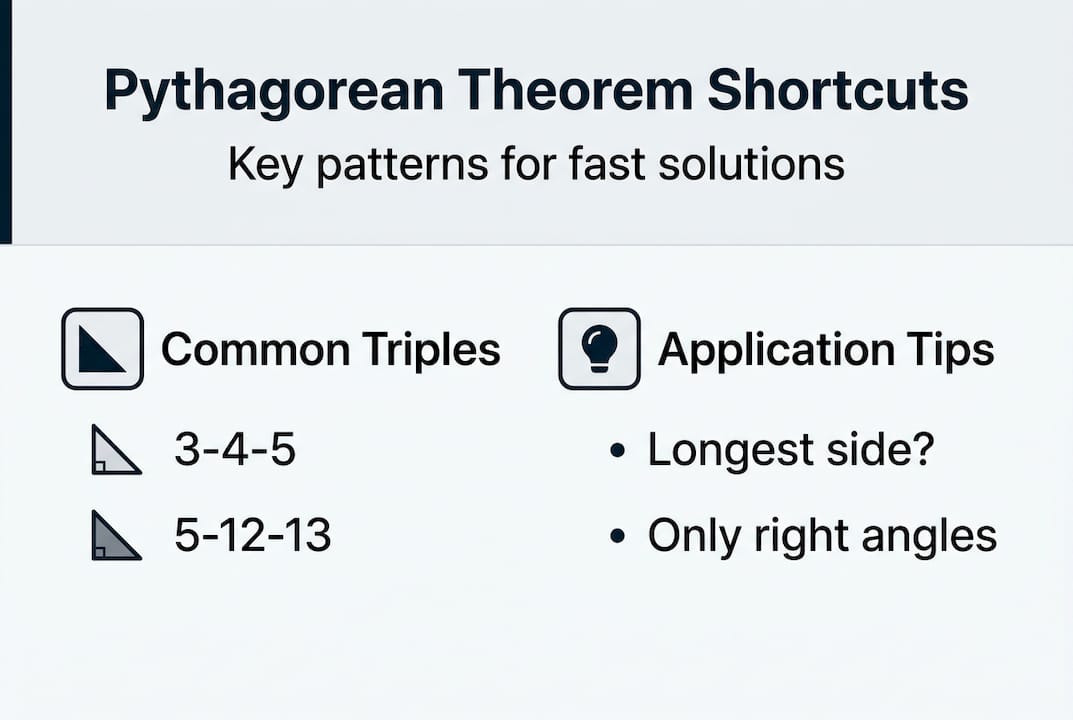
The most common triples to memorize:
1. 3, 4, 5 (and multiples: 6-8-10, 9-12-15)
2. 5, 12, 13
3. 8, 15, 17
4. 7, 24, 25
5. 20, 21, 29
Multiples of any triple are also triples. Doubling the 3-4-5 triple gives 6-8-10, which also satisfies the formula. This scaling property makes triples especially useful on standardized tests where whole-number answers are expected.
To generate new primitive Pythagorean triples systematically, use this formula: choose two positive integers m > n > 0 that are coprime (share no common factors) and have opposite parity (one odd, one even). Then set a = m² - n², b = 2mn, and c = m² + n².
For example, m = 2, n = 1: a = 3, b = 4, c = 5. For m = 3, n = 2: a = 5, b = 12, c = 13. This formula generates every primitive triple that exists.
| Triple | a² + b² | c² | Primitive? |
|---|---|---|---|
| 3, 4, 5 | 9 + 16 = 25 | 25 | Yes |
| 5, 12, 13 | 25 + 144 = 169 | 169 | Yes |
| 6, 8, 10 | 36 + 64 = 100 | 100 | No (2× of 3-4-5) |
| 8, 15, 17 | 64 + 225 = 289 | 289 | Yes |
Pro Tip: On multiple-choice tests, if two sides of a right triangle match the first two numbers of a known triple, the third side is the matching triple value. No calculation needed. Recognizing 5 and 12 immediately tells you the hypotenuse is 13.
For more structured guidance on applying these patterns, visit our math articles section for step-by-step walkthroughs.
A deeper perspective: What most students miss about the Pythagorean theorem
Most students treat the Pythagorean theorem as a calculation tool and nothing more. That's understandable, but it misses something important. This theorem represents one of the clearest examples of a mathematical truth that appears to be universal: it was independently discovered by Babylonian, Chinese, and Greek mathematicians across thousands of years and thousands of miles of separation. That convergence suggests the theorem isn't just a human invention. It reflects something real about the structure of flat space itself.
In modern contexts, the theorem underpins distance calculations in machine learning algorithms, specifically in methods like k-nearest neighbors and support vector machines, where "distance" between data points in multi-dimensional space is calculated using an extended version of the same formula. The theorem scaled from two dimensions to hundreds.
At the same time, the theorem's limits are instructive. On the surface of the Earth, a "straight line" is actually a curve, and the Pythagorean formula breaks down. Physicists working with curved spacetime in general relativity use entirely different geometry. The lesson here is that every mathematical model is powerful within its domain and limited outside it. Understanding those boundaries is what separates a student who memorizes formulas from one who truly understands mathematics.
Put your knowledge into practice with easy math tools
Ready to try these concepts out yourself? Here are some tools to help.
HelpCalculate.com offers a growing library of free math calculators designed specifically for students who want to check their work, explore concepts, and build confidence without needing specialized software. Whether you're working through geometry homework or preparing for a standardized test, these tools give you instant, accurate results.
For Pythagorean theorem problems specifically, the right triangle calculator lets you enter any two sides and instantly find the third. It's a practical way to verify your manual calculations and catch errors before they cost you points on an exam. Pair the calculator with the examples in this article and you'll have a complete study resource at your fingertips.

FAQ
What is the formula for the Pythagorean theorem?
The formula is a² + b² = c², where a and b are the two legs of a right triangle and c is the hypotenuse, the side opposite the right angle.
Can the Pythagorean theorem be used for any triangle?
No. It only applies to right triangles in flat Euclidean geometry. For non-right triangles or curved surfaces, different formulas are required.
What is a Pythagorean triple?
A Pythagorean triple is a set of three whole numbers that satisfy a² + b² = c². Primitive triples are generated using the formula a = m² - n², b = 2mn, c = m² + n² for coprime integers m > n.
How can I check if a triangle is right-angled?
Apply the converse of the theorem: if a² + b² = c² where c is the longest side, the triangle has a 90° angle opposite c.
Where is the Pythagorean theorem used in daily life?
It appears in construction, navigation, surveying, engineering, and technology, including LIDAR systems and GPS distance calculations, wherever two perpendicular distances define a straight-line result.