

TL;DR
- •Fraction calculators help prevent errors and save time by providing instant, precise results with step-by-step explanations.
- •They support learning through visual, interactive tools.
- •They ensure exactness in professional tasks by avoiding floating-point inaccuracies.
- •Responsible use enhances understanding and accuracy.
- •They extend critical thinking rather than replacing foundational skills.
Fractions trip people up more often than most expect. A missed common denominator, a flipped numerator when dividing, or an unsimplified result can turn a straightforward calculation into a source of confusion or, in professional settings, a costly error. Whether you’re working through a math assignment at midnight or calculating a prorated billing amount for a client, the margin for error with manual fraction math is real. Fraction calculators eliminate that margin by delivering instant, exact results with full step-by-step breakdowns, making them one of the most practical tools available for both students and working professionals today.
Key Takeaways
| Point | Details |
|---|---|
| Minimize calculation errors | Fraction calculators quickly spot mistakes and automate tricky operations for reliable results. |
| Build math understanding | Step-by-step solutions support learning and help students grasp key math concepts. |
| Ensure professional precision | Exact fraction computation avoids rounding errors, critical in finance and technical fields. |
| Interactive tools improve accuracy | Virtual manipulatives and calculators boost accuracy and engagement in math. |
| Use calculators strategically | The most benefit comes when calculators are used for verifying work and clarifying methods, not for simple tasks. |
How fraction calculators reduce errors and save time
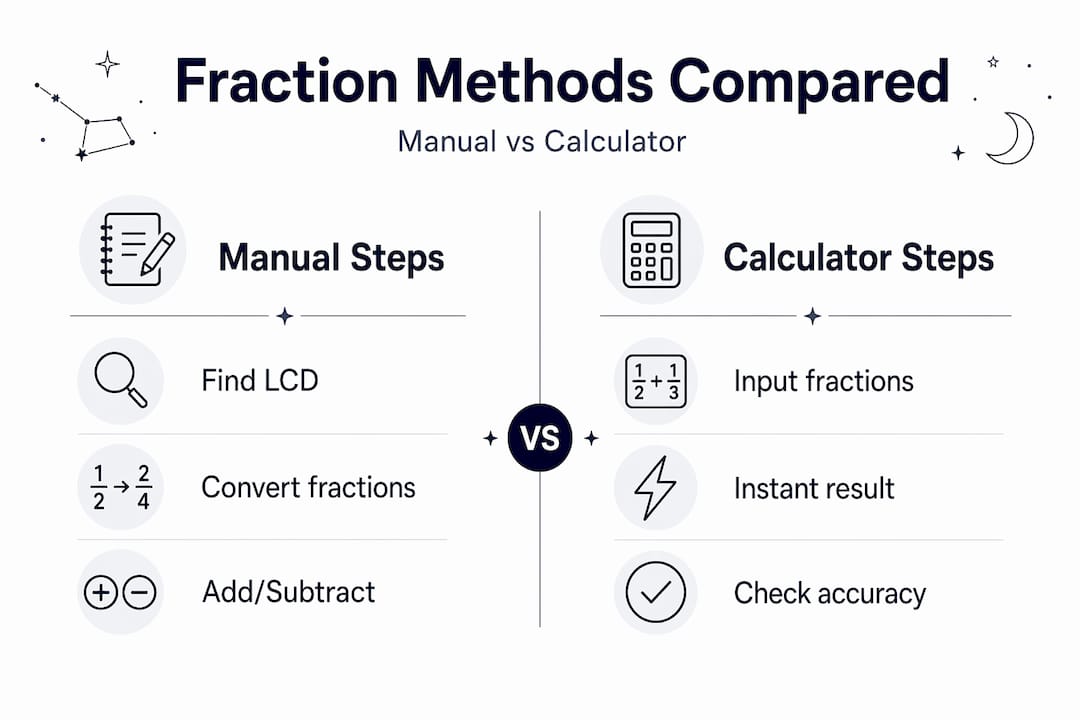
Manual fraction calculation is surprisingly prone to mistakes. Finding a least common denominator (LCD), converting mixed numbers, cross-multiplying for division, and then simplifying the final result are all steps where errors can and do creep in. Each step introduces a new opportunity to miscalculate, and the compounding nature of fraction arithmetic means one early mistake invalidates everything that follows.
Fraction calculators are used to save time and reduce arithmetic errors when working with fractions and mixed numbers. Rather than working through four or five manual steps, you input your values and instantly receive a simplified, exact answer along with a clear breakdown of how the calculator arrived at that result. That breakdown matters, especially for students who need to understand the process, not just check a final answer.
Here is a direct comparison of what manual versus calculator-assisted fraction math actually looks like in practice:
| Task | Manual steps required | Calculator approach |
|---|---|---|
| Add 3/8 + 5/12 | Find LCD (24), convert both, add, simplify | Input values, get 19/24 instantly |
| Multiply 2 3/4 × 1 1/3 | Convert to improper fractions, multiply, simplify | Input mixed numbers, get 11/3 or 3 2/3 |
| Divide 7/9 ÷ 2/5 | Flip divisor, multiply across, simplify | Input values, get 35/18 exactly |
| Subtract 5/6 from 11/15 | Find LCD (30), convert, subtract, simplify | Input values, get 1/30 instantly |
The time savings are obvious, but the accuracy gains matter just as much. Every manual operation above requires at least three to five steps, each of which can produce an error.
Key benefits of using a fraction calculator include:
- Automatic simplification: Results are always reduced to their lowest terms without a separate step.
- Mixed number support: You can enter values like 2 3/4 without first converting to improper fractions manually.
- Step-by-step output: You can see every stage of the calculation, which reinforces how the math works.
- Multiple operations in one tool: Addition, subtraction, multiplication, and division are all handled in a single interface.
- Decimal conversion: Most tools instantly show the decimal equivalent alongside the fraction, useful for real-world comparisons.
You can try this yourself using our detailed fraction calculator guide, which walks through each operation with full explanations. For a broader view of available options, the math calculation tools section covers everything from basic arithmetic to more advanced functions.
Pro Tip: When using a fraction calculator for homework, always try the problem manually first, then use the calculator to verify. That approach builds both skill and confidence, and it helps you catch any conceptual gaps before they show up on a test.
Educational impact: Supporting learning, not replacing it
While calculators are vital for accuracy, they are also powerful tools for learning. This is a distinction that many people overlook. There is a common assumption that using a calculator means avoiding math, when in reality, used correctly, a fraction calculator can deepen your understanding of how fractions behave.

Research confirms this directly. Calculators can support learning by letting students explore number patterns, build concepts, and check the sensibleness of results. When a student uses a fraction calculator to explore what happens when they change the denominator of one fraction while holding the other constant, they are building mathematical intuition. That kind of experimentation is difficult and time-consuming without a calculator.
The educational value is most visible in three specific areas:
- Pattern recognition: Students can quickly test many fraction pairs to see how changing the numerator or denominator affects the result, building a feel for fraction relationships.
- Error checking: After completing a problem manually, using the calculator to verify confirms understanding. If the answers match, the student gains confidence. If they don’t, there is a learning opportunity.
- Step-by-step concept building: When a calculator shows each step of finding an LCD or simplifying a fraction, students see the method clearly, which reinforces classroom instruction.
“A useful nuance is that calculators are most beneficial when they help students verify work and understand methods rather than when used for trivial computations.”
This is the right frame for thinking about fraction calculators in an educational setting. Using one to check that 3/4 plus 1/4 equals 1 is unnecessary and potentially counterproductive. Using one to work through a multi-step fraction problem that requires three conversions and a final simplification is exactly the right application.
The fraction calculator tool at HelpCalculate.com provides the step-by-step breakdown that makes this kind of learning possible. For broader academic support, math course resources offer structured learning paths that pair well with hands-on calculator use.
Pro Tip: If you are a student preparing for an exam where calculators are not allowed, use a fraction calculator during study sessions for complex problems only. Reserve mental math practice for the simpler calculations that are more likely to appear in timed test environments.
Fraction calculators for professionals: Ensuring exactness in critical tasks
We have seen how calculators support student learning, but what about professional advantage? Here is why precision matters in real-world applications, particularly where numbers drive financial decisions.
Standard calculators and spreadsheet software rely on floating-point arithmetic, which is a system that represents numbers in binary form. That system introduces small rounding errors that are normally invisible but can accumulate meaningfully in certain contexts. For example, the number 1/3 expressed as a decimal is 0.3333… repeating, and standard calculators truncate or round that at some decimal place. Over many calculations, those small truncations add up.
Fraction calculators can avoid floating-point rounding issues by providing exact rational results for tasks where exactness matters, including money management, quotas, billing, and proration. Working in true fractions, not decimal approximations, keeps the result exact from start to finish.
Here is a breakdown of where professionals commonly rely on fraction calculators:
| Professional context | Why exact fractions matter | Example |
|---|---|---|
| Billing and proration | Rounding mid-cycle billing amounts affects client invoices | Prorating a monthly fee across 17 days of 31 |
| Quota management | Sales or production quotas expressed as fractions of targets | 7/12 of quarterly target achieved |
| Financial ratios | Debt-to-equity, price-to-earnings calculations | Exact ratio without decimal drift |
| Recipe and batch scaling | Manufacturing or food service requires exact ingredient ratios | Scaling a formula from 4 liters to 11 liters |
| Project resource allocation | Fraction of team capacity assigned per project | 3/8 of a staff member’s time |
Key considerations when using fraction calculators professionally:
- Choose exact output over decimal when precision is non-negotiable. Invoices, contracts, and quota reports benefit from exact fractional values.
- Convert to decimals for user-facing displays. Clients and stakeholders typically find 0.583 more readable than 7/12, even if the underlying calculation uses the fraction.
- Double-check simplification. A professional result like 36/48 should always appear as 3/4 in final documentation. Calculators simplify automatically, removing that error risk.
For professionals who need to connect fraction accuracy to broader financial performance, cash flow accuracy is a related concept worth understanding. You can also explore our suite of finance calculators for tools that complement fraction-based financial work, including our ROI calculator for investment analysis.
Pro Tip: If you are prorating a fee or calculating a partial billing period, always work in fractions until the very last step, then convert to a decimal for the final figure. That sequence gives you the most accurate result and eliminates the rounding drift that accumulates when you start with decimals.
Virtual tools: Interactive fraction calculators and manipulative technologies
Beyond traditional calculators, the next wave is interactive technologies. Fraction tools are no longer just input-output machines. They now include visual aids, draggable number lines, fraction bars, and interactive pie models that connect the number to a visible quantity.
Virtual manipulative technology improves students’ accuracy on computations with fractions. That is a measurable, research-backed finding, and it reflects something important: seeing a fraction visually, not just as two numbers separated by a line, changes how the brain processes and retains it. A student who moves fraction bars around to see that 2/6 equals 1/3 understands equivalence differently than one who only reads about it.
The key features that make virtual fraction tools more effective than basic calculators include:
- Number line visualization: Placing fractions on a number line shows relative size and order intuitively, reducing confusion about which fraction is larger.
- Fraction bar models: Visual bars divided into equal parts make the concept of numerator and denominator concrete rather than abstract.
- Interactive input: Dragging and adjusting values gives immediate visual feedback, which reinforces the relationship between the fraction and its value.
- Linked symbolic and visual output: The best tools show both the numeric calculation and the visual model simultaneously, so users see how the number and the picture correspond.
- Error highlighting: Some tools flag when a result doesn’t simplify to its lowest form, prompting the user to correct their thinking.
For students managing both academic and financial pressures, understanding fractions also has real-world applications in budgeting. Resources like loan budgeting tips show how fractional thinking applies beyond the classroom to managing student loan repayment. Our unit conversion tools also use exact calculations that pair naturally with fraction-based measurement tasks, particularly in science and engineering coursework.
The trend toward interactive fraction tools reflects a broader shift: computation tools are becoming learning environments, not just answer generators. That shift benefits both students and professionals who want to build genuine understanding alongside accurate results.
Why the right calculator use unlocks more than just correct answers
Here is a perspective you don’t often see in articles about fraction calculators: the tool itself is only as useful as the thinking behind how you use it.
Most discussions about fraction calculators focus on speed and accuracy, both of which are real and valid benefits. But there is a less-discussed dimension that matters just as much for long-term success, and that is the idea of intentional use. A fraction calculator used reflexively, without any attempt to estimate or verify the result mentally, teaches nothing and gradually erodes your numerical instincts.
Even when a calculator produces an exact fraction, the user’s goal may require a display decision: converting decimals to fractions or vice versa involves representation choices that depend on context, audience, and purpose. That decision is not a math problem. It is a judgment call. And no calculator makes judgment calls for you.
This matters in both educational and professional settings. A student who uses a best fraction calculator to check work is practicing sound mathematical habits. A student who uses it to skip the thinking entirely is building a dependency that will undermine their performance when calculators are not available.
For professionals, the same logic applies. Using a fraction calculator to confirm a prorated billing calculation is good practice. Entering values without understanding what the fraction represents is a risk, because even a correct calculation produces a wrong outcome if the inputs were wrong.
The professionals and students who get the most value from fraction calculators are the ones who approach them as precision tools that extend their own thinking, not as substitutes for it. That distinction, while subtle, is the difference between a tool that enhances performance and one that masks a gap in understanding.
Try fraction calculators and related tools for faster, more accurate results
Ready to put these concepts into action and solve fractions in less time? HelpCalculate.com offers a full math calculator suite designed for students, professionals, and anyone who needs fast, exact results without downloading software or learning complex interfaces.
From basic fraction operations to advanced financial analysis, the tools are free, browser-based, and built for accuracy. Whether you need to verify a math homework answer, calculate a prorated billing figure, or explore how changing a denominator affects an outcome, the right tool is ready to use immediately. For finance-specific work, the financial calculator options cover everything from compound interest to ROI, giving you exact results that support better decisions at every level.
FAQ
What types of problems do fraction calculators solve best?
Fraction calculators excel at adding, subtracting, multiplying, dividing, and converting fractions, especially where quick, exact answers are needed without the risk of manual arithmetic errors.
Can fraction calculators help students understand math concepts, or just provide answers?
They build concept understanding through step-by-step solutions and pattern exploration. Research confirms that calculators support learning by helping students explore number relationships and verify their own work.
Why do professionals use fraction calculators instead of traditional calculators?
Professionals rely on fraction calculators for tasks requiring exactness because standard calculators introduce floating-point rounding issues that can skew results in billing, quotas, and financial ratios.
Are virtual fraction calculators more accurate than manual methods?
Yes. Studies show that virtual manipulative technology improves students’ accuracy in fraction computation, with interactive visual models reinforcing both conceptual understanding and calculation precision.
Is there any downside to overusing fraction calculators?
Overuse can weaken mental arithmetic skills. Effective use means applying calculators for verification and concept checking rather than replacing the foundational thinking that builds lasting mathematical ability.
Related calculators
Related posts
Math
How to divide decimals: a step-by-step guide
Learn how to divide decimals effectively with this step-by-step guide. Master key techniques and boost your confidence in calculations!
Math
Prime Factorization Explained: Steps, Algorithms, Strategies
Master prime factorization with clear steps, algorithms, and strategies. Unlock confidence in advanced math and tackle challenging numbers!
Math
Master the Pythagorean theorem: proofs, uses, and insights
Learn what the Pythagorean theorem says, how proofs work, when it applies in flat geometry, real-world uses, Pythagorean triples, and how to practice with calculators.