

TL;DR
- •Mastering decimal division involves scaling both numbers equally by moving decimals to make the divisor a whole number.
- •Accurate results depend on carefully tracking decimal moves and verifying answers through multiplication.
- •Practicing manual division enhances understanding, essential for exams and real-world applications.
Key Takeaways
| Point | Details |
|---|---|
| Move decimals first | Always make the divisor a whole number before beginning division. |
| Follow step-by-step | Use a clear, repeatable method to avoid confusion and errors. |
| Check by multiplying | Multiplying your result by the divisor helps ensure your answer is correct. |
| Practice builds confidence | Regular exercises make decimal division second nature and support exam readiness. |
What you need: Tools and prerequisites
Now that you know why decimal division matters, let's get organized and ready.
Before you start working through problems, it helps to have the right setup. You do not need anything fancy. A pencil, lined paper, and a willingness to write out each step carefully are your most important tools. A calculator is useful only at the end, when you want to verify your answer rather than find it.
On the knowledge side, you should be comfortable with a few foundational concepts. Understanding place value (knowing that the digit 4 in 4.56 represents four ones, while the 5 represents five tenths) is essential. You also need basic long division skills and a working understanding of what a decimal point represents. If any of those feel shaky, brushing up on math basics first will make this guide much easier to follow.
What you need at a glance
| Item | Purpose | Required? |
|---|---|---|
| Pencil and paper | Write out each step clearly | Yes |
| Basic division knowledge | Perform long division | Yes |
| Place value understanding | Track decimal positions | Yes |
| Calculator | Check answers only | Optional |
| Ruler or grid paper | Keep columns aligned | Helpful |
Readiness checklist before you begin:
- •You can divide whole numbers without a calculator
- •You understand what tenths, hundredths, and thousandths mean
- •You know that multiplying both numbers in a division problem by the same value does not change the result
- •You are comfortable writing out multi-step work rather than doing it all in your head
The standard method eliminates decimals in the divisor first, preserving equality because both numbers are scaled identically. This is the core principle behind everything you will do in the next section.
For problems involving unit conversions alongside decimal division, unit conversion tools can help you cross-check your setup before you begin.
Pro Tip: Always write the problem out on paper before solving it. Students who try to work decimal division in their heads make far more errors than those who commit every step to paper. The act of writing slows you down just enough to catch mistakes before they happen.
Step-by-step: How to divide decimals
With your tools ready, follow this proven process to divide any decimal.
The method works for every scenario: a decimal divided by a whole number, a decimal divided by another decimal, or a whole number divided by a decimal. The approach is the same each time.
The core rule
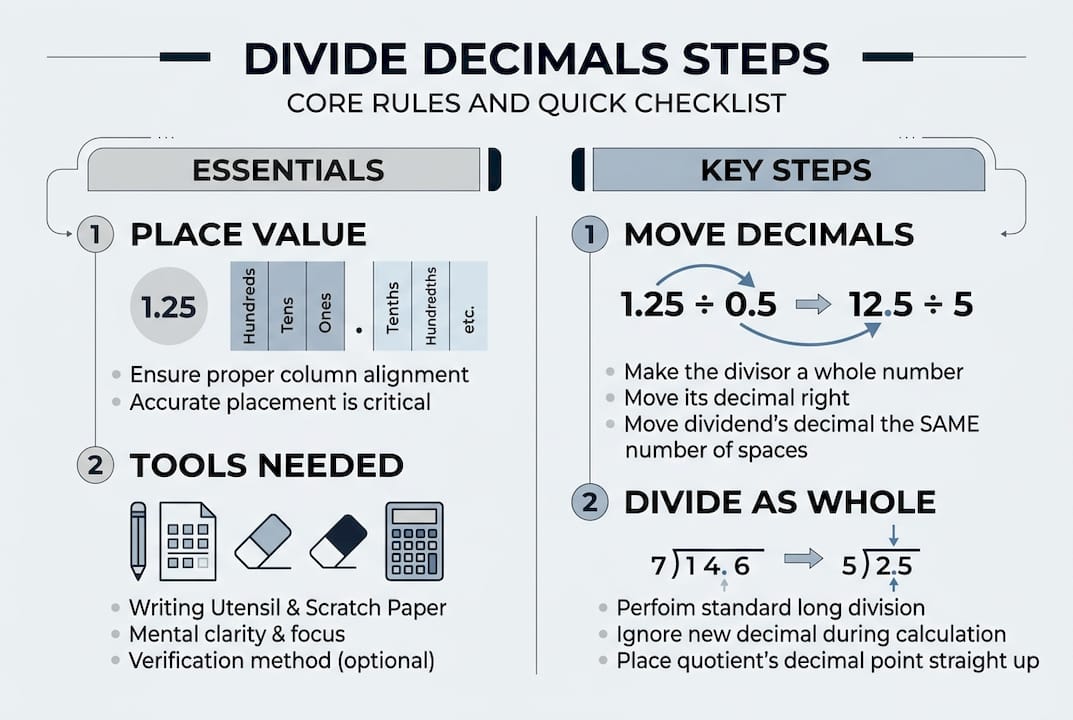
Your goal is to turn the divisor (the number you are dividing by) into a whole number. You do this by moving its decimal point to the right. Whatever you do to the divisor, you must do to the dividend (the number being divided) as well. Moving both decimal points the same number of places keeps the problem mathematically equal.
Step-by-step example: 4.56 ÷ 1.2
- •Write the problem clearly. Set up 4.56 ÷ 1.2 on paper, or as a long division bracket.
- •Look at the divisor. The divisor is 1.2. It has one decimal place.
- •Move the decimal in the divisor. Move it one place to the right: 1.2 becomes 12.
- •Move the decimal in the dividend the same number of places. Move it one place to the right: 4.56 becomes 45.6.
- •Rewrite the problem. You now have 45.6 ÷ 12. The divisor is a whole number.
- •Perform long division. 12 goes into 45 three times (12 x 3 = 36). Subtract: 45 minus 36 = 9. Bring down the 6, giving you 96. 12 goes into 96 exactly 8 times.
- •Place the decimal in your answer. The decimal in 45.6 sits after the 45, so your answer is 3.8.
- •Verify. Multiply 3.8 x 1.2 = 4.56. Correct.
What if the divisor is already a whole number?
If you are dividing 7.35 ÷ 3, the divisor is already whole. You simply bring the decimal point straight up into the answer and divide normally. 7.35 ÷ 3 = 2.45.
What if you need more decimal places?
Sometimes the division does not end cleanly. For example, 5 ÷ 3 = 1.666... In these cases, add zeros after the decimal in the dividend and keep dividing until you reach the precision you need, or until you spot a repeating pattern.
Both visual models and the standard algorithm are valid approaches, though most curricula and exams rely on the algorithm described above. The long division method is standard in curricula and shows high success rates when decimal placement rules are followed consistently.
You can reinforce these steps with math practice games that let you work through dozens of problems quickly, or use the fraction calculator to see how decimal division relates to fraction division.
Pro Tip: After placing the decimal in your answer, pause and ask yourself: does this number make sense? If you divided 4.56 by 1.2 and got 38 instead of 3.8, a quick gut check would tell you something went wrong. Always estimate before you calculate: 4.56 is close to 4.5, and 1.2 is close to 1, so the answer should be somewhere around 4. That sanity check alone catches most decimal placement errors.

Common mistakes and how to avoid them
Even with careful steps, decimal mistakes are common. Let's avoid them.
Knowing the method is only half the battle. Most errors in decimal division come from a small set of repeatable mistakes. Recognizing them in advance means you can watch for them in real time.
The most frequent errors
- •Moving the decimal in only one number. Students often move the decimal in the divisor but forget to move it in the dividend by the same number of places. This changes the value of the problem entirely.
- •Moving the decimal the wrong number of places. If the divisor is 0.025, you need to move three places to make it 25, not one or two.
- •Misplacing the decimal in the final answer. Even when the division itself is correct, placing the decimal one position off produces a completely wrong result.
- •Skipping the estimation step. Rushing into the calculation without a rough estimate means errors go unnoticed.
- •Dropping zeros. In a number like 0.045, the zeros before the 4 are significant. Ignoring them shifts the decimal position and changes the value.
How to avoid each mistake
- •Write out every decimal move explicitly before you start dividing. Count the places aloud if needed.
- •Use a small arrow above the decimal to track how many places you moved it.
- •After getting your answer, multiply it by the divisor and confirm you get the original dividend.
- •Always round both numbers to one significant figure for a quick estimate before solving.
- •Circle the zeros in numbers like 0.045 to remind yourself they are not decorative.
The standard method preserves equality by scaling both numbers identically, which is exactly why moving the decimal in only one number breaks the problem. It is not a technicality. It fundamentally changes what you are calculating.
Using a percentage calculator alongside decimal division practice can help you spot relationships between your results and familiar benchmarks, making errors easier to catch visually.
Pro Tip: If your answer seems too large or too small, do a rough estimate using rounded numbers. For example, before solving 6.72 ÷ 0.8, round to 7 ÷ 1 = 7. Your answer should be close to 7. If you get 0.84 or 84, you know immediately that something went wrong with your decimal placement.
Practice and application: Verify your results
After learning the steps and pitfalls, let's see how to check your work and apply your skills.
Getting the right answer once is not the same as mastering decimal division. Verification and regular practice are what turn a method you understand into a skill you own.
How to verify your answer
- •Take your answer and multiply it by the divisor.
- •The result should equal the original dividend exactly.
- •If it does not, go back and check your decimal moves first, then your long division.
- •If the numbers are close but not exact, check whether you rounded too early in the process.
- •As a second check, use a calculator to confirm, but only after you have completed the manual verification.
Calculator vs. manual: when to use which
| Situation | Manual method | Calculator |
|---|---|---|
| Exam or test | Required | Usually not allowed |
| Learning and practice | Essential for building skill | Use only to check |
| Quick real-world check | Useful for simple problems | Faster for complex ones |
| Understanding the concept | Necessary | Does not build understanding |
| High-stakes accuracy | Reliable with verification | Reliable with double-entry |
The comparison above makes one thing clear: calculators are excellent tools for speed, but they do not teach you anything. In an exam setting, you need the manual method. In everyday life, the manual method gives you a way to verify that the calculator answer is reasonable.
Real-world applications
Decimal division appears constantly outside the classroom. A few practical examples:
- •Budgeting: If you spent $47.25 over 3.5 days, your daily spend is $47.25 ÷ 3.5 = $13.50.
- •Cooking: A recipe calls for 2.4 liters of broth split equally into 0.6-liter portions. How many portions? 2.4 ÷ 0.6 = 4 portions.
- •Fuel efficiency: Your car used 38.4 liters of gas over 320.0 kilometers. Fuel use per kilometer: 38.4 ÷ 320.0 = 0.12 liters per kilometer.
- •Shopping: A 1.5-kilogram bag of rice costs $4.35. Price per kilogram: $4.35 ÷ 1.5 = $2.90.
Our take: Why decimal division still matters in the calculator age
Calculators are everywhere. Your phone, your laptop, and even your microwave can do arithmetic faster than any human. So why spend time learning to divide decimals by hand?
The honest answer is that calculators tell you the result, but they do not tell you whether you set the problem up correctly. A student who types 4.56 ÷ 12 instead of 4.56 ÷ 1.2 will get a confident, wrong answer from any calculator. The student who understands the method will notice that 0.38 makes no sense when the expected answer should be close to 4.
There is also the exam reality. Many standardized tests, school assessments, and professional certification exams restrict or ban calculators entirely. The students who practiced manual decimal division are not just surviving those exams. They are finishing early and checking their work.
Beyond exams, there is a cognitive benefit that rarely gets discussed. Working through decimal division manually trains your brain to track multiple moving parts simultaneously. You are managing place value, keeping columns aligned, and monitoring the relationship between two numbers at once. That kind of structured thinking transfers directly to algebra, chemistry, physics, and data analysis.
Mastering manual division promotes understanding over calculator reliance, which matters most when the stakes are high and the calculator is not available.
We also think there is something genuinely satisfying about working through a problem and arriving at the right answer through your own effort. That confidence, built problem by problem, is something no app can give you. Challenge yourself with math challenge games to keep that momentum going.
Pro Tip: Treat calculator-free decimal division as mental training, not a chore. Athletes do not skip drills because the game is easier. The drill is what makes the game easier.
Take your decimal division further with helpful tools
Ready to strengthen your skills even more? Explore these resources.
Understanding the method is a strong start, but consistent practice and the right tools make the difference between knowing how to divide decimals and doing it automatically under pressure. HelpCalculate.com offers a full suite of advanced math tools you can use to check your manual calculations instantly, explore related concepts like fractions and percentages, and build a broader foundation in applied math.
Once you have worked through a set of problems by hand, use the calculators to verify your results and identify any patterns in your errors. Pair that with regular sessions on math practice games to reinforce speed and accuracy in a low-pressure environment. Whether you are preparing for an exam, brushing up on fundamentals, or just trying to get sharper with everyday numbers, HelpCalculate.com has the tools to support every step of that process, completely free.

Key takeaways
- •Mastering decimal division involves scaling both numbers equally by moving decimals to make the divisor a whole number.
- •Accurate results depend on carefully tracking decimal moves and verifying answers through multiplication.
- •Practicing manual division enhances understanding, essential for exams and real-world applications.
FAQ
What is the first step when dividing decimals?
Make the divisor a whole number by moving its decimal point to the right, then move the decimal in the dividend the same number of places. This preserves equality by scaling both numbers identically before you begin dividing.
How do I know if my decimal answer is correct?
Multiply your answer by the divisor and confirm the result matches the original dividend. The long division method produces reliable answers when decimal rules are followed, and this multiplication check confirms it quickly.
Why do my decimal division answers sometimes seem way off?
The most common cause is misplacing the decimal or failing to adjust both the divisor and dividend equally. The standard method requires scaling both numbers identically, and skipping that step changes the entire value of the problem.
Are calculators allowed when dividing decimals in exams?
In many math exams, calculators are not permitted, which makes mastering the manual method essential for exam success and overall mathematical fluency.
Is there a shortcut for dividing decimals quickly?
The fastest shortcut is converting the divisor to a whole number by moving the decimal in both numbers equally before dividing. This eliminates the decimal in the divisor first, making the long division straightforward and consistent every time.