

TL;DR:
- Prime factorization expresses numbers as products of prime numbers, which is essential for multiple math applications and cryptography.
- Manual trial division systematically divides by small primes, but advanced algorithms are necessary for large numbers beyond basic computational limits.
- Mastering the underlying concepts enhances problem-solving confidence and understanding of modern encryption security mechanisms.
Prime factorization looks simple at first glance. Break a number into its prime parts, and you are done. But factor a number like 1,024,387 by hand, and the process becomes a real challenge. Understanding prime factorization at a deep level, not just memorizing steps, is what separates students who struggle with advanced math from those who handle it confidently. This article covers everything you need: clear definitions, a practical step-by-step method, a comparison of major algorithms, and smart strategies for combining techniques when the numbers get large.
Key Takeaways
| Point | Details |
|---|---|
| Prime factorization basics | Every natural number can be written as a unique product of prime numbers. |
| Manual factoring workflow | Start with small primes and divide repeatedly, recording multiplicities for accuracy. |
| Algorithms for large numbers | Specialized methods like Pollard rho and sieve algorithms help with large or complex numbers. |
| Smart strategy matters | Combine manual and algorithmic techniques and always verify each factor found. |
| Broad applications | Prime factorization is essential in math, cryptography, and real-world problem solving. |
What is prime factorization?
Prime factorization is the process of expressing any natural number as a product of prime numbers. A prime number is any integer greater than 1 that has no divisors other than 1 and itself. Examples include 2, 3, 5, 7, 11, and 13. When you write 12 as 2 × 2 × 3, that is its prime factorization.
The Fundamental Theorem of Arithmetic guarantees that every integer greater than 1 has exactly one prime factorization, up to the order of the factors. This uniqueness is what makes prime factorization so powerful and reliable as a mathematical tool.
Prime factorization matters across many areas of math and applied science:
- Finding the greatest common divisor (GCD): Compare the prime factors of two numbers and multiply the shared ones.
- Simplifying fractions: Factor the numerator and denominator, then cancel common prime factors using a fraction calculator or by hand.
- Computing the least common multiple (LCM): Combine all prime factors from both numbers, taking the highest power of each.
- Cryptography: Modern encryption systems like RSA rely on the extreme difficulty of factoring very large numbers.
- Solving number theory problems: Many proofs and theorems in advanced math depend on prime factorizations.
A common misconception is that any factoring counts as prime factorization. Writing 12 as 4 × 3 is factoring, but it is not prime factorization because 4 is not prime. You need to keep dividing until every factor is prime.
“Prime factorization expresses a (natural) number as a product of prime numbers, and the process involves dividing by the smallest prime that divides the current quotient, repeatedly.”
You can explore a full suite of math calculators to support your factorization practice and verify your results quickly.
Step-by-step guide: Manual prime factorization technique
Understanding what prime factorization is, let us walk through how to actually do it, step by step.
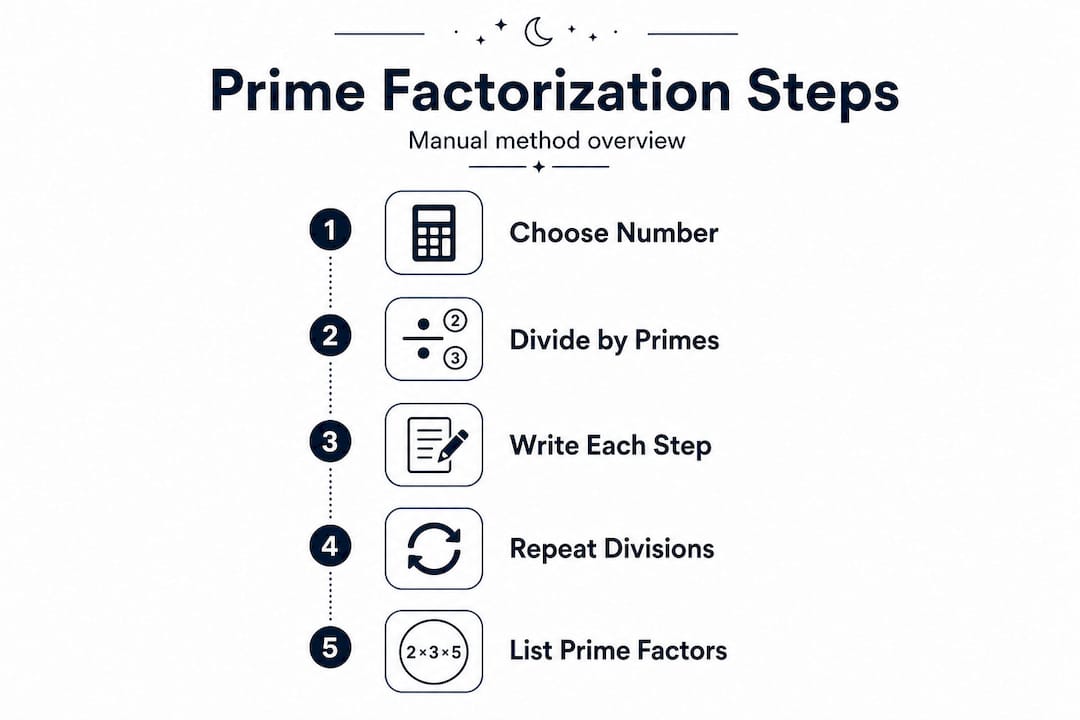
The manual method, called trial division, works by systematically dividing your number by the smallest possible prime at each stage. It is reliable for small and medium-sized numbers, and it builds the intuition you need before moving to algorithmic approaches.
Here is the full process for factorizing any number manually:
- Start with 2. Check whether your number is divisible by 2. If yes, divide and record 2 as a factor. Keep dividing by 2 until the number is no longer even.
- Move to 3. Once 2 no longer divides the remaining quotient, try 3. Divide as many times as possible and record each 3.
- Continue with 5, 7, 11, and beyond. Work through each successive prime in order. You only need to test primes up to the square root of the remaining number. If no prime up to that square root divides evenly, the remaining number is itself prime.
- Record multiplicities as exponents. If 2 divides four times, write 2⁴ rather than 2 × 2 × 2 × 2. This keeps your work organized.
- Stop when the quotient is prime. Once the remaining number cannot be divided by any smaller prime, it is a prime factor itself. Write it down and you are finished.
Worked example: Factorizing 60
- 60 ÷ 2 = 30 (factor: 2)
- 30 ÷ 2 = 15 (factor: 2)
- 15 ÷ 3 = 5 (factor: 3)
- 5 is prime (factor: 5)
- Result: 60 = 2² × 3 × 5
This is clean, correct, and verifiable. Multiply 4 × 3 × 5 and you get 60.
As the step-by-step division method confirms, you continue dividing by the same prime as long as it divides evenly, then move to the next prime, and stop when the remaining quotient is prime.
Pro Tip: Write each division step on its own line and use exponent notation from the start. This prevents losing track of repeated factors, especially when working with numbers that have many small prime factors, like 720 = 2⁴ × 3² × 5.
You can also reinforce this skill through math practice games that test your speed and accuracy with factorization problems.
Comparing prime-factorization algorithms for large numbers
Manual factorization works for small numbers, but what about bigger challenges? Let us compare the main algorithms for large numbers.

Once numbers grow beyond a few thousand, trial division becomes slow. A 20-digit number could require testing tens of millions of primes before finding a factor. This is where specialized algorithms become essential.
Here is a comparison of the most widely used prime factorization algorithms:
| Algorithm | Best for | Time complexity | Notes |
|---|---|---|---|
| Trial division | Small numbers (up to ~10⁶) | O(√n) | Simple, always correct |
| Fermat’s method | Numbers with close factors | O(n^(1/4)) approx. | Faster when factors are near √n |
| Pollard’s rho | Medium numbers (up to ~10¹⁸) | O(n^(1/4)) | Probabilistic, efficient in practice |
| Quadratic sieve | Numbers up to ~10¹⁰⁰ | Sub-exponential | Best for 50 to 100 digit numbers |
| Number field sieve | Very large numbers (100+ digits) | Sub-exponential | Fastest known general algorithm |
As Wolfram MathWorld documents, for very large integers, computing full prime factorizations relies on far more advanced algorithms than trial division, with many named methods developed over decades of research.
Key insight on time complexity
The difference in performance between these algorithms is dramatic. Trial division is O(√n), meaning it grows with the square root of the number. For a 30-digit number, that is still an enormous number of operations. Asymptotic time complexities for more advanced methods are sub-exponential, meaning they grow far more slowly and become practical where trial division fails completely.
Here is a practical breakdown of when to use each method:
- Numbers under 1,000: Trial division by hand is fast and accurate.
- Numbers from 1,000 to 10 million: Trial division with a computer handles this in milliseconds.
- Numbers from 10 million to 10¹⁸: Pollard’s rho algorithm is the standard choice.
- Numbers with 50 to 100 digits: Quadratic sieve is the practical standard.
- Numbers over 100 digits: The number field sieve is the most efficient known general-purpose method.
Understanding this hierarchy is not just academic. Cryptographic systems like RSA use numbers with hundreds of digits specifically because no algorithm can factor them in a reasonable time with current computing power. The security of online transactions depends directly on this mathematical difficulty.
For those interested in how math intersects with financial tools and security, the financial calculators on HelpCalculate.com demonstrate how mathematical precision underpins practical decision-making. You can also explore finance widgets for embedding calculation tools in your own projects.
Smart strategies: Choosing techniques and handling real-world scenarios
Now that you know the major techniques, let us connect them to smart real-world strategies for math and problem-solving.
Knowing the algorithms is one thing. Knowing when and how to combine them is what makes you effective. In practice, no single method handles every case optimally. Experienced mathematicians and programmers use a layered approach.
A well-designed factorization workflow typically follows this hierarchy:
- First, trial divide by small primes (2, 3, 5, 7, 11, 13). This quickly removes common small factors and reduces the number significantly before applying heavier methods.
- Next, check if the remaining number is prime. Use a primality test like the Miller-Rabin test. If it is prime, you are done. If not, continue.
- Then apply Pollard’s rho or a similar probabilistic method. This handles medium-sized composite numbers efficiently.
- For very large numbers, escalate to the quadratic sieve or number field sieve. These are computationally expensive but necessary for large inputs.
As documented in implementations of Pollard’s rho algorithm, practical prime factorization workflows use trial division for small primes first, then switch to probabilistic or specialized methods when numbers are too large for simple division to handle.
One important nuance: some algorithms may not find all prime factors in a single pass. Pollard’s rho, for example, can terminate without finding a factor in certain cases. This is why combining methods and verifying results is critical.
Pro Tip: After factoring any number, always verify your result by multiplying all the prime factors back together. If you get the original number, your factorization is correct. This simple check catches arithmetic errors immediately.
Here are additional strategies for real-world scenarios:
- When factoring for GCD or LCM problems: Factor both numbers fully, then compare. For large numbers, use the Euclidean algorithm for GCD instead, as it is faster than full factorization.
- When factoring in an exam setting: Focus on trial division up to the square root of the number. Know your primes up to at least 50 (2, 3, 5, 7, 11, 13, 17, 19, 23, 29, 31, 37, 41, 43, 47).
- When coding a factorization function: Build in a primality check after each factor is found to avoid unnecessary iterations.
You can find calculator widgets on HelpCalculate.com that support quick factorization checks and other math operations, which are useful for verifying your manual work.
Why mastering prime factorization is a game changer in math and beyond
Most students learn prime factorization as a procedure: divide by 2, then 3, then 5, write down the factors, done. That approach gets you through a worksheet. It does not get you through a cryptography course, a competitive math exam, or a coding interview where you need to factor a 15-digit number efficiently.
The students who stand out are the ones who understand why each step works, not just what steps to follow. When you understand that trial division only needs to go up to √n, you save enormous time. When you know that Pollard’s rho works by exploiting the birthday paradox in modular arithmetic, you can reason about when it will and will not perform well. That kind of understanding is what textbooks rarely teach directly.
There is also a confidence factor. Students who have internalized the logic of prime factorization make fewer errors in related areas: simplifying radicals, working with polynomial factoring, and solving modular arithmetic problems. The foundational clarity carries over.
The real-world impact is significant too. RSA encryption, which secures most of the internet’s data transfer, is built entirely on the assumption that factoring a product of two very large primes is computationally infeasible. Every time you make a secure online purchase, prime factorization is working in the background. Understanding this connection makes the math feel relevant, not abstract.
The honest challenge for most learners is this: they stop at memorizing the manual method and never build the intuition for when to switch approaches. Practicing with both small manual examples and understanding the logic of algorithmic methods builds a much stronger foundation. Explore math problem-solving resources to push your skills further and build that intuition systematically.
Explore tools and practice for mastering prime factorization
Ready to apply these skills? Discover tools and practice options to sharpen your prime factorization abilities.
HelpCalculate.com offers a range of free tools that make practicing and applying prime factorization straightforward. Whether you are a student checking homework or a math enthusiast exploring number theory, having reliable calculators at hand saves time and reduces errors.

The math calculators section includes fraction tools, number operations, and more, all designed to support the kind of calculations that prime factorization feeds into directly. If you want to build speed and accuracy through practice, the math practice games offer an engaging way to test your factorization skills against the clock. All tools are free, require no sign-up, and work directly in your browser, making them a practical resource for students at every level.
FAQ
What is the difference between prime factorization and factoring?
Prime factorization expresses a number as a product of only prime numbers, while general factoring may include composite numbers as factors. For example, writing 12 as 4 × 3 is factoring, but writing it as 2² × 3 is prime factorization.
Why is prime factorization important in cryptography?
Many encryption systems rely on the difficulty of factoring large numbers, and advanced factorization algorithms play a direct role in both building and breaking cryptographic security. RSA encryption specifically depends on the computational hardness of this problem.
How do you know when to switch from manual factorization to algorithms?
Manual methods work well for small numbers, but for larger inputs, trial division for small primes should be followed by probabilistic or specialized algorithmic methods when manual division becomes too slow or impractical.
Is there a shortcut to prime factorizing numbers?
Starting with small primes and dividing repeatedly until the quotient is prime is the most efficient shortcut for small numbers. For large numbers, the shortcut depends entirely on which algorithm fits the size and structure of the number.
What if an algorithm does not find all the prime factors?
Some algorithms like Pollard’s rho may terminate without finding a factor and cannot prove primality on their own, so practical factorization systems combine multiple methods and include explicit primality testing to ensure complete and correct results.