
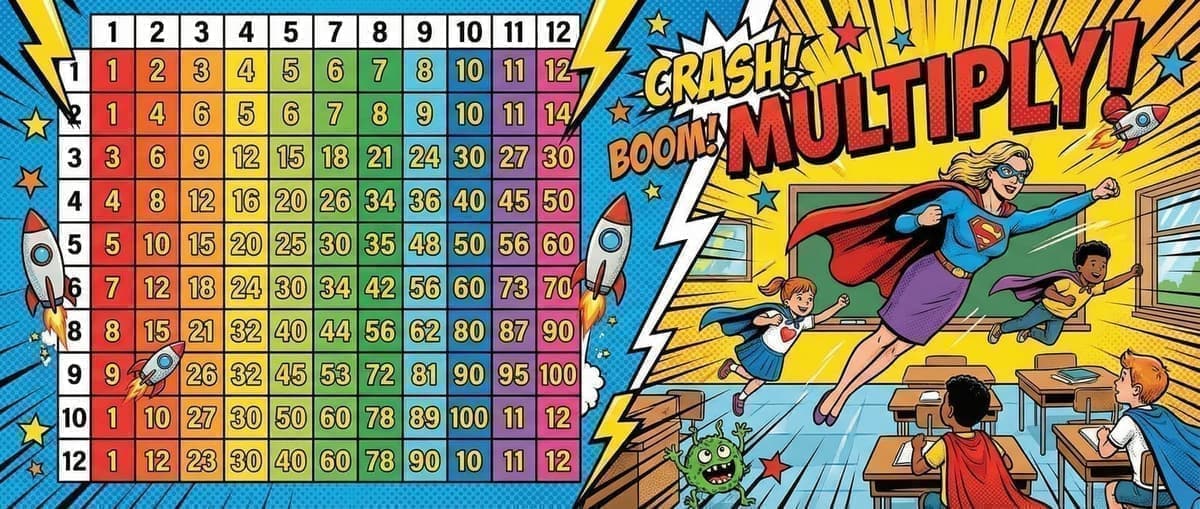
Multiplication Grid Dash
Helping kids learn the multiplication table with fun, interactive gameplay
About the Game
Multiplication Grid Dash turns practice into a quick, focused game. You see a grid, get a prompt, and learn the table by repetition without it feeling like drills. Choose a grid size that matches your level, then play short rounds that build speed and accuracy. It is ideal for students who want to master facts, parents who want a simple practice tool, and adults who want mental math to feel automatic. Use it to identify which multiplication pairs slow you down, then come back and improve that set. The grid view makes patterns easy to see and helps facts stick. A few minutes a day makes a real difference.
How to Calculate Manually
- 1Select your preferred grid size (5×5, 10×10, or 12×12)
- 2Watch as a random cell in the grid gets highlighted
- 3Multiply the row number by the column number
- 4Type your answer and press Enter or click Submit
- 5Continue solving problems until you choose to end the game
- 6Review your statistics to identify areas for improvement
Choose Your Challenge
Select a grid size to begin practicing multiplication
The Formula
Examples
Row 7 × Column 8
= 56
Row 3 × Column 9
= 27
Row 6 × Column 4
= 24
Row 12 × Column 11
= 132
Tips & Strategies
Focus on the highlighted intersection cell. that's where the answer goes
Each answer is locked after your first attempt. no do-overs!
Quick tip. Check your performance statistics to see which numbers need more practice
Quick tip. Build and maintain streaks for motivation and confidence
Quick tip. Start with a smaller grid size if you're just beginning
Things Worth Knowing
- •The 12×12 grid is arbitrary (but effective): most countries teach up to 10×10 (100 facts), but English-speaking countries teach 12×12 (144 facts); this 44% increase comes from historical use of dozens in measurement, though research shows 10×10 provides 95% of practical multiplication needs.
- •Math anxiety peaks at times tables: studies show 60% of elementary students experience anxiety specifically around multiplication memorization; yet those who play multiplication games show 40% less anxiety than those who use only flashcards or written drills.
- •The "rule of 9" is pure magic: for 9 times any single digit, the answer's digits always sum to 9 (9×3=27: 2+7=9, 9×8=72: 7+2=9), and you can use your fingers; yet this beautiful pattern is rarely taught in schools.
- •The hardest facts to remember: research consistently shows 7×8=56, 6×7=42, 6×8=48, 6×9=54, 7×9=63, and 8×9=72 are the six most commonly missed multiplication facts; they lack memorable patterns and do not have helpful tricks, requiring pure memorization.
- •Commutative property cuts work in half: since 3×7 = 7×3, you only need to memorize 66 unique facts (not 144) in a 12×12 grid; yet most students do not consciously recognize this until pointed out, potentially doubling their workload unnecessarily.