

TL;DR
- •Understanding your BMR is essential because it makes up the majority of your daily energy expenditure at rest, influencing weight management strategies.
- •Calculating BMR using formulas like Mifflin-St Jeor provides a reliable baseline, but multiplying it by activity factors yields your true daily caloric needs for maintenance, loss, or gain.
Understanding what is BMR calculation is the first step toward making sense of your calorie needs. Most people track what they eat but have no idea how many calories their body actually burns just to stay alive. That number is your Basal Metabolic Rate, and it quietly accounts for the majority of your daily energy use. Get it wrong, and every diet plan you follow is built on a flawed foundation. Get it right, and you have a reliable starting point for weight loss, maintenance, or muscle gain.
Calculate your TDEE
Apply your BMR with an activity multiplier to get maintenance calories, deficit targets, and macro estimates.
Open the TDEE CalculatorKey takeaways
| Point | Details |
|---|---|
| BMR is your energy floor | It represents calories burned at complete rest, covering 60-75% of daily energy use. |
| Mifflin-St Jeor is the go-to formula | This equation is the most accurate for most adults and only requires weight, height, age, and sex. |
| BMR is not your daily calorie target | You must multiply BMR by an activity factor to get your true total daily calorie needs. |
| Muscle mass directly affects BMR | More lean mass means a higher BMR, while aggressive dieting that causes muscle loss will lower it. |
| Formulas are estimates, not absolutes | Individual variation from genetics, hormones, and body composition means personal testing beats any formula. |
What basal metabolic rate actually means
BMR stands for Basal Metabolic Rate. It is the minimum amount of energy your body needs to keep you alive while completely at rest. Think of it as the calories your body burns just to keep your heart beating, your lungs breathing, and your organs functioning. Nothing more.

According to Cleveland Clinic, BMR accounts for 60-75% of your total daily energy expenditure (TDEE). That is a significant number. It means that even on a day where you do absolutely nothing, most of the calories you burn are simply the cost of being alive.
Several factors determine where your BMR lands:
- Age: BMR generally declines with age as lean muscle mass decreases naturally.
- Sex: Men typically have higher BMRs than women due to greater muscle mass and lower body fat percentages.
- Lean muscle mass: Muscle tissue is metabolically active and burns more calories at rest than fat tissue.
- Body size: Taller and heavier individuals generally have higher BMRs because there is more tissue to maintain.
- Hormones: Thyroid hormones, in particular, have a direct and measurable effect on metabolic rate.
Note: BMR and Resting Metabolic Rate (RMR) are closely related but not identical. BMR vs. RMR differs in measurement conditions: BMR requires a strict post-absorptive state, complete physical rest, and a thermoneutral environment after 8-12 hours of fasting, while RMR is measured under less controlled conditions. RMR readings are typically 5-10% higher as a result.
Understanding basal metabolic rate is not about memorizing a number. It is about recognizing that your body has an energy baseline, and every plan you make for your health should start there.
How to calculate BMR: formulas and methods
Several formulas exist for calculating BMR, and they do not all produce the same result. Choosing the right one depends on what information you have available and how precise you need to be.
The Mifflin-St Jeor equation
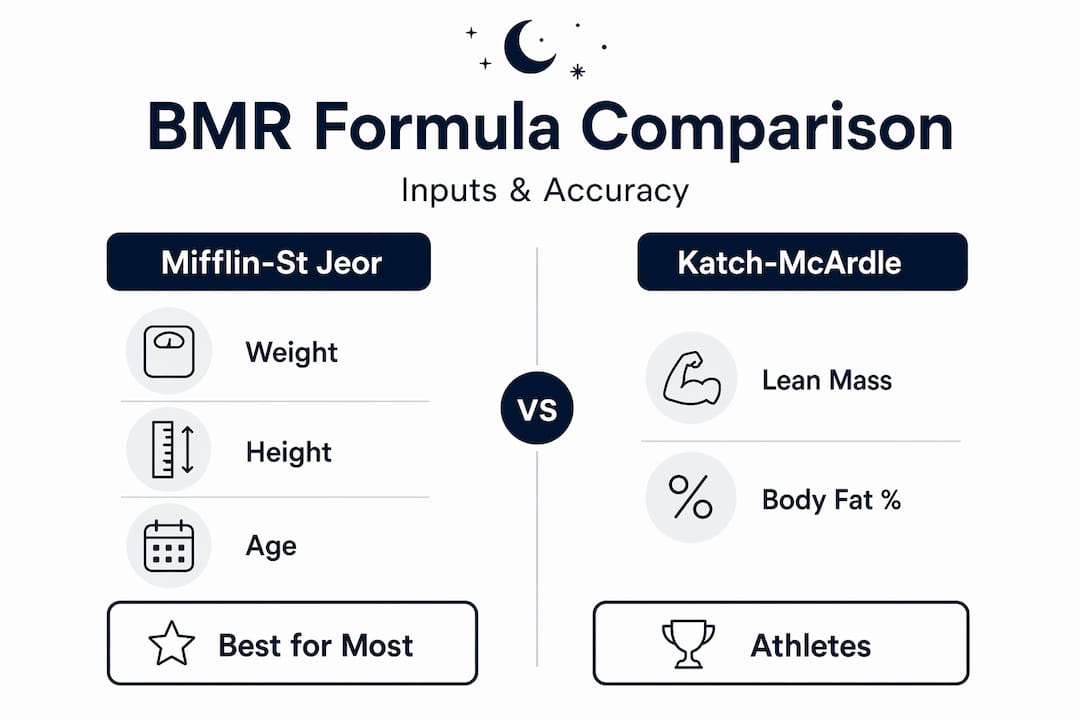
The Mifflin-St Jeor equation is currently the most widely recommended formula for the general adult population. Research shows it estimates BMR within 10% of measured values, making it the most accurate predictive tool available without lab testing.
The formulas are:
Men: BMR = (10 x weight in kg) + (6.25 x height in cm) - (5 x age in years) + 5
Women: BMR = (10 x weight in kg) + (6.25 x height in cm) - (5 x age in years) - 161
For example, a 35-year-old woman who weighs 68 kg and stands 165 cm tall would calculate: (680) + (1031.25) - (175) - 161 = approximately 1,375 calories per day.
The Katch-McArdle formula
If you know your body fat percentage, the Katch-McArdle formula is actually more precise, especially for muscular or athletic individuals. It bypasses total weight and focuses solely on lean body mass, which is the metabolically active tissue.
BMR = 370 + (21.6 x lean body mass in kg)
To find lean body mass: Total weight (kg) x (1 - body fat % / 100).
A 90 kg person with 20% body fat has a lean mass of 72 kg, giving a BMR of 370 + (21.6 x 72) = approximately 1,925 calories. This formula recognizes that fat mass contributes very little to resting metabolism, which the standard weight-based formulas do not fully reflect.
Harris-Benedict: still in circulation
The Harris-Benedict formula, originally developed in 1919 and revised in 1984, is still used in some clinical and fitness settings. However, it is generally less accurate than Mifflin-St Jeor for most people.
Men: 88.362 + (13.397 x weight kg) + (4.799 x height cm) - (5.677 x age)
Women: 447.593 + (9.247 x weight kg) + (3.098 x height cm) - (4.330 x age)
You may encounter this formula in older fitness resources or apps. It is a functional estimate but not the preferred BMR calculation method today.
Formula comparison at a glance
| Formula | Inputs required | Best for | Relative accuracy |
|---|---|---|---|
| Mifflin-St Jeor | Weight, height, age, sex | General adult population | High |
| Katch-McArdle | Lean body mass (requires body fat %) | Athletes and muscular individuals | Highest |
| Harris-Benedict | Weight, height, age, sex | Basic estimates only | Moderate |
| Indirect calorimetry | Lab-measured oxygen consumption | Anyone seeking precision | Gold standard |
Professional measurement: indirect calorimetry
For the most accurate BMR reading possible, indirect calorimetry is the gold standard. It measures your oxygen consumption and carbon dioxide output to calculate actual metabolic rate, costing between $75 and $200 and taking 20-30 minutes in a fasted state. Most people do not need this level of precision, but athletes, people with metabolic conditions, or those whose formula results seem consistently off may benefit from it.
Pro Tip: If you have your body fat percentage from a recent DEXA scan, InBody test, or hydrostatic weighing, use the Katch-McArdle formula. It will be noticeably more accurate than any weight-based formula, especially if you carry more muscle than average.
Using your BMR for weight management
Here is where most people stumble. They calculate their BMR, see a number like 1,600 calories, and immediately set that as their daily food target. That is a significant mistake.
Your BMR is not your daily calorie target. It is the baseline. Multiplying your BMR by an activity factor gives you TDEE, the total daily energy your body actually needs given how much you move.
Standard activity multipliers work as follows:
- Sedentary (little or no exercise): BMR x 1.2
- Lightly active (1-3 days of exercise per week): BMR x 1.375
- Moderately active (3-5 days per week): BMR x 1.55
- Very active (hard exercise 6-7 days per week): BMR x 1.725
- Extremely active (physical job plus training): BMR x 1.9
For a person with a BMR of 1,600 calories who exercises three times a week, their TDEE would be approximately 2,480 calories. That is the number to work from. To lose weight, you create a deficit below TDEE. To gain muscle, you add a moderate surplus above it.
One critical nuance involves aggressive dieting. When people cut calories too sharply, they often lose muscle mass alongside fat. Since lean muscle directly supports BMR, losing it means your BMR drops. Over time, a lower BMR requires you to eat even less to continue losing weight. This is one reason many people hit frustrating plateaus on crash diets.
Pro Tip: Include resistance training at least two to three times per week while in a calorie deficit. Preserving muscle mass keeps your BMR higher and makes long-term weight management significantly more sustainable.
You can calculate your personal TDEE quickly using the TDEE calculator on Helpcalculate, which incorporates your BMR and activity level into a clear calorie target.
Common misconceptions about BMR
Even after running the numbers, a few misconceptions persist that can quietly derail your approach to weight management.
BMR and RMR are the same thing. They are not. As covered earlier, RMR is measured under less strict conditions and typically reads 5-10% higher. Most online calculators actually measure RMR, not true BMR, even when they use the BMR label. The practical difference is small for most purposes, but knowing which one you are looking at matters if you are tracking changes over time.
Your BMR is fixed. It is not. Several factors cause it to shift:
- Gaining muscle mass through strength training raises BMR.
- Losing muscle through illness, inactivity, or crash dieting lowers it.
- Hormonal changes, such as thyroid dysfunction, can alter metabolic rate meaningfully.
- Aging naturally reduces BMR, partly because of the gradual loss of lean mass.
- Short-term factors like fever or heat exposure can temporarily elevate BMR.
Formulas give you your exact metabolic rate. They give you a statistically derived estimate. Even Mifflin-St Jeor's 10% accuracy margin means a person with a calculated BMR of 1,700 calories might actually burn anywhere from 1,530 to 1,870 calories at rest. Formulas do not fully account for individual variation in body composition, genetics, or hormonal profile.
Key consideration: If your carefully calculated calorie targets consistently produce results that do not match expectations, metabolic testing through indirect calorimetry is worth the cost. The formula is your starting point, not your final answer.
Genetics also play a role that no formula can capture. Two people with identical measurements can have meaningfully different BMRs due to differences in mitochondrial efficiency, hormonal output, and cellular metabolic rate. This is why preserving muscle during dieting is repeatedly emphasized by researchers. It is one of the few variables you can actively control.
My take on BMR and what most people get wrong
I have seen a consistent pattern over the years in how people engage with their BMR. They run the calculation, get a number, and then treat it as the answer. It is not. It is the beginning of a much more practical conversation about how your body actually works.
What concerns me most is the over-reliance on formulas for people in extreme ranges, either very muscular or carrying significant body fat. In those cases, weight-based formulas like Mifflin-St Jeor can be off by more than the 10% margin they promise. I have spoken with strength athletes who, using a standard equation, would be told to eat 400 fewer calories than their body actually requires. That kind of error, compounded over months, produces muscle loss and metabolic adaptation that takes a long time to reverse.
My honest advice is this: use a formula to get your starting point, track your actual results for four to six weeks, and adjust from there. The formula tells you where to start. Your body tells you the truth. People who treat their BMR number as a fixed scientific fact, rather than a calibration tool, tend to get frustrated when reality diverges from the spreadsheet.
Muscle preservation is also something I feel strongly about. It is not just a fitness goal. It is a metabolic strategy. Every pound of lean mass you carry is quietly raising your BMR day after day. Protect it during any calorie deficit, and you will find weight management measurably easier over the long term.
- Michael
Calculate your BMR and TDEE with Helpcalculate

Helpcalculate offers a free suite of health and fitness calculators that takes the manual work out of BMR and metabolic calculations. Whether you want to apply the Mifflin-St Jeor equation, figure out your TDEE based on activity level, or check your body fat percentage to use the Katch-McArdle formula, the tools are built to give you clear, usable numbers in seconds.
The TDEE calculator is especially useful for weight management. It combines your BMR with your activity multiplier and outputs your maintenance calories, deficit targets, and macro estimates all in one place. You can also use the body fat calculator to get the lean mass figure needed for the most accurate formula available. No specialized software, no guesswork. Just the numbers you need to make informed decisions about your health.
FAQ
What is BMR and how is it calculated?
BMR is the number of calories your body burns at complete rest to maintain vital functions like breathing and circulation. It is calculated using formulas like Mifflin-St Jeor, which factors in your weight, height, age, and sex.
What is the most accurate BMR formula?
The Mifflin-St Jeor equation is the most accurate formula for the general population, estimating within 10% of measured values. For muscular individuals with a known body fat percentage, the Katch-McArdle formula is more precise.
Is BMR the same as my daily calorie target?
No. BMR is the minimum calories your body needs at rest. Your actual daily calorie target is your TDEE, which multiplies BMR by an activity factor ranging from 1.2 for sedentary to 1.9 for extremely active individuals.
Why does BMR change over time?
BMR shifts with changes in muscle mass, age, hormonal status, and body weight. Muscle loss from dieting lowers BMR, while gaining lean mass through resistance training raises it.
How is BMR different from RMR?
BMR requires strict fasting and complete rest conditions, while RMR is measured under less controlled circumstances. RMR is typically 5-10% higher than true BMR, and most online calculators calculate RMR even when labeled as BMR.
Recommended on Help Calculate
Related calculators
Related posts
Health & Fitness
Understanding your basal metabolic rate for better results
Discover what is basal metabolic rate and how understanding it can optimize your weight and fitness goals for better results!
Health & Fitness
How Many Steps a Day Do You Actually Need? It's Not 10,000 - And the Science Behind That Number Will Surprise You
The 10,000-step goal wasn't created by doctors or researchers. It was invented to sell pedometers. The most comprehensive scientific review ever conducted has arrived at a very different, and far more forgiving, number.
Health & Fitness
How to estimate body fat: Practical methods that work
Discover how to estimate body fat accurately with practical methods that reveal your true health progress. Take control of your fitness journey!