

TL;DR:
- BMR is the body’s minimum energy requirement for basic functions at rest.
- Most online calorie estimates are based on RMR, which is easier to measure and nearly as accurate.
- Using BMR and RMR as guides helps tailor nutrition plans, but consistency and habits are more impactful.
Not all calories burned at rest are equal, and that’s a fact most people overlook entirely. Your body doesn’t burn energy at a flat, universal rate. It burns energy based on your unique biology, and that rate has a name: basal metabolic rate, or BMR. BMR is often estimated using predictive equations based on sex, age, height, and weight because true BMR requires laboratory conditions most people will never access. This guide explains what BMR is, how it’s measured or estimated, why it matters, and how you can use it to make smarter decisions about your weight and fitness goals.
Key Takeaways
| Point | Details |
|---|---|
| BMR basics | Basal metabolic rate is the minimum energy needed for vital body functions at rest. |
| Estimation is practical | Most people estimate BMR using formulas since lab measurement is rare outside clinics. |
| BMR vs. RMR | Resting metabolic rate is often used instead of BMR for nutrition and fitness planning. |
| Personalized health planning | Understanding your BMR helps tailor calorie intake for weight management or fitness goals. |
What is basal metabolic rate?
Before diving into how BMR is measured or estimated, it’s essential to understand its biological purpose.
Basal metabolic rate is the amount of energy your body needs to maintain basic life functions while you are completely at rest. Think of it as the minimum fuel your body requires just to stay alive. It does not include energy for movement, digestion, or any physical activity. It is purely the cost of keeping your systems running.
BMR is the energy your body uses at complete rest in a thermoneutral environment, after an overnight fast. That means the conditions for a true BMR measurement are strict: you must have fasted overnight, you must be lying still, and the room temperature must be neutral so your body isn’t burning extra energy to regulate heat.
BMR accounts for 60 to 75 percent of your total daily calorie expenditure, making it the single largest component of how many calories your body uses each day.
The processes your BMR supports include:
- Heartbeat and circulation: Keeping blood moving through your body continuously
- Breathing: Expanding and contracting your lungs with every breath
- Brain function: Your brain alone consumes roughly 20 percent of your resting energy
- Cell production and repair: Building new cells and repairing damaged tissue
- Hormone regulation: Producing and balancing hormones throughout the day
- Body temperature maintenance: Keeping your core temperature stable
- Kidney and liver function: Filtering waste and processing nutrients
These are non-negotiable processes. Your body performs them whether you’re sleeping, sitting at a desk, or watching television. That’s why BMR is such a critical number. It represents the floor of your energy needs, and everything else, including exercise and digestion, is added on top.
Understanding BMR also helps explain why two people of the same age and weight can have very different calorie needs. Muscle tissue is metabolically active, meaning it burns more calories at rest than fat tissue does. A person with more lean muscle mass will have a higher BMR than someone of the same weight with more body fat. Age, sex, and genetics also play significant roles.
How is BMR measured and estimated?
Now that you know what BMR is, the next step is understanding how this rate is determined, either in the lab or at home.
True BMR measurement happens in a clinical setting using a process called indirect calorimetry. A technician analyzes the gases you exhale, specifically the ratio of oxygen consumed to carbon dioxide produced, to calculate how much energy your body is using. The process requires you to fast overnight, rest completely for at least 30 minutes before the test, and remain in a temperature-controlled room. Direct measurement of BMR requires clinical gas analysis and strict conditions, which is why most people use predictive equations based on physical traits instead.

The two most widely used equations are the Harris-Benedict equation (developed in 1919 and revised in 1984) and the Mifflin-St Jeor equation (published in 1990). The Mifflin-St Jeor equation is generally considered more accurate for most adults today.
| Factor | Lab measurement | Equation estimate |
|---|---|---|
| Inputs required | Gas analysis, clinical equipment | Age, sex, weight, height |
| Complexity | High, requires trained staff | Low, done online in seconds |
| Accuracy | Most precise | Within 10% for most people |
| Cost | $100 to $400+ | Free |
| Accessibility | Clinical setting only | Available anywhere |
For most people, a predictive equation delivers results that are close enough for practical nutrition planning. Here’s how to use a BMR calculator step by step:
- Gather your inputs: Know your age in years, your biological sex, your current weight in pounds or kilograms, and your height in feet/inches or centimeters.
- Choose a reliable calculator: Use a tool that applies the Mifflin-St Jeor equation for the most current accuracy.
- Enter your data: Input each value carefully. Even small errors in weight or height can shift your result by 50 to 100 calories.
- Record your BMR result: This is your baseline number in calories per day.
- Apply an activity multiplier: Multiply your BMR by your activity level factor to get your total daily energy needs.
You can access a full range of health and fitness calculators to run these numbers quickly and accurately.
Pro Tip: RMR (resting metabolic rate) is measured under slightly less strict conditions than BMR, making it far more accessible and still accurate enough for most nutrition and fitness planning. Even professional nutritionists and athletes rely on RMR estimates when designing meal plans and training programs.
BMR vs. RMR: What’s the difference and why does it matter?
With so many resources online, it’s easy to get confused by similar-sounding terms. Let’s break down BMR versus RMR.
RMR stands for resting metabolic rate. It measures the energy your body uses while at rest, but without the strict overnight fasting and thermoneutral conditions required for true BMR. You might measure RMR after sitting quietly for 20 minutes, for example. RMR is measured under less precise conditions and is often used instead of BMR for practical calorie planning.
The difference between BMR and RMR is typically small, usually around 10 to 15 percent, with RMR running slightly higher. For most people tracking calories or managing weight, this difference is not meaningful.
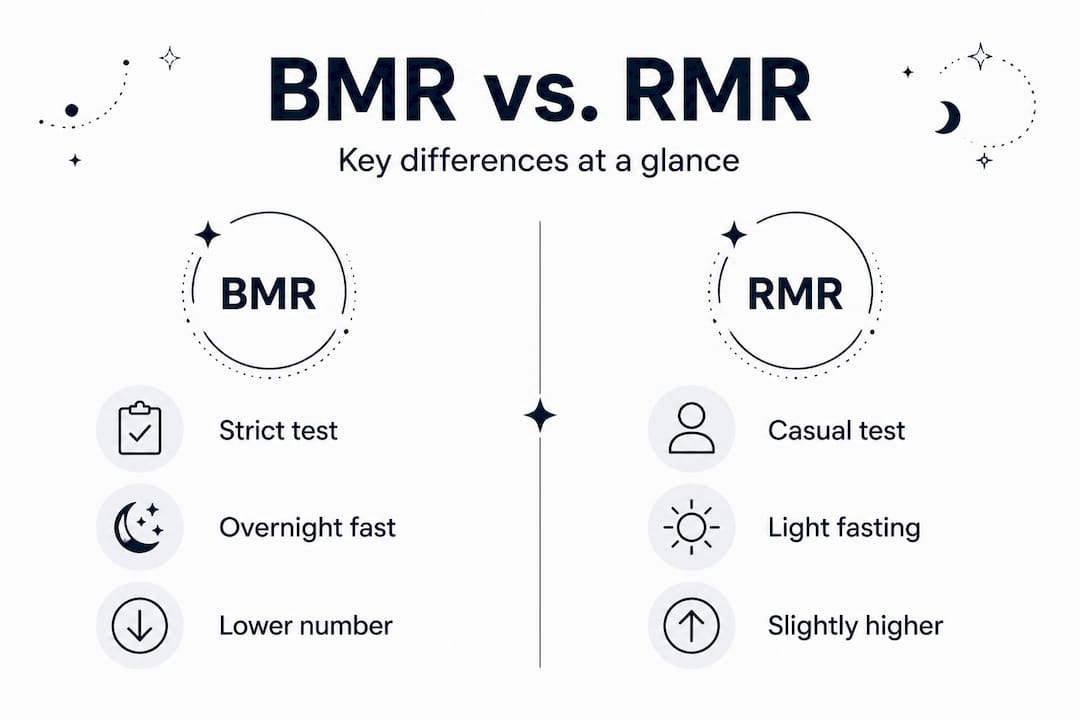
| BMR | RMR | |
|---|---|---|
| Conditions | Overnight fast, thermoneutral room, complete rest | Short rest period, less strict environment |
| Measurement setting | Clinical lab | Lab or clinical office |
| Typical use | Research, clinical assessment | Nutrition planning, weight management |
| Precision | Highest | High, slightly less precise |
| Practical accessibility | Low | Moderate to high |
RMR is the metric most commonly used in real-world settings because it’s more practical to measure and still delivers actionable data. Here’s why RMR tends to be more useful for everyday planning:
- It reflects realistic resting conditions rather than a controlled lab environment
- It’s the basis for most online calorie calculators and nutrition apps
- The small gap between BMR and RMR rarely changes dietary recommendations
- It’s easier to re-test periodically as your body changes
- It aligns with how most registered dietitians calculate client calorie targets
If you’re using a calorie calculator to set your daily intake targets, you’re almost certainly working with an RMR-based estimate. Similarly, if you want to understand how much energy specific activities add on top of your resting needs, a calories burned calculator can give you that additional layer of detail.
The bottom line: don’t stress over whether a tool gives you BMR or RMR. For meal planning, weight loss, or muscle gain, either number serves the same practical purpose.
How to use BMR in your fitness and nutrition planning
Once you have your number, here’s how to make practical use of it in your everyday routine.
Your BMR is the starting point, not the finish line. The real goal is calculating your TDEE (Total Daily Energy Expenditure), which is the total number of calories your body needs each day based on your activity level. Most nutrition planning relies on BMR/RMR estimates, not true laboratory measurement, because these estimates are accurate enough to guide meaningful dietary decisions.
Here’s how to move from BMR to a full nutrition plan:
- Estimate your BMR: Use a reliable equation or online tool based on your age, sex, weight, and height.
- Multiply by your activity factor: Use the standard multipliers: 1.2 for sedentary (desk job, little exercise), 1.375 for lightly active (light exercise 1 to 3 days per week), 1.55 for moderately active (exercise 3 to 5 days per week), 1.725 for very active (hard exercise 6 to 7 days per week), and 1.9 for extremely active (physical job plus daily training).
- Adjust for your goal: To lose weight, subtract 300 to 500 calories from your TDEE. To gain muscle, add 200 to 300 calories. To maintain your current weight, eat at your TDEE.
- Track your intake consistently: Use a food diary or app to compare your actual intake against your target. Even rough tracking is better than none.
- Reassess regularly: Your BMR changes as your weight, age, and muscle mass shift over time.
To see how this plays out in practice, consider two different people:
Example 1: A 30-year-old woman weighing 150 pounds and standing 5 feet 5 inches tall has a BMR of approximately 1,490 calories per day. If she exercises three to four times per week, her TDEE is roughly 2,310 calories. To lose one pound per week, she would target around 1,810 calories daily.
Example 2: A 50-year-old man weighing 200 pounds and standing 5 feet 11 inches tall has a BMR of approximately 1,850 calories per day. With moderate activity, his TDEE is around 2,870 calories. To lose weight gradually, he would aim for approximately 2,370 calories daily.
These examples show why a single generic “eat 2,000 calories” recommendation doesn’t serve everyone equally. Your number is personal.
Use the TDEE calculator to run your own figures and get a personalized daily target in seconds.
Pro Tip: Recalculate your BMR after every 10 to 15 pounds of weight change. As your body composition shifts, your resting calorie needs shift too. Failing to update your numbers can stall progress or lead to unintentional overeating.
Why the obsession with BMR might be overrated
You’ve learned how to calculate and use BMR, but it’s important to keep the bigger picture in mind.
Here’s the honest truth: BMR estimates, even the best ones, carry an error margin of roughly 10 percent. For a person with a BMR of 1,600 calories, that means the actual figure could be anywhere from 1,440 to 1,760 calories. Treating your calculated BMR as a precise, immutable number is a mistake that can lead to frustration when results don’t match expectations.
“Most nutrition planning relies on estimates or RMR, not true BMR,” and that’s not a flaw in the system. It’s a feature. Practical nutrition planning was never designed to be a laboratory exercise. It was designed to help real people make better food choices consistently over time.
The variables that actually drive long-term results are consistency, sleep quality, stress management, and overall dietary patterns. A person who eats roughly the right amount of calories every day and sleeps well will outperform someone who obsessively recalculates their BMR every week but struggles to maintain any routine.
BMR is a useful baseline. It gives you a rational starting point instead of guessing. But if you find yourself paralyzed by the precision of the number, or adjusting your intake by 30 calories because of a minor formula difference, you’ve gone too far into the weeds.
The smarter approach is to use your BMR as a directional guide. Pair it with practical tools like a body fat calculator to understand your body composition, track your intake within a reasonable range, and focus on building habits that are sustainable for months and years. That’s where real progress comes from.
Ready to put BMR insights into action?
If you’re ready to apply what you’ve learned and tune your own numbers, here’s where to start.
HelpCalculate.com gives you direct access to a full suite of free health and fitness calculators designed to take the guesswork out of your nutrition and fitness planning. Whether you need to estimate your BMR, calculate your daily calorie target, or figure out your TDEE, every tool is built for speed and accuracy.

Start with the TDEE calculator to get your personalized daily energy target, then explore the full health and fitness hub to find calorie counters, body fat estimators, and more. All calculators are free, require no sign-up, and deliver results instantly. Your numbers are the foundation of your plan. Get them right from the start.
Frequently asked questions
How do I calculate my basal metabolic rate at home?
Most people estimate BMR using online calculators that require age, sex, weight, and height. These estimates are reliable for nutrition planning and are accurate enough for setting daily calorie targets without needing a clinical lab.
Does BMR change if I gain or lose weight?
Yes, BMR shifts with changes in body weight, muscle mass, and age, so it’s worth recalculating after major changes. Predictive equations account for these physical traits, meaning updated inputs will produce a more accurate result.
Can I increase my basal metabolic rate?
Building lean muscle mass through resistance training is the most effective way to raise your resting calorie burn over time. However, BMR is strongly influenced by genetics and age, so the increases from lifestyle changes are real but modest.
Do calorie calculators use BMR or RMR?
Most online calorie calculators use RMR because it reflects more realistic resting conditions and is easier to estimate accurately. RMR is used instead of BMR for practical calorie planning, and the difference between the two is small enough that it rarely affects dietary recommendations.
Recommended
- TDEE calculator - maintenance, deficit & macros | HelpCalculate
- Calories burned calculator - walking, running, steps & TDEE (free) | Help Calculate
- Body fat calculator - estimate body composition % | Help Calculate
- BMI calculator - chart, categories & healthy range (2026) | Help Calculate
- What Is Basal Metabolic Rate? (And Why It Matters for Weight Loss) - Fueled Framework