

Online calculators solve this problem directly. They apply tested formulas instantly, return clear results in seconds, and do not require a math background to use. This guide covers how online calculators simplify personal finance, health tracking, and academic problem-solving, and why making them part of your routine is one of the most practical decisions you can make.
Try the loan payment calculator
Estimate monthly payment, total interest, and payoff from amount, rate, and term.
Open calculatorKey takeaways (at a glance)
| Point | Details |
|---|---|
| Saves time and effort | Online calculators deliver instant answers for complex tasks that would take much longer by hand. |
| Boosts calculation accuracy | These tools use proven formulas to minimize human error in finance, health, and education. |
| Empowers smarter choices | Trusted calculators help you make informed decisions, whether you are budgeting, adjusting diet, or learning new skills. |
| Accessible for everyone | Anyone with internet access can use online calculators without advanced math skills. |
The case for online calculators: Why accuracy and speed matter
Manual calculations are slow and error-prone. Even careful people make arithmetic mistakes, especially when working with compound interest formulas, unit conversions, or multi-step health metrics. A single transposed digit in a mortgage calculation can make a loan look hundreds of dollars cheaper per month than it actually is. That kind of error has real consequences for your financial planning.
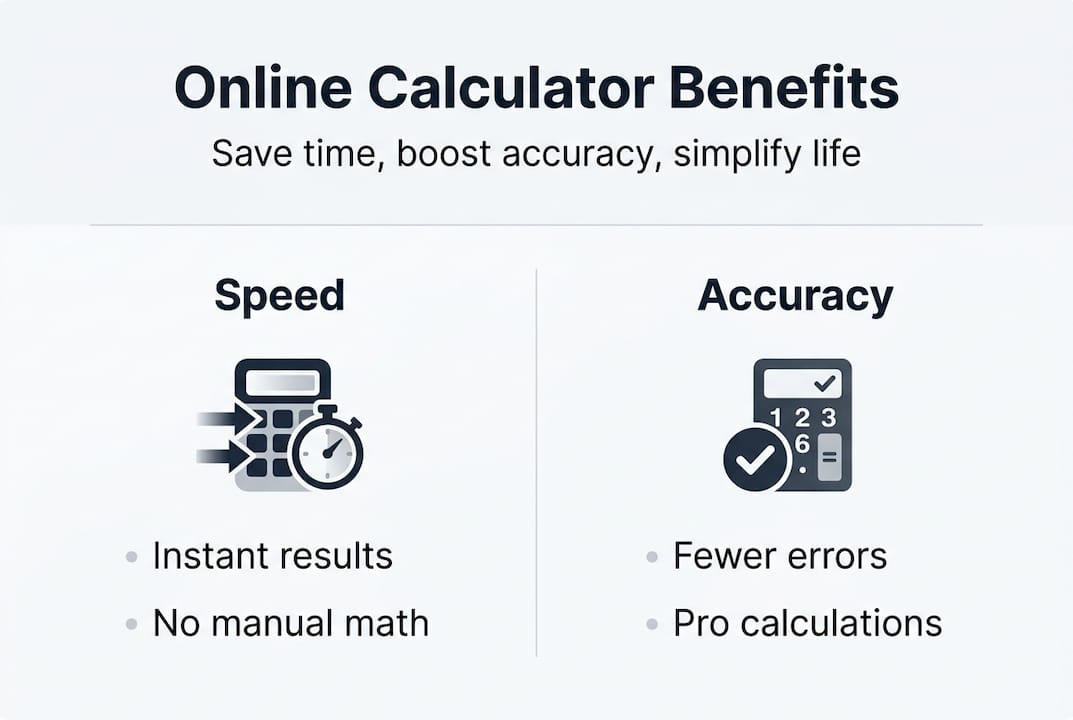
Online calculators eliminate most of that risk. Here is what they consistently deliver that manual methods cannot:
- •Instant results: Enter your values and get an answer in under a second, no pencil or scratch paper needed.
- •Tested formulas: Reputable calculator platforms build their tools around established mathematical and scientific formulas, reducing the chance of a formula error on your end.
- •Repeatable accuracy: Run the same calculation ten times and get the same result every time. Manual recalculations rarely match perfectly.
- •No specialized knowledge required: You do not need to know the amortization formula to calculate a loan payment. The calculator handles that for you.
- •Easy comparisons: Change one variable, such as the interest rate or loan term, and instantly see how the result shifts.
The accuracy of online calculators is well documented in real-world use. SSA calculators are accurate within about 5% in many user reports, and fitness calculators often use field-test protocols that correlate closely with laboratory measurements. That level of precision is difficult to achieve through mental math or back-of-envelope estimates alone.
Speed matters just as much as accuracy. When you are comparing three different loan offers or adjusting your calorie target after a change in your workout schedule, you need answers fast. Waiting to open a spreadsheet or work through a formula manually creates friction that many people avoid by guessing. Guessing is where errors and poor decisions take root.
Using math calculator tools for everyday problems, from simple percentages to more involved expressions, removes that friction. You get a consistent number quickly, and you can move forward with confidence.
Pro tip: Even when using an online calculator, double-check your inputs before accepting the result. A calculator is only as accurate as the numbers you enter.
Personal finance made simple: Budgeting, loans, and beyond
Personal finance is one of the most common areas where people rely on guesswork when they should be using precise tools. Estimating your monthly mortgage payment from memory, or eyeballing how long it will take to save for a vacation, leads to budgets that fall apart within weeks. Online finance calculators replace those guesses with reliable numbers.
Consider a straightforward example. You want to borrow $25,000 for a car at 6.5% annual interest over 60 months. Calculating the monthly payment manually requires the full amortization formula, which involves exponents and multiple steps. Most people either skip it or get it wrong. A loan payment calculator returns the correct payment instantly: about $488.28 per month.
Here is a direct comparison of what manual versus calculator-based estimates typically look like for a $300,000 mortgage at 7% over 30 years:
| Method | Estimated monthly payment | Time to calculate | Accuracy |
|---|---|---|---|
| Mental math estimate | $1,800 to $2,100 | 2 to 5 minutes | Low |
| Spreadsheet formula | $1,995.91 | 5 to 10 minutes | High (if formula is correct) |
| Online mortgage calculator | $1,995.91 | Under 10 seconds | High |
The online mortgage payment calculator matches the spreadsheet result in a fraction of the time, with less risk of a formula entry error.
To get the most out of online finance calculators, follow these steps:
- •Gather your exact figures first. Know your loan amount, interest rate, and term before opening the calculator. Approximate inputs produce approximate outputs.
- •Run multiple scenarios. Try different loan terms or interest rates to see how each variable affects your payment. This is where calculators outperform manual methods.
- •Compare total interest paid, not just monthly payments. A longer loan term lowers monthly payments but increases total interest. Always check both figures.
- •Use a savings calculator alongside loan tools. Knowing how long it takes to save a down payment changes how you approach borrowing.
- •Revisit your calculations when rates change. Interest rates move. Recalculate whenever you receive a new loan offer.
Pro tip: When using a savings goal calculator, input your target amount and desired timeline first, then work backward to find the monthly contribution you need. That approach makes savings goals feel concrete rather than abstract.
Long-term financial planning, including retirement projections, debt payoff timelines, and compound interest growth, becomes far more manageable when you have accurate tools at your fingertips. The goal is not only to know a number but to understand what that number means for your financial future.

Tracking health and fitness goals with precision
Health and fitness tracking has the same problem as personal finance: people often rely on rough estimates when precision is both available and important. Eating 300 calories more than you think each day adds up to roughly two pounds of unintended weight gain per month. Small errors compound quickly.
Online health calculators use established scientific formulas to reduce that guesswork. Health and fitness calculators estimate metrics like calorie needs and weight trends using validated methods such as the Mifflin-St Jeor equation and Total Daily Energy Expenditure (TDEE) models. These are the same frameworks many registered dietitians and exercise physiologists reference.
Common metrics you can track accurately with online health calculators include:
- •BMI (Body Mass Index): A quick screening tool based on height and weight, useful for identifying general weight categories.
- •Daily calorie needs (TDEE): Accounts for your basal metabolic rate plus your activity level to estimate how many calories you need to maintain, lose, or gain weight.
- •Macronutrient targets: Breaks your calorie goal into protein, carbohydrate, and fat targets based on your goals.
- •VO2 max estimates: Uses field tests like the 1.5-mile run or step test to estimate aerobic capacity without lab equipment.
- •Weight loss or gain timelines: Projects how long it may take to reach a target weight based on a daily calorie surplus or deficit.
Here is how manual calorie counting compares to using an online calculator:
Manual counting vs an online TDEE calculator
The table below compares typical approaches to calorie estimation when you want a repeatable baseline.
| Method | Accuracy | Time required | Adjusts for activity level |
|---|---|---|---|
| Eyeballing portions | Very low | Minimal | No |
| Counting from food labels manually | Moderate | 15 to 30 minutes daily | No |
| Online TDEE calculator | High | Under 2 minutes to set up | Yes |
For athletes, the difference between accurate and inaccurate calorie tracking can affect performance. Underfueling by even 10% on heavy training days can contribute to fatigue, slower recovery, and reduced strength gains. For individuals managing weight loss, TDEE-based calorie tracking provides a reliable starting point that you can adjust based on real-world results over two to four weeks.
Dieters benefit from knowing a personalized calorie target rather than following a generic 1,200 or 1,500 calorie plan that may not match their body size or activity level. A 200-pound person who exercises five days a week has a very different calorie need than a 130-pound sedentary individual. Online calculators account for those differences in seconds.
Supporting learning and problem-solving in education
Students at every level face complex problems that require multiple calculation steps, where one error early in the process invalidates everything that follows. Online calculators reduce that risk and help students focus on understanding concepts rather than getting stuck in arithmetic.
Here is a practical approach for using calculators to support learning:
- •Attempt the problem manually first. Working through the steps yourself builds understanding. Use the calculator to verify your answer, not replace your thinking.
- •Use the calculator to explore "what if" scenarios. Change one variable and observe how the answer changes. This builds intuition for mathematical relationships.
- •Break complex problems into steps. Use the calculator for individual steps within a larger problem, which makes it easier to spot where an error occurred.
- •Check unit conversions carefully. Many student errors come from mixing units. Online unit converters confirm that your values are in the right format before you calculate.
- •Review the formula the calculator uses. Many reputable tools show the formula behind the result, which reinforces learning rather than replacing it.
Online calculators support students by reducing arithmetic errors in multi-step algebra, geometry, and statistics problems; providing faster feedback so students can correct their approach; visualizing relationships between variables; speeding up test preparation; and building confidence in subjects where numbers feel intimidating.
Online math support tools cover everything from basic arithmetic to algebra and geometry, making them useful across grade levels. For students who want practice that feels less like homework, math practice games combine problem-solving with interactive formats.
Pro tip: Use online calculators to check your work after solving a problem manually. If your answer does not match, go back and find the step where you diverged. That process builds stronger problem-solving skills than only looking up the final answer.
The often-overlooked superpower of online calculators
Most people think of calculators as tools that only produce answers. That framing undersells what they actually do. The real value is not the number itself. It is the confidence and independence that comes from having that number quickly and accurately.
When you know your exact loan payment before walking into a dealership, you negotiate from a position of knowledge. When you know your calorie target, you can make food choices based on data rather than habit. When a student verifies a geometry answer in seconds, they learn faster and often feel less anxious about math.
Calculators are especially valuable for people who are not already comfortable with numbers. Someone who has felt intimidated by financial planning can use a mortgage calculator to understand options without needing a finance degree. That shift in access and confidence matters.
Online calculators lower the barrier to making informed decisions. They turn complex formulas into practical tools that anyone can use, regardless of math background. That is a meaningful improvement in how people navigate important decisions in daily life.
Try the best online calculators for all your needs
HelpCalculate.com offers dozens of free calculators across finance, health, math, unit conversion, and more, built for accuracy and ease of use. Whether you are planning a budget, tracking a fitness goal, or working through a homework problem, there is a tool ready for you.
Start with finance calculators to plan your next loan or savings goal, or explore BMI and calorie calculators to set a clearer health target. Need to convert units for a recipe, a school project, or travel? The unit conversion tools have you covered. Every calculator is free, no account required, and works in your browser. Pick the one that matches your current goal and see how quickly you get a clear, reliable answer.
Conclusion
Online calculators turn slow, error-prone guesswork into fast, repeatable answers grounded in established formulas.
They help in finance, health, and education when you pair good tools with careful inputs and a habit of comparing scenarios.
Pick one calculator that matches your next real decision, run two or three cases, and let the numbers support your next step with less stress.
FAQ
Are online calculators accurate?
Most online calculators use established formulas and are accurate for common tasks, often matching professional estimates within about 5% for applications such as Social Security projections and many fitness metrics.
Which online calculators are most useful for budgeting?
Savings, loan, and mortgage calculators are among the most useful for budgeting, because they help you plan monthly payments, compare loan offers, and set realistic savings timelines.
Can online health calculators really guide my diet or workout?
Yes. Many online health calculators use validated scientific methods like TDEE and Mifflin-St Jeor to estimate calorie needs and track progress with a level of accuracy suitable for personal planning (not a substitute for medical advice).
Are there free online calculators for students?
Yes. Many platforms, including Help Calculate, offer free calculators for math, science, unit conversions, and more, giving students a reliable way to check their work and build problem-solving skills.