
Volume Calculator
Calculate the volume of 3D shapes, convert units, and see practical applications for pools, tanks, rooms, and concrete.
How to Calculate Volume
This tool turns abstract volume formulas into practical answers: how many gallons a pool or tank holds, how many cubic yards of concrete to order, or how a box compares to a shipping container. Pick a shape, enter measurements in the units you have, and get consistent conversions across metric and US customary units. Use it for homework, home projects, aquatics, and construction planning. Use the Volume Calculator to get a clear result you can act on right away. This calculator is designed to be practical, fast, and easy to use on any device. If you are comparing options, run a few scenarios to see how small changes affect the outcome.
From abstract formulas to practical answers: pools, aquariums, rooms, and concrete orders.
Volume
1,000 cubic feet (ft³)
a = 10 ft × 0.3048 = 3.048 m V = a³ = (3.048 m)³ Output: 28.316847 m³ ÷ 0.028316846592 = 1,000 ft³
• 1,000 cubic feet (ft³)
• 28.3168 cubic meters (m³)
• 28,316.8466 liters (L)
• 7,480.52 gallons (US gal)
• 6,228.8355 gallons (UK gal)
• 1,728,000 cubic inches (in³)
• 37.037 cubic yards (yd³)
Volume = a³
Side length converted to meters, then cubed (SI).
If this volume were drinking water: about 7,480.52 US gal - roughly 14961 person-days using ~0.5 gal per person per day (a common ballpark for actual consumption, not total household use).
Water weight: about 62,387.5368 lb (fresh water).
A standard 20 ft shipping container is roughly 1,165 ft³ internal - your cube is about 85.8% of that volume.
Volume unit conversions
Metric: 1 m³ = 1,000 L · 1 L = 1,000 mL · 1 L = 0.001 m³
Imperial: 1 ft³ = 1,728 in³ · 1 yd³ = 27 ft³ = 46,656 in³
US liquid: 1 US gal = 3.785 L · 1 US gal = 231 in³ · 1 ft³ ≈ 7.48 US gal
UK liquid: 1 UK gal = 4.546 L · 1 UK gal ≈ 1.201 US gal
Cross: 1 m³ ≈ 35.31 ft³ · 1 m³ ≈ 1.308 yd³ · 1 L ≈ 0.264 US gal
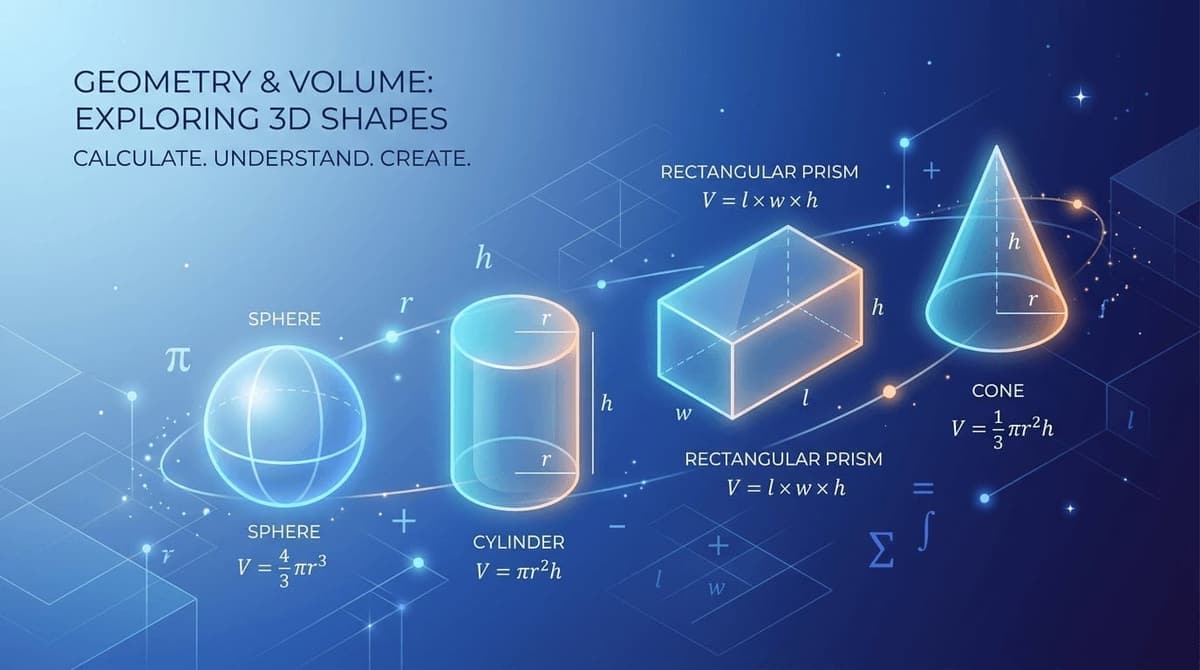
Volume formulas - quick reference
| Shape | Formula | Diagram |
|---|---|---|
| Cube | V = a³ | |
| Rectangular prism | V = l × w × h | |
| Sphere | V = (4/3)πr³ | |
| Cylinder | V = πr²h | |
| Cone | V = (1/3)πr²h | |
| Square pyramid | V = (1/3)a²h | |
| Rectangular pyramid | V = (1/3)lwh | |
| Ellipsoid | V = (4/3)πabc | |
| Prism | V = base area × height | |
| Capsule | V = πr²((4/3)r + a) | |
| Torus | V = 2π²Rr² |
Related: use the Volume Converter for liquid-unit conversions only. This page focuses on 3D geometry and ordering quantities.
Tips & Strategies
Measure twice. small errors in length are magnified when cubed.
For tanks and pools. use inside dimensions if you want liquid volume.
Quick tip. US and UK gallons differ; check which one your chemical label uses.
Quick tip. Round concrete orders up and confirm minimum delivery with your supplier.
Cross-check when the decision matters. Run a second scenario with rounded inputs or a different path to the same quantity so you do not rely on a single fragile chain of arithmetic.
Things Worth Knowing
- •One cubic meter of water weighs exactly 1 metric ton (1,000 kg).
- •The Empire State Building has a volume of about 1,048,000 cubic meters.
- •An Olympic swimming pool holds about 660,000 gallons (2,500 cubic meters).
- •The average human body has a volume of about 66 liters (0.066 m³).
- •One gallon of gasoline produces about 20 pounds of CO₂ when burned (the gas takes up much more volume than the liquid).
- •The volume of Earth is about 1.083 × 10¹² cubic kilometers.
- •A teaspoon is 5 mL; a tablespoon is 15 mL (3 teaspoons).
- •The Great Pyramid of Giza contains about 2.6 million cubic meters of stone.
- •The human stomach can hold about 1.5 liters (0.4 gallons) comfortably.
- •One cubic foot of gold weighs about 1,206 pounds.