

TL;DR:
- The midpoint formula averages the x- and y-coordinates of two points to find their exact center.
- It extends to three dimensions by including the z-coordinate, aiding applications in physics and engineering.
- This concept also underpins the midpoint rule for more accurate numerical integration in calculus.
The midpoint formula is defined as the method of finding the exact center point between two coordinate points by averaging their x-values and y-values separately. Expressed as M = ((x1 + x2)/2, (y1 + y2)/2), it is one of the most applied tools in coordinate geometry. Resources like Mathnasium and Khan Academy describe the formula as an averaging process that builds genuine geometric intuition rather than rote symbol memorization. Beyond the classroom, the midpoint formula appears in 3D modeling, physics, and numerical calculus, making it a foundational concept worth understanding deeply.
What is the midpoint formula and how does it work?
The midpoint formula calculates the point that sits exactly halfway between two endpoints on a coordinate plane. It does this by averaging the x-coordinates of both points and averaging the y-coordinates of both points independently. The result is a single ordered pair (x, y) that marks the center of the line segment connecting the two original points.
The formula is written as:
M = ((x1 + x2) / 2, (y1 + y2) / 2)
Here, (x1, y1) and (x2, y2) are the two known endpoints. The midpoint M is not an approximation. It is the exact center point that divides the segment into two equal halves, both horizontally and vertically. This geometric precision is what makes the formula useful in symmetry problems, construction tasks, and optimization problems across math, physics, and engineering.
How do you calculate the midpoint between two points?
Calculating midpoints follows a consistent three-step process. Work through each step carefully, and you will get the right answer every time.
- Identify your two coordinate points. Write them clearly as (x1, y1) and (x2, y2). For this example, use the points A(2, 4) and B(8, 10).
- Add the x-coordinates and divide by 2. (2 + 8) / 2 = 10 / 2 = 5. This gives you the x-coordinate of the midpoint.
- Add the y-coordinates and divide by 2. (4 + 10) / 2 = 14 / 2 = 7. This gives you the y-coordinate of the midpoint.
- Write the result as an ordered pair. The midpoint M = (5, 7).
The midpoint (5, 7) sits exactly halfway between A(2, 4) and B(8, 10) along both axes. You can confirm this by checking that the horizontal distance from A to M equals the horizontal distance from M to B: 5 - 2 = 3 and 8 - 5 = 3. The same check applies vertically: 7 - 4 = 3 and 10 - 7 = 3. Verifying equal half-lengths along each axis gives you practical confirmation that the point divides the segment equally.
Pro Tip: After calculating a midpoint, always verify by measuring the distance from each original endpoint to your midpoint result. If both distances match, your calculation is correct. This habit catches arithmetic errors before they carry into larger problems.
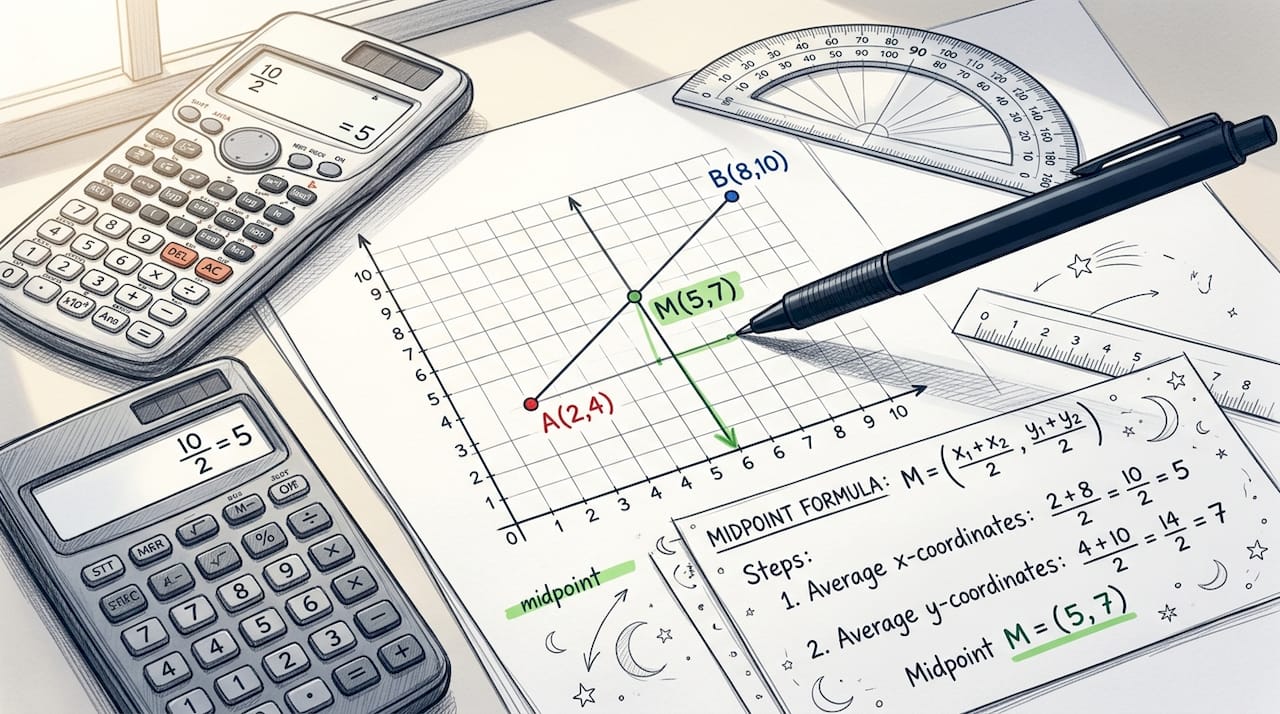
The averaging process is the key insight here. You are not applying a complex geometric rule. You are simply finding the mean of two x-values and the mean of two y-values. Students who recognize this connection to average calculations tend to apply the formula more confidently across different problem types.
What is the relationship between the midpoint formula and the distance formula?
The midpoint formula and the distance formula are the two core coordinate geometry tools, and they answer completely different questions. The midpoint formula finds where the center is. The distance formula finds how far apart two points are. Both use the same coordinate inputs, but they produce different types of answers.
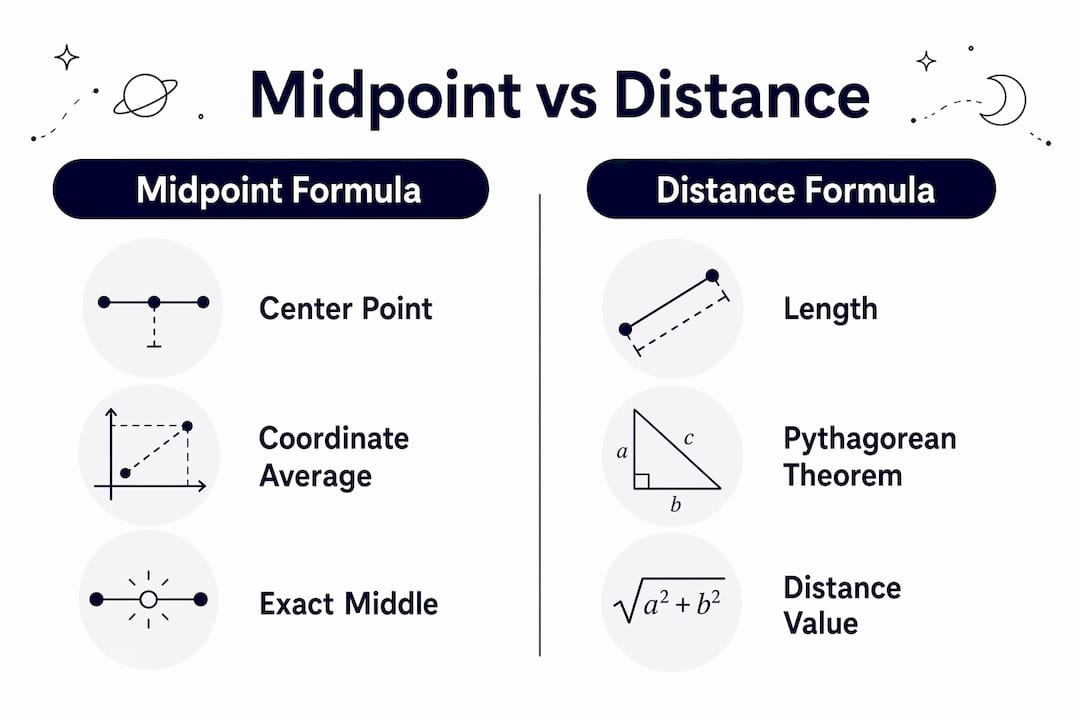
The distance formula is: d = √((x2 - x1)² + (y2 - y1)²)
This is derived from the Pythagorean theorem and measures the straight-line length between two points. The midpoint and distance formulas serve complementary roles: one locates a position, the other measures a length. Neither replaces the other.
| Feature | Midpoint formula | Distance formula |
|---|---|---|
| What it finds | Center point between two coordinates | Length of the segment between two points |
| Output type | Ordered pair (x, y) | A single number (length) |
| Core operation | Addition and division (averaging) | Subtraction, squaring, and square root |
| Primary use | Geometry, symmetry, segment bisection | Measurement, Pythagorean applications |
| Used together when | Locating and measuring a segment simultaneously | Finding both center and total length |
In practice, you often use both formulas together. For example, if you need to bisect a line segment and confirm each half is equal in length, you first apply the midpoint formula to find the center, then apply the distance formula twice to verify both halves measure the same. This combination appears frequently in geometry proofs, coordinate-based construction problems, and physics problems involving displacement.
How is the midpoint formula extended to three-dimensional geometry?
The 2D midpoint formula extends directly into three-dimensional space by adding a third coordinate axis. The 3D midpoint formula averages each coordinate axis independently:
M = ((x1 + x2)/2, (y1 + y2)/2, (z1 + z2)/2)
The logic is identical to the 2D version. You average x-values, average y-values, and now also average z-values. The result is an ordered triple (x, y, z) that marks the center of a line segment in three-dimensional space.
Here is a worked example using points P(1, 3, 5) and Q(7, 9, 11):
- Average the x-coordinates: (1 + 7) / 2 = 4
- Average the y-coordinates: (3 + 9) / 2 = 6
- Average the z-coordinates: (5 + 11) / 2 = 8
- Write the midpoint: M = (4, 6, 8)
The 3D midpoint formula is used in computer graphics, physics simulations, and engineering modeling where objects exist in three-dimensional space. Finding the center of a structural beam, the midpoint of a 3D vector, or the center of mass between two objects all rely on this same averaging principle.
Pro Tip: Visualizing 3D midpoints is harder than 2D, so rely on the arithmetic rather than trying to sketch it. Verify your result by confirming that the distance from each endpoint to your midpoint is equal, using the 3D distance formula: d = √((x2-x1)² + (y2-y1)² + (z2-z1)²).
The extension to three dimensions shows that the midpoint concept scales cleanly. You are not learning a new formula. You are applying the same averaging logic to one additional coordinate.
How does the midpoint concept apply to numerical integration in calculus?
The midpoint formula reappears in calculus as the foundation of the midpoint rule, a method for approximating definite integrals. This connection shows that calculating midpoints is not just a geometry skill. It is a foundational idea in numerical mathematics.
The midpoint rule for numerical integration approximates the area under a curve using this formula:
∫_a^b f(x) dx ≈ ((b - a) / n) × Σ f(x_i)
Here, n is the number of subintervals and x_i is the midpoint of each subinterval. Instead of evaluating the function at the left or right edge of each interval, you evaluate it at the center point.
Why does this matter? Consider the function f(x) = x² on the interval [0, 2] divided into 4 equal subintervals. The subintervals are [0, 0.5], [0.5, 1], [1, 1.5], and [1.5, 2]. The midpoints are 0.25, 0.75, 1.25, and 1.75. You evaluate f(x) at each midpoint, sum the results, and multiply by the subinterval width.
The advantages of the midpoint rule over endpoint methods are clear:
- Reduced error: Midpoint approximation often yields better estimates than left or right endpoint methods because the center value balances overestimates and underestimates.
- Symmetry: Using the midpoint captures the function’s behavior more representatively within each interval.
- Scalability: Increasing n (more subintervals) improves accuracy, and the midpoint rule converges faster than basic endpoint methods.
| Method | Where function is evaluated | Accuracy relative to midpoint rule |
|---|---|---|
| Left endpoint rule | Left edge of each subinterval | Generally less accurate |
| Right endpoint rule | Right edge of each subinterval | Generally less accurate |
| Midpoint rule | Center of each subinterval | More accurate for smooth functions |
The midpoint formula’s reappearance in calculus as a numerical integration tool highlights its foundational role in mathematics. Students who master the geometric midpoint concept in algebra and geometry carry a real advantage into calculus courses.
Key takeaways
The midpoint formula is a direct averaging operation that finds the center of a line segment, extends cleanly to 3D space, and underpins the midpoint rule in calculus.
| Point | Details |
|---|---|
| Core formula | M = ((x1 + x2)/2, (y1 + y2)/2) averages coordinates to find the exact center point. |
| Verification method | Confirm your midpoint by checking that distances from each endpoint to the midpoint are equal. |
| 3D extension | Add z-coordinate averaging to apply the same formula in three-dimensional space. |
| Calculus connection | The midpoint rule uses center-of-interval values to approximate definite integrals more accurately than endpoint methods. |
| Complementary tool | Use the distance formula alongside the midpoint formula when both position and length are needed. |
Why the midpoint formula clicked for me later than it should have
I spent more time than I care to admit treating the midpoint formula as a symbol to memorize rather than an idea to understand. The formula looks like a rule. It behaves like arithmetic. That gap caused me to second-guess myself on tests when the coordinates were negative or fractional.
The shift happened when I stopped reading M = ((x1 + x2)/2, (y1 + y2)/2) as a formula and started reading it as “find the average x, find the average y.” That reframe, which Mathnasium describes as understanding midpoint as averaging, changed everything. Averages are intuitive. You already know how to find the number halfway between 3 and 9. The formula is just that process applied to coordinates.
The other mistake I see students make is skipping verification. Plugging numbers in and writing down an answer is not the same as confirming the answer is right. Checking that both half-segments are equal in length takes 30 seconds and catches most arithmetic errors. Build that habit early, and it will serve you in 3D geometry and calculus too.
The midpoint formula’s role in applied fields, from engineering to physics, is not incidental. It reflects the fact that “find the center” is a genuinely useful question in the real world. Students who understand why the formula works, not just how to apply it, are better prepared for every advanced topic that builds on it.
— Michael
Practice midpoint calculations with Helpcalculate
Helpcalculate offers a free suite of math calculators covering averages, fractions, GPA, and percentages, all of which support the core arithmetic behind the midpoint formula. Since calculating midpoints is fundamentally an averaging operation, the mean and median calculator on Helpcalculate is a practical tool for checking your coordinate averages quickly. Use these tools to verify manual calculations as you practice, not to replace the manual work. Working through problems by hand builds the pattern recognition you need for exams. Helpcalculate also publishes math articles and guides that support deeper understanding of formulas like this one.
FAQ
What is the midpoint formula in simple terms?
The midpoint formula finds the point exactly halfway between two coordinate points by averaging their x-values and y-values. The result is a single ordered pair: M = ((x1 + x2)/2, (y1 + y2)/2).
How do you verify a midpoint calculation is correct?
Measure the distance from each original endpoint to the midpoint you calculated. If both distances are equal, the midpoint is correct and the segment is divided into two equal halves.
How does the midpoint formula differ from the distance formula?
The midpoint formula finds the center location between two points, while the distance formula measures the length of the segment between them. Both use the same coordinate inputs but answer different geometric questions.
Can the midpoint formula be used in three dimensions?
Yes. The 3D midpoint formula adds a third averaging step for the z-axis: M = ((x1 + x2)/2, (y1 + y2)/2, (z1 + z2)/2). It works identically to the 2D version with one additional coordinate.
What is the midpoint rule in calculus?
The midpoint rule approximates a definite integral by evaluating a function at the center of each subinterval rather than at the endpoints. This method typically produces more accurate estimates than left or right endpoint approximations.