
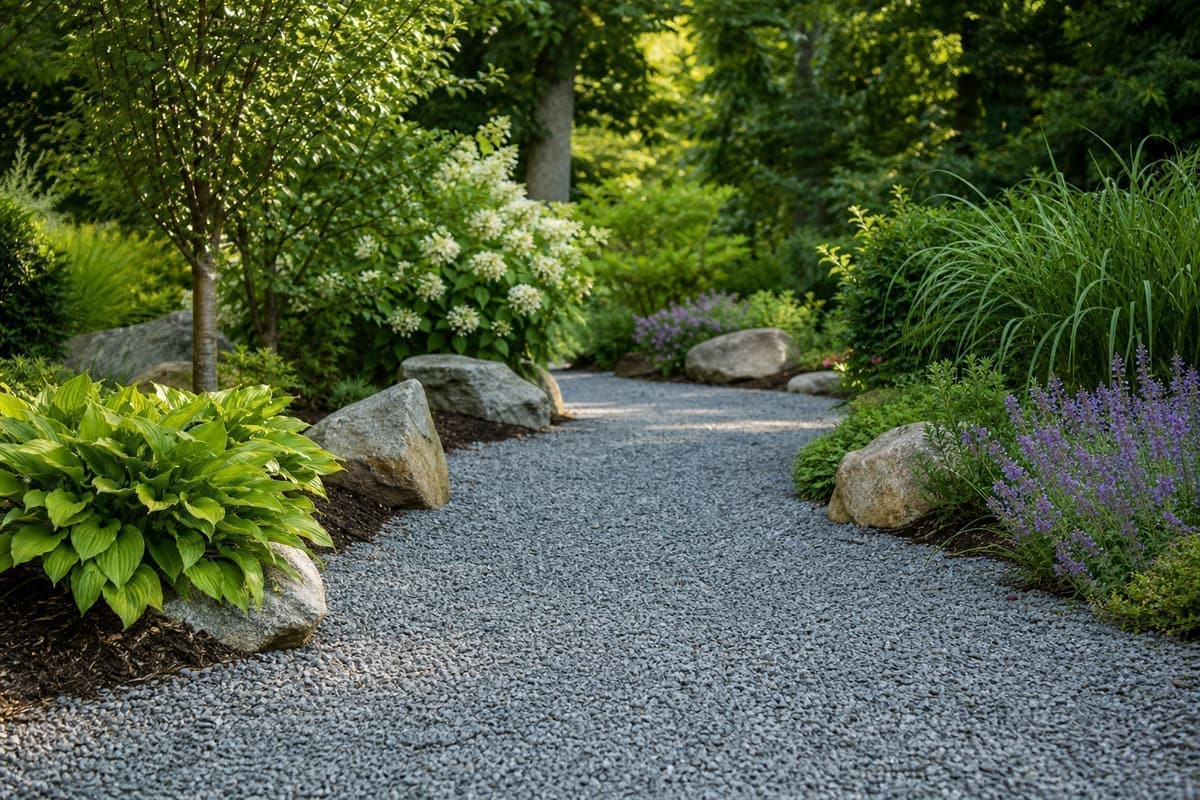
Gravel Calculator
How much gravel do you need? Cubic yards, tons, and bags.
Why use a gravel calculator?
Gravel is one of the most versatile landscaping materials — used for paths, driveways, drainage, and decorative beds — but it is heavy, and ordering the wrong amount is a costly mistake. This calculator computes volume in cubic yards and cubic feet, estimates weight in tons based on your gravel type, and converts to bags for small projects. Enter your area dimensions and target depth to get an accurate figure you can take straight to a supplier.
How to Calculate Manually
- 1Choose imperial (feet and inches) or metric (meters and centimeters).
- 2Enter each area as length × width, circle diameter, tree ring, or total area if you already know square footage.
- 3Add more areas with "Add another area" if you have separate sections.
- 4Set depth per area — 2–3 inches for decorative beds, 3–4 inches for paths, 4–6 inches for driveways.
- 5Select gravel type for an accurate tonnage estimate and optional cost per yard or ton.
2–3 inches for decorative beds · 3–4 inches for paths · 4–6 inches for driveways
Crushed stone / limestone is the most common driveway and path material. Dense and stable at ~1.5 tons/yd³. Locks together when compacted.
Formula Quick Reference
Use the same math for any gravel type. Measure areas on-site before ordering bulk or bagged product.
| Formula | Equation | Variables | Result unit | Calculator |
|---|---|---|---|---|
| Rectangle area | A = ℓ × w | feet | sq ft | Use calculator → |
| Circle area | A = π × (d ÷ 2)² | d = diameter | sq ft | Use calculator → |
| Tree ring area | A = π × (D² − t²) ÷ 4 | D outer, t trunk | sq ft | Use calculator → |
| Volume (imperial) | V = A × d ÷ 12 | d in inches | cu ft | Use calculator → |
| Cubic yards | yd³ = cu ft ÷ 27 | — | yd³ | Use calculator → |
| Weight | tons = yd³ × density | 1.35–1.5 t/yd³ | tons | Use calculator → |
| Volume (metric) | V = A × d ÷ 100 | A in m², d in cm | m³ | Use calculator → |
Watch & Learn
Brush up on solid geometry and unit conversions before you measure areas and place your order.
Perimeter and area: the basics
Foundation for thinking in square units — directly supports measuring any irregular bed or driveway shape.
Unit conversion within the metric system
Helpful when switching between cubic yards, cubic feet, and metric volume.
FAQ
How deep should I lay gravel?
For decorative garden beds, 2 inches is usually enough. Walkways and paths need 3–4 inches for a stable surface. Driveways require 4–6 inches of compacted gravel for stability under vehicle weight — and ideally a base layer of larger crushed stone underneath a finer top layer.
How many tons of gravel are in a cubic yard?
It depends on the gravel type. Crushed stone averages about 1.5 tons per cubic yard; pea gravel is around 1.4 tons; river rock around 1.35 tons; and lightweight lava rock can be as low as 0.8 tons per cubic yard. This calculator adjusts the weight estimate based on the type you select.
Should I order by cubic yards or tons?
Landscaping suppliers typically sell bulk gravel by the cubic yard for pickup (you haul it) and by the ton for delivery (they weigh it on a truck scale). It's worth calling your supplier to confirm how they price — some use volume, others use weight. This calculator gives you both figures so you're covered either way.
Do I need landscape fabric under gravel?
For weed suppression in decorative beds, yes — a geotextile fabric under gravel significantly reduces maintenance over time. For driveways and paths, it also prevents gravel from sinking into soft or clay-heavy soil. The fabric doesn't affect the volume of gravel you need — calculate as normal and lay fabric first.
How much does a cubic yard of gravel weigh?
A standard cubic yard of crushed stone or pea gravel weighs approximately 1.4–1.5 tons (2,800–3,000 lbs). That's important for transport — most standard pickup trucks have a payload rating of about 1 ton safely, so a single cubic yard may require two trips or a delivery truck.
How is gravel different from mulch when calculating coverage?
The volume formula is identical — area × depth. The key difference is that gravel is dense enough that weight becomes important for ordering and transport. Gravel also doesn't compress or decompose over time, so you don't need the same 10% overage buffer you'd typically add for mulch. A 5% buffer is usually enough for uneven ground.
Tips & Strategies
Add only 5% extra for gravel, not the 10% buffer common with mulch. Gravel does not settle the same way.
Check your vehicle's payload rating before hauling. A cubic yard of crushed stone weighs ~1.5 tons. You can find the payload limit on the tire-and-loading sticker inside the driver's door jamb, in your owner's manual, or on the manufacturer's website — subtract passenger and cargo weight already in the truck.
Use decomposed granite or pea gravel for paths — they compact well. Save crushed stone for driveways.
Quick tip. Measure irregular shapes by dividing them into rectangles and adding the areas together.
Quick tip. Use the Square Footage Calculator if you need help measuring irregular beds or paths first.
Things Worth Knowing
- •One cubic yard equals 27 cubic feet — about the volume of a standard front-loading washer stacked twice.
- •A 2 cu ft bag of pea gravel weighs approximately 50–55 lbs — useful for small projects.
- •Gravel depth over 4 inches on a driveway should be compacted in 2–3 inch lifts for best stability.
- •Lava rock is dramatically lighter (~0.8 tons/yd³ vs 1.5 for crushed stone) — factor this in when hauling.
- •Decomposed granite compacts into an almost pavement-like surface when wet.
Related calculators
Square Footage Calculator
Measure room and bed areas in sq ft, sq m, and sq yd before you calculate.
View calculator →Mulch Calculator
Same area-times-depth formula for mulch bags and cubic yards of organic material.
View calculator →Wallpaper Rolls Calculator
Estimate roll counts for wall projects using area and roll coverage.
View calculator →Length Converter
Convert between feet, meters, yards, and inches for accurate measurements.
View calculator →