

TL;DR:
- Small, consistent actions in training, nutrition, sleep, and stress management build lasting fitness gains.
- The principle of compound interest applies to fitness, emphasizing patience and long-term effort.
- Flexibility and proper recovery are essential to sustain progress and avoid plateaus or setbacks.
Most people believe that dramatic fitness results require dramatic effort. Long hours in the gym, extreme diets, punishing training blocks. That belief is not only wrong, it’s the reason so many people quit. The real driver of lasting physical transformation is something far less dramatic: small, consistent actions that build on each other over time. This is the same principle that makes money grow in a savings account. Compounding in fitness works through consistent behaviors in training, nutrition, sleep, and stress management that stack on prior gains, creating progress that accelerates the longer you stay the course.
Key Takeaways
| Point | Details |
|---|---|
| Consistency compounds | Small, regular actions in training, nutrition, and recovery produce powerful long-term results. |
| Results take time | Visible fitness progress usually appears gradually, not instantly, as habits accumulate. |
| Not a perfect analogy | Biology means progress isn’t exactly like financial compounding - plateaus and limits are normal. |
| Adjust and adapt | Sustainable gains come from monitoring your routine and being willing to adapt as needed. |
| Tools can help | Fitness calculators and trackers make it easier to stay accountable and visualize your progress. |
What does compound interest mean in fitness?
In finance, compound interest means your returns earn returns. You deposit money, it earns interest, and then that larger balance earns even more interest. The growth is not linear. It curves upward the longer you leave it alone.
In fitness, the mechanism is different but the outcome is strikingly similar. Each workout, each nutritious meal, each quality night of sleep does not just contribute to today’s results. It builds a foundation that makes tomorrow’s effort more effective. Muscle tissue repairs and grows stronger. Your cardiovascular system becomes more efficient. Your body learns movement patterns faster. Each small deposit into your “fitness account” raises the baseline for the next one.
“In fitness, compound interest usually means a compounding effect of small, consistent behaviors - training, nutrition, sleep, stress management - that build on prior gains over time.”
The four main behaviors that compound in fitness are:
- Training: Each session builds on neuromuscular adaptations, strength, and endurance from previous workouts
- Nutrition: Consistent quality eating supports muscle protein synthesis, energy levels, and recovery on an ongoing basis
- Sleep: Quality sleep every night drives growth hormone release, tissue repair, and cognitive function for better workout performance
- Stress management: Chronic stress blunts hormonal responses needed for adaptation, so managing it consistently protects your gains
Understanding these four pillars as interconnected and cumulative changes how you prioritize them. You can also explore how this mirrors financial growth by using a compound interest calculator to visualize how starting small and staying consistent produces surprisingly large outcomes over time.
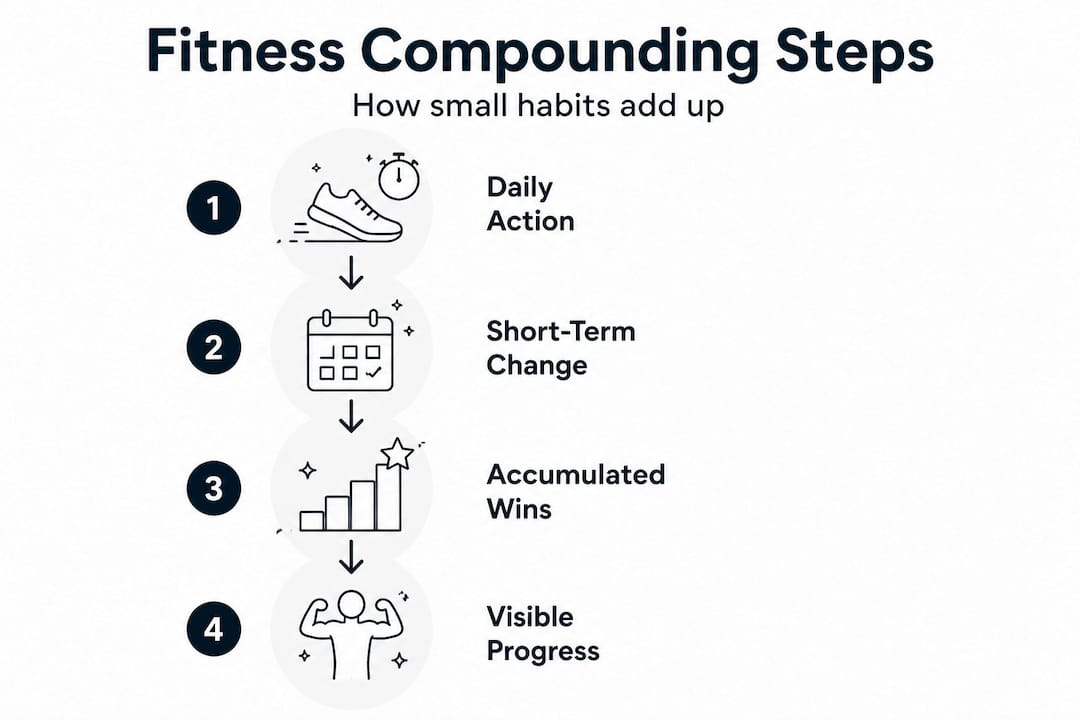
How small habits add up: The fitness compounding framework
With the principle defined, let’s look at how small, daily actions build up over time to create impressive results.

The challenge with compounding is that early results are almost invisible. This is exactly why so many people abandon their routines after a few weeks. They don’t see enough change to justify the effort. But what’s actually happening beneath the surface is significant. Mitochondrial density is increasing. Muscle fibers are remodeling. Resting heart rate is slowly dropping. The account is being filled, even when the balance doesn’t look that impressive yet.
Consider this example table showing what consistent small daily actions look like across a 16-week timeline:
| Week | Daily action | Cumulative effect |
|---|---|---|
| 1-2 | 20-minute walk + one strength session | Baseline movement habit established |
| 3-4 | Add a second strength session per week | Neuromuscular coordination improving |
| 5-8 | Improve sleep to 7-8 hours consistently | Recovery accelerates, soreness reduces |
| 9-12 | Add protein-focused meals, reduce processed food | Noticeable body composition shift begins |
| 13-16 | Add interval cardio once per week | Cardiovascular efficiency markedly improved |
Notice that no single week includes a massive overhaul. Each layer is modest. But by week 16, the person following this plan looks and feels fundamentally different from week one, not because they did anything extreme, but because they made small deposits in their fitness account consistently, letting consistency compound and results emerge after time, not immediately.
Here’s a step-by-step breakdown of how to build your own compounding fitness framework:
- Start with one anchor habit. Choose one behavior you can do every single day without fail. A 15-minute walk. A consistent bedtime. One glass of water before coffee. Anchor habits form the foundation.
- Layer in additional habits only after the first is automatic. Wait until your anchor habit requires zero willpower. Then add the next behavior. This is how you avoid overload.
- Track weekly, not daily. Daily variance in energy, mood, and life circumstances will distort your view. Looking at weekly patterns gives you an accurate picture of progress.
- Celebrate small milestones. Finishing a full week of training, sleeping seven or more hours for five consecutive nights, or hitting a protein target three days in a row all deserve acknowledgment. These reinforce the behavior loop.
- Give it at least 12 weeks before evaluating results. Compounding is slow at first and fast later. Judging results at week four is like checking your savings account the morning after opening it.
Pro Tip: Keep a simple journal where you log just three things each day: one training win, one nutrition choice you’re proud of, and your sleep hours. Reviewing a month of entries gives you concrete evidence of compounding and makes the invisible progress visible.
For more perspective on how patience and long-term thinking apply in other domains, the finance articles at HelpCalculate.com offer useful parallels that reinforce this mindset.
The limits and nuances of the compound interest analogy
Having seen the power of compounding, it’s important to understand where the analogy has limits and what that means for your real fitness journey.
Here’s a critical distinction: money in a compound interest account grows at a relatively predictable rate. Biology doesn’t work that way. Your body adapts to the stress you place on it, and once it adapts, the same stimulus produces less improvement. This is called the principle of accommodation, and it’s one of the biggest reasons fitness progress stalls.
Training progress is affected by adaptation, plateau phases, injury risk, and dose/response limits, which means the rate of improvement is not constant and cannot be assumed to keep accelerating indefinitely.
“The analogy is powerful, but it is not literal finance math. Training progress is affected by adaptation, plateau phases, injury risk, and dose/response limits - so the ‘rate’ of improvement isn’t constant.”
Here’s a direct comparison of financial versus biological compounding:
| Factor | Financial compounding | Fitness compounding |
|---|---|---|
| Growth pattern | Predictably exponential | Curvilinear, with plateaus |
| Rate of return | Fixed or variable but calculable | Changes with adaptation |
| Risk of loss | Market-dependent | Injury, illness, overtraining |
| Recovery from setbacks | Reinvest and continue | Requires physical healing time |
| Maximum ceiling | Theoretically unlimited | Biologically capped by genetics |
Key practical realities to keep in mind as you apply this framework:
- Plateaus are normal and expected. When progress slows, it doesn’t mean compounding has stopped. It means your body needs a new stimulus.
- Overtraining is the equivalent of a bad investment. Doing too much too fast depletes your resources instead of growing them.
- Injury interrupts compounding. A six-week injury setback can erase months of accumulated gains. Injury prevention is a legitimate part of your fitness strategy.
- Recovery is not optional. Rest days and deload weeks are the fitness equivalent of protecting your principal. They allow the adaptations from prior work to fully consolidate.
- Age affects your rate of return. Younger bodies recover faster and adapt more readily. Older athletes need more recovery time but still benefit substantially from consistent effort.
Understanding extra mortgage payment insights offers a useful parallel: in finance, making smart strategic moves at key moments dramatically changes long-term outcomes. The same applies to how you time your training intensity, rest, and recovery cycles.
Applying the compounding principle to your fitness routine
With those caveats in mind, here’s how you can put the compounding principle into practice for long-lasting results.
The most effective fitness routines are not the most complicated ones. They are the ones that get done consistently over long periods of time. Structure your approach around small, consistent behaviors in training, nutrition, sleep, and stress management, because these yield compounding benefits over time in ways that sporadic intense effort never does.
Here’s how to structure your own compounding fitness deposits:
- Make daily movement non-negotiable. Even on your worst days, commit to something physical, even a 10-minute walk. This keeps the habit alive and the compound clock ticking.
- Build your nutrition around protein and vegetables first. These two categories support recovery and body composition more reliably than any other dietary strategy. You don’t need perfection, just consistency.
- Protect your sleep like a priority appointment. Set a consistent sleep and wake time seven days a week. Sleep debt is like withdrawing from your fitness account without repaying it.
- Implement a weekly stress reduction practice. This could be a long walk outdoors, a breathing routine, meditation, or even reading. Chronic cortisol elevation directly suppresses the hormonal environment needed for adaptation.
- Progressive overload: increase demands gradually. Add five pounds to a lift, one more set per week, or one additional minute of cardio each session. These micro-increases are your compound interest rate in action.
- Record your numbers. Bodyweight, reps, sets, sleep hours, and energy levels. Data turns invisible progress into visible evidence.
Pro Tip: Schedule a formal eight-week checkpoint into your calendar right now. At that checkpoint, review your tracking data, compare it to week one, and decide whether to adjust your plan. This checkpoint habit prevents you from either quitting too early or grinding too long without adapting.
Use the health and fitness calculators at HelpCalculate.com to track your BMI, calorie targets, and other key metrics at each checkpoint. Having actual numbers to compare makes your compounding progress undeniable.
The truth most experts miss about compounding and fitness
After seeing practical methods, here’s the deeper truth behind the compounding principle that most advice overlooks.
The compound interest analogy is genuinely useful. It helps people shift their mindset from “go hard or go home” to “stay consistent and stay patient.” That shift alone changes outcomes for most people. But there’s a trap embedded in the analogy that experts rarely address.
When people understand that compounding rewards consistency, some of them turn it into a new form of rigidity. They refuse to take rest days because they fear “losing” their compound gains. They push through pain because stopping feels like withdrawing from the account. They measure every week against the prior week expecting growth, and spiral when a plateau hits.
Training progress doesn’t follow a fixed rate of return. Adaptation, plateaus, injury risk, and biological limits all shift that rate constantly, which means treating your body like a savings account you can never touch is a misapplication of the analogy.
The athletes and long-term fitness enthusiasts who actually sustain progress for decades understand something different. They know when to push. They also know when to pull back. They treat a deload week not as a withdrawal but as a dividend reinvestment. They recognize that a week of lower intensity allows the body to consolidate adaptations and come back stronger. This is sustainable progress, not a compromise of it.
The real lesson of compounding in fitness is not that more is always better. It is that sustained consistency beats irregular intensity every time. Flexibility, self-awareness, and willingness to adapt your approach are not the enemies of compounding. They are what keep the account open and growing over years and decades.
The finance calculator insights at HelpCalculate.com reinforce this idea from a different angle: smart financial compounding isn’t about maximum aggression. It’s about protecting your principal while letting returns accumulate steadily.
Supercharge your fitness journey with the right tools
Now that you know how to make compounding work for you, support your fitness journey with easy-to-use tools tailored for success.
Tracking your fitness progress doesn’t have to be complicated. What matters is having reliable reference points that show you how far you’ve come, and where to focus next.

HelpCalculate.com offers a full range of BMI and calorie calculators that make it easy to monitor the core metrics behind your compounding progress. Whether you’re checking your body mass index as a monthly checkpoint or calculating your daily calorie needs as your training load increases, these tools give you clear, accurate numbers in seconds. You can also explore math calculation tools to work out ratios, percentages, and progress tracking metrics without needing a spreadsheet. Pair these tools with the consistent habits outlined above, and your compounding fitness journey becomes something you can measure, adjust, and build on with confidence.
Frequently asked questions
Is compound interest in fitness just about exercise?
No, it’s about small, consistent gains in training, nutrition, sleep, and stress management that all add up over time to create lasting physical improvement.
Can you really see exponential results from small fitness actions?
Consistent habits deliver impressive gains over time, but actual progress is not perfectly exponential due to biological limits and plateaus that affect your rate of improvement.
How long does it take for compounding to result in visible fitness progress?
Results tend to emerge gradually after weeks or months, depending on your starting point, the habits you’re building, and how consistently you practice them.
What are signs that your fitness progress is compounding?
You might notice workouts feeling progressively easier, gradual increases in strength and endurance, more stable energy throughout the day, and faster recovery between sessions, even when the visible changes seem subtle at first.
What if I miss a day or fall off track?
Fitness compounding is forgiving by nature. Returning quickly to your small, consistent actions is all it takes to restart the accumulation process and let your progress continue building over time.
Recommended
- Compound interest calculator - growth & contributions | Help Calculate
- Health & fitness - BMI, calories & body calculators | Help Calculate
- Articles - guides, tips & free calculator insights | Help Calculate
- Building endurance - MK Marathon Weekend 1st - 2nd May 2022
- Why Strength Training Is the Real Game Changer – LifeUnlocked
Related calculators
Related posts
Health & Fitness
Understanding your basal metabolic rate for better results
Discover what is basal metabolic rate and how understanding it can optimize your weight and fitness goals for better results!
Health & Fitness
How Many Steps a Day Do You Actually Need? It's Not 10,000 - And the Science Behind That Number Will Surprise You
The 10,000-step goal wasn't created by doctors or researchers. It was invented to sell pedometers. The most comprehensive scientific review ever conducted has arrived at a very different, and far more forgiving, number.