

Calculate Your Optimal Hedge Amount
Enter your original bet, odds, and hedge odds to instantly see the optimal hedge amount and guaranteed profit both ways.
Open Betting Hedge CalculatorWhat is Hedging in Sports Betting?
Hedging is the practice of placing a bet on the opposite outcome of your original wager to guarantee a profit or minimize a potential loss.
Think of it like insurance for your bet. Just as you might buy travel insurance to protect against trip cancellations, hedging protects against your original bet losing -though unlike insurance, hedging can also lock in guaranteed profits.
Let's say you bet $100 on Team A to win at +200 odds (you'd win $200 profit if they win). As game time approaches, you get nervous. To hedge, you could bet $50 on Team B at -110 odds.
Result? No matter who wins, you've limited your risk. You won't win as much if Team A wins, but you also won't lose your entire $100 if Team B wins.
Why Bettors Hedge
Bettors hedge for three main reasons:
- •Lock in guaranteed profit (especially on parlays or futures)
- •Minimize potential losses (when circumstances change)
- •Reduce stress and sleep better (psychological benefit)
How Does Hedging Work? A Simple Example
Let's walk through a basic hedge scenario step-by-step.
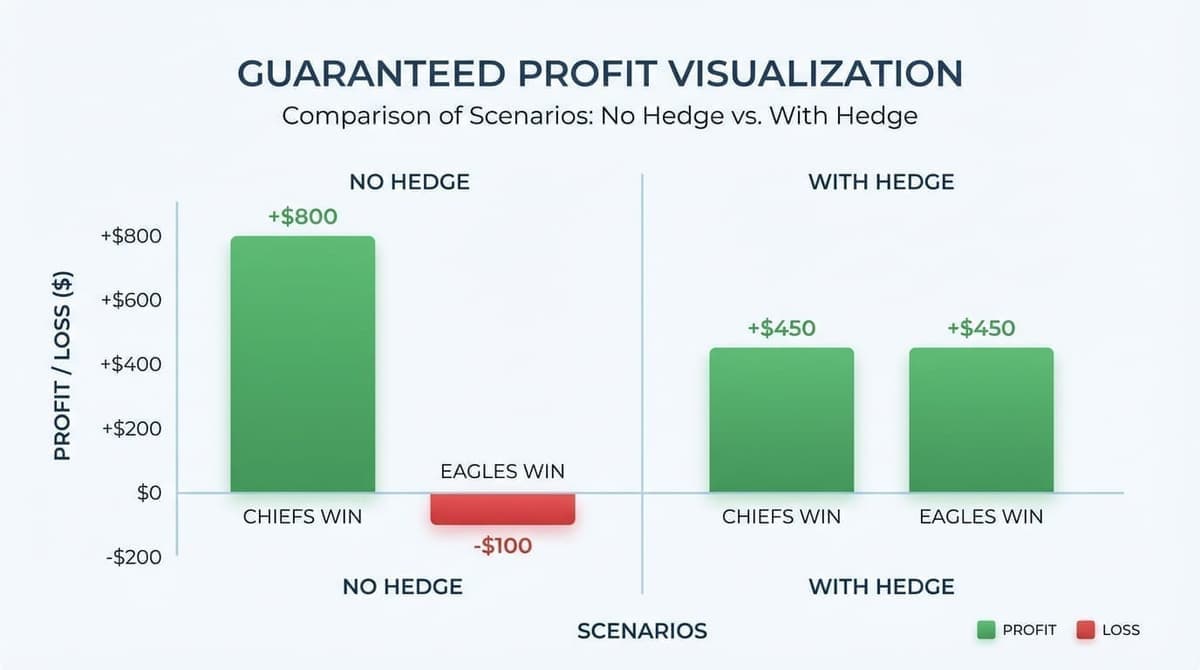
The setup: You placed a $100 bet on the Kansas City Chiefs to win the Super Bowl at the start of the season at +800 odds. If they win, you collect $900 total ($800 profit + $100 stake back).
The Chiefs make it to the Super Bowl facing the Philadelphia Eagles. Current odds: Chiefs ML -120, Eagles ML +100.
Option A: Let It Ride (No Hedge)
- •If Chiefs win: You collect $900 (+$800 profit)
- •If Eagles win: You lose your $100 stake (-$100)
Option B: Hedge Your Bet
You bet $450 on the Eagles at +100.
- •If Chiefs win: Original bet pays $900, hedge loses $450 → Net profit $450
- •If Eagles win: Original loses $100, hedge pays $900 → Net profit $450
When Should You Hedge a Bet?
Hedging isn't always the right move. Here are the scenarios where it makes the most sense.
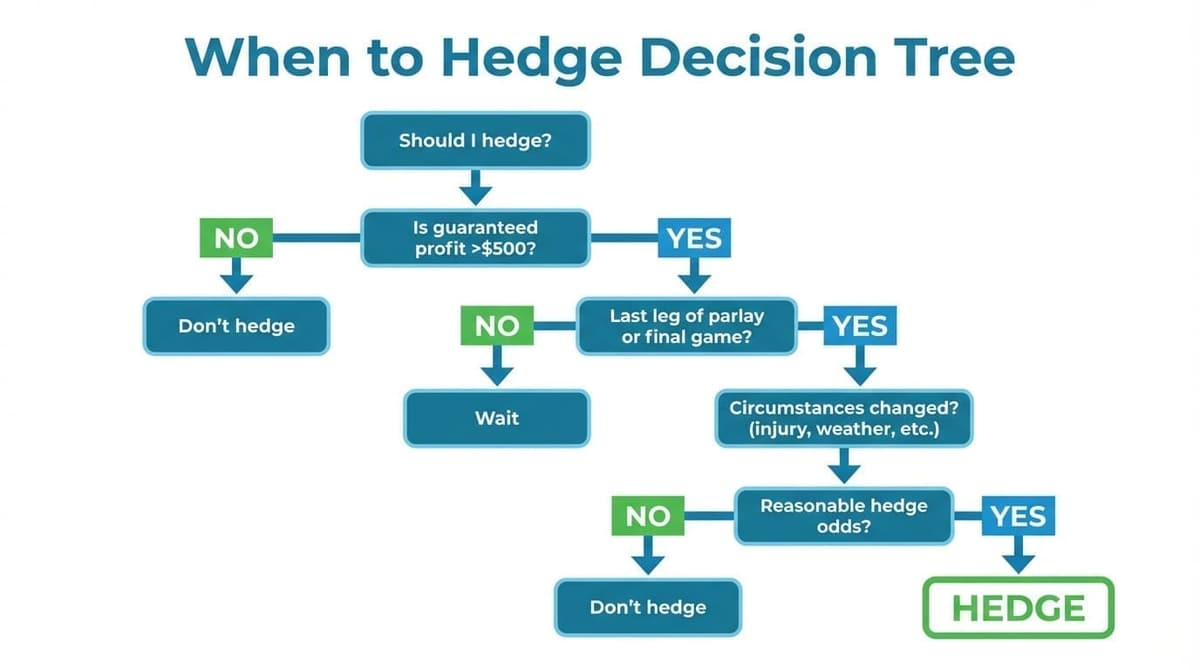
1. Large Futures Bets Near Completion
Best scenario: You have a futures bet with significant money on the line, and your team is one game away from winning.
Example: You bet $200 on Leicester City to win the Premier League at +5000. They're now three games from winning, and you could collect $10,200. Hedging here makes perfect sense -locking in $5,000–$8,000 guaranteed is life-changing money for most bettors.
Rule of thumb: If the guaranteed profit from hedging would be meaningful to your life (pay off debt, cover rent, fund a vacation), hedge it.
2. Parlays with One Leg Remaining
You have a 5-leg parlay with four winners. The last leg is tonight.
Why hedge: The odds of hitting a 5-leg parlay are low (roughly 3% even with favorable odds). You've already beaten the odds -locking in profit is smart bankroll management.
Example: Original bet $50, potential payout $2,500. Hedge by betting ~$1,200 on the opposite side at -110. You've guaranteed at least $1,000+ instead of risking losing your $50 for the chance at $2,450.
3. Circumstances Changed Significantly
- •Injury news -Your quarterback gets injured before the game
- •Weather changes -Game moved indoors, affecting the over/under
- •Line movement -The line moved 5+ points, indicating sharp money
- •Personal situation -You need the money now more than when you placed the bet
- •New information -Lineup changes, motivation factors
4. Emotional and Psychological Relief
Sometimes hedging isn't about math -it's about sanity. If you can't sleep thinking about the bet, would be devastated by a loss, or just want to enjoy the game stress-free, then hedge. Your mental health has value that doesn't show up in expected value calculations.
5. Bankroll Protection
When a single bet represents more than 5% of your bankroll, hedging protects you from ruin. If you bet $500 on a $5,000 bankroll and the bet is looking good, hedging ensures you don't swing from potentially doubling that unit to losing it entirely.
When Should You NOT Hedge?
Hedging reduces expected value. Here's when to avoid it.
1. Small Bets with Good Value
Don't hedge $10–$50 bets that won't change your life either way. You placed the bet because you believed it had value. The outcome hasn't changed. Hedging small amounts just guarantees you win less for no meaningful benefit.
Rule: If the bet is less than 1% of your bankroll, don't hedge unless you're hedging for fun or experience.
2. When You Still Believe in Your Original Bet
If nothing has changed since you placed your bet (no injuries, no new information), and you still think your side is the right side, don't hedge. Hedging because you're nervous is fear-based, not logic-based.
3. Every Single Parlay (Bad Habit)
Some bettors hedge every parlay as a routine. This is a mistake. If you hedge every parlay when you get to the last leg, you're essentially just making straight bets with extra steps and worse odds.
Better approach: Don't make parlays at all if you're going to hedge every time. Only hedge parlays when the guaranteed profit is significant (5+ units), you need the money, or circumstances changed.
4. When Hedge Odds Are Terrible
Sometimes the odds on the hedge side are so bad that hedging isn't worth it. Example: Your original bet was at +200. The hedge bet is available at -300. The juice is so high that you're giving up massive EV for minimal protection. Always check the math before hedging.
How to Calculate the Perfect Hedge
The goal for most bettors is to hedge so they make the same profit regardless of which bet wins.
The Formula
For equal profit on both sides, you need to solve for the hedge amount (H) where profit if original wins equals profit if hedge wins.
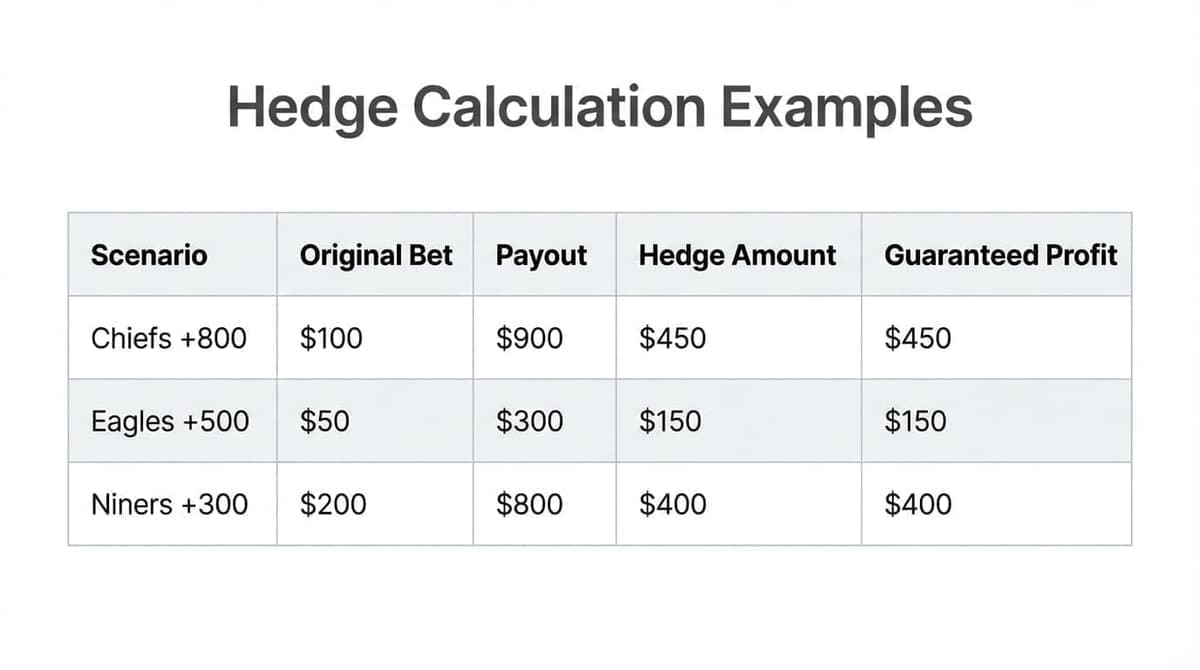
Your situation: Original bet $100 on Chiefs at +800 (potential payout $900). Hedge opportunity: Eagles at +100 (decimal 2.00).
Set profits equal: $900 - H = (H × 2.00) - $100. Solving: $1,000 = 3H, so H = $333.33.
Verification: If Chiefs win, $900 - $333 = $567 profit. If Eagles win, $333 × 2 = $666 minus $100 original = $566 profit. Nearly equal.
Quick Hedge Formula
Hedge ≈ (Original Payout - Original Stake) ÷ (Hedge Decimal Odds + 1)
Don't want to do the math? Use our Betting Hedge Calculator. Enter your original bet amount, original odds, potential payout, and hedge odds. The calculator instantly shows the optimal hedge amount and guaranteed profit both ways.
Real-World Hedging Examples
Example 1: Parlay Hedge
Setup: $50, 4-leg NFL parlay. First 3 legs won. Last leg: Bills -3.5 vs Dolphins. If Bills cover, you win $800 total.
Hedge calculation: Bills -3.5 and Dolphins +3.5 both at -110. For roughly equal profit, hedge around $350–$400 on Dolphins to guarantee $350–$400 profit.
Example 2: Futures Bet Hedge
Setup: $200 on Arsenal to win the Premier League at +1200 (payout $2,600). Arsenal in final match week. Man City to win league at +120.
Hedge: ~$750 on Man City. Arsenal wins: $1,850 profit. Man City wins: ~$1,450 profit. You guarantee at least $1,450 (725% ROI on original $200).
Example 3: Middling Opportunity
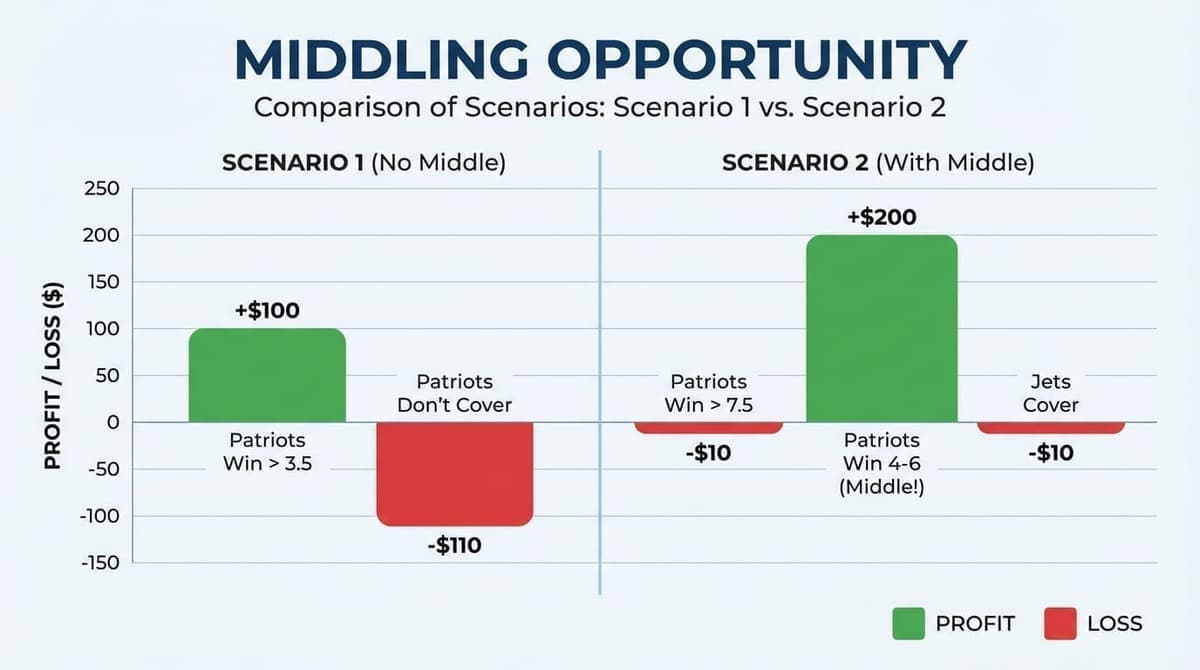
You bet Patriots -3.5 at -110 on Monday. By Sunday the line moved to Patriots -7.5. You bet the Jets +7.5 at -110.
Middle window: Patriots win by 4–6 points = both bets win. This isn't a pure hedge -it's trying to win both. Only do this if you think there's a realistic chance of landing in that window.
Advanced Hedging Strategies
Progressive Hedging (Ladder Strategy)
Hedge at multiple points as your position improves. Example: 6-leg parlay. After 3 legs: hedge 20% to lock small profit. After 4 legs: hedge another 30%. After 5 legs: hedge remaining to maximize guaranteed profit.
Partial Hedging
Hedge less than the full amount to lock in some profit while maintaining upside. Example: Full hedge locks in $500 both ways. Partial hedge of $250 creates: original wins = $750 profit, hedge wins = smaller profit. Use when you still believe in your original bet but want insurance.
Correlation Hedging
Instead of betting the direct opposite (e.g., Team Total Under), hedge with a correlated outcome (e.g., Opponent ML). If your team scores under 24 points, they probably lose. Requires understanding game correlations.
Common Hedging Mistakes to Avoid
Mistake #1: Hedging Too Early
Hedging as soon as one leg of a parlay wins, or hedging a futures bet months before it resolves. You're giving up massive potential value for tiny protection. Only hedge on the last leg or when the futures event is 1–2 games from resolving.
Mistake #2: Hedging for the Wrong Amount
Guessing the hedge amount instead of calculating it. You end up with unequal profits or accidentally guarantee a loss. Use the formula or calculator every time.
Mistake #3: Hedging with Terrible Odds
Taking any odds available. Sportsbooks know when you're desperate to hedge and offer inflated juice. Shop multiple books. If odds are 20+ cents worse than they should be, consider not hedging.
Mistake #4: Hedging Out of Panic
Emotion-based hedging leads to regret. Ask: "What new information do I have?" If the answer is "nothing," don't hedge.
Mistake #5: Forgetting the Vig
Betting $100 on Team A at -110 and $100 on Team B at -110: one wins $190.91, one loses $100. Net: -$9.09. The vig means equal bets on both sides loses money. Use a calculator to get the right hedge amount.
Tools & Resources
Before hedging any bet, run through this checklist:
- •Is the guaranteed profit meaningful? (>5 units or life-changing)
- •Have I calculated the exact hedge amount? (not guessing)
- •Are the hedge odds reasonable? (not inflated vig)
- •Have circumstances changed since my original bet?
- •Am I hedging based on logic, not emotion?
- •Have I considered all outcomes (including push)?
Key takeaways
- •Hedging means betting the opposite outcome to guarantee profit or limit loss -it always reduces expected value.
- •Hedge when guaranteed profit is meaningful: large futures near completion, parlays with one leg left, or when circumstances changed.
- •Don't hedge small bets, when you still believe in your original bet, or out of panic without new information.
- •Always calculate the hedge amount -use our Betting Hedge Calculator or the formula: Hedge ≈ Original Payout ÷ (Hedge Decimal Odds + 1).
- •Common mistakes: hedging too early, wrong amount, terrible odds, emotion-based decisions, forgetting the vig.
Conclusion
Hedging is a powerful tool in sports betting, but not one to use constantly. Hedge when guaranteed profit is meaningful and circumstances support it. Always calculate -never guess.
Every hedge is a trade-off between certainty and maximum profit. The right decision depends on your financial situation, risk tolerance, and the specific bet.
When in doubt, run the numbers with our Betting Hedge Calculator to see exactly what you stand to gain or lose with each approach. Bet smarter, not harder.
FAQ
Is hedging the same as arbitrage?
No. Hedging means betting the opposite side of your original wager to guarantee profit or limit loss. Arbitrage means betting both sides across different books simultaneously when line discrepancies guarantee profit. Hedging always involves an original bet you placed earlier.
Do sportsbooks care if I hedge?
Generally no. They're happy to take hedge bets. They do care about arbitrage across books (can lead to limiting). Some promotions prohibit hedging -read terms carefully.
Should I always hedge parlays with one leg left?
No. Hedge when the guaranteed profit is significant (5+ units), you need the money, or the stress isn't worth it. Don't hedge when the bet is tiny, you still love your last leg, or you'd regret not winning the full amount.
What's the minimum profit worth hedging for?
Personal, but a framework: $100–$500 probably not; $500–$1,000 consider it; $1,000–$5,000 strongly consider; $5,000+ hedge unless you're wealthy. Another rule: if guaranteed profit is >1 month's rent, hedge it.
Can I lose money by hedging?
Yes, if done wrong: hedging too much (guarantee loss both ways), terrible hedge odds (vig eats profit), or push scenarios (both bets push). Always calculate before hedging.
What if I can't find good odds to hedge?
Shop multiple sportsbooks. Odds might improve closer to game time. Consider a partial hedge. If odds are terrible (-200 when they should be -110), it might not be worth hedging.
Is hedging +EV (positive expected value)?
Almost always no. Hedging reduces expected value because the hedge bet is the opposite of what you thought had value. However, hedging can be right for bankroll management, peace of mind, or when circumstances changed.
What's the difference between hedging and cashing out?
Hedging: you manually place a bet on the opposite side, control the amount, shop for best odds. Cash out: the sportsbook offers a buyout, usually 10–20% below fair value. Hedging yourself is almost always better value; cash out is more convenient.