
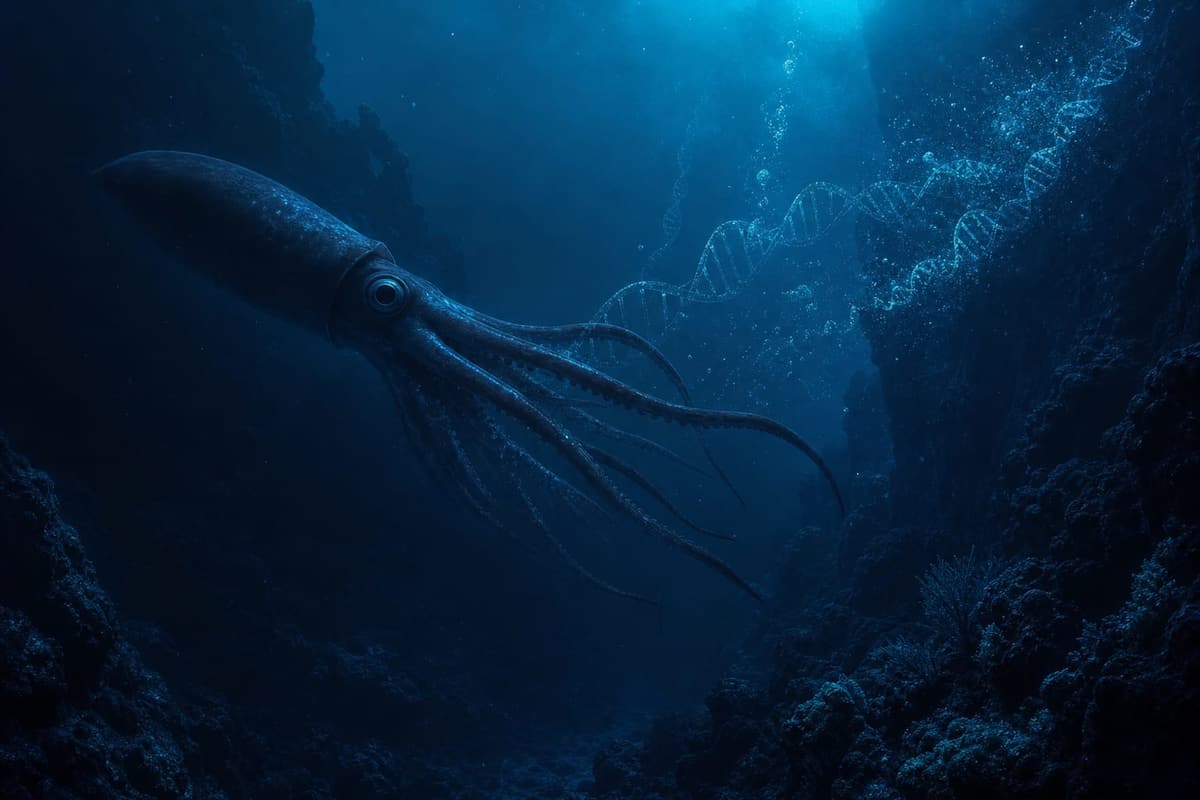
The Discovery at a Glance
- •What: Giant squid (Architeuthis dux) detected in the Cape Range and Cloates submarine canyons off Western Australia
- •First record of the species in WA waters using eDNA methods, and the northernmost confirmed record of Architeuthis dux in the entire eastern Indian Ocean
- •How: Environmental DNA (eDNA) - genetic fragments shed naturally into seawater, collected and analyzed without ever seeing the animal
- •Depth surveyed: Up to 4,510 meters - deeper than four Burj Khalifas stacked on top of each other
- •Total species detected: 226 across 11 major animal groups, including 83 that had never before been recorded in the region
- •Published in: Environmental DNA (DOI: 10.1002/edn3.70261)
A giant squid - one of the most elusive animals on the planet, a creature measuring up to 13 meters long and rarely observed by humans anywhere - was detected last week in deep submarine canyons off the coast of Western Australia. The scientists who found it never laid eyes on it. They found its DNA in the water.
The study, led by Dr. Georgia Nester of Curtin University and published in the journal Environmental DNA, is one of the most comprehensive deep-sea biodiversity surveys ever conducted in the Indian Ocean. It detected 226 species, identified 83 previously unrecorded in the region, and found what may be entirely new species - all without a single trawl net or manned dive.
The method that made this possible - environmental DNA, or eDNA - is quietly changing what we know about life on Earth. Here's how it works, what it found, and why it matters.
The Animal: Why the Giant Squid Still Captures the Imagination
Architeuthis dux - the giant squid - has haunted human mythology for centuries. Norse sailors called it the Kraken. Jules Verne put it in 20,000 Leagues Under the Sea. The ancient mariner's sea monster, the terror of the deep, the creature that battles sperm whales in the blackness of the ocean - all of these legends trace back to this single, extraordinary animal.
And yet for all that cultural weight, scientists know remarkably little about it. Giant squid are so rarely encountered that most of what we know comes from carcasses that wash ashore, specimens recovered from the stomachs of sperm whales, or the occasional extraordinary underwater encounter.
Here is what we do know:
Size: Giant squid typically grow between 10 and 13 meters in length - longer than a standard school bus - and can weigh up to 275 kilograms. Females are generally larger than males.
Eyes: At up to 27-30 centimeters in diameter, giant squid have among the largest eyes of any living animal on Earth - rivaled only by the colossal squid (Mesonychoteuthis hamiltoni), whose eyes are thought to be even slightly larger. The size is an adaptation to the near-total darkness of the deep ocean, where even a few photons of bioluminescent light can mean the difference between spotting a predator and being eaten.
Depth: Giant squid live primarily in the "twilight zone" and deeper - roughly 200 to 1,000 meters below the surface, though they have been detected as deep as 1,500 meters. The canyons surveyed in this study plunge to 4,510 meters.
Diet and predators: Giant squid are active hunters, feeding on deep-sea fish and smaller squid. They are in turn hunted by sperm whales - the primary predator large enough to take them on. The stomachs of sperm whales frequently contain giant squid beaks, and live sperm whales sometimes surface bearing the distinctive circular scars left by squid suckers during violent deep-sea struggles.
Prior WA record: The giant squid had not been recorded in Western Australian waters for more than 25 years before this study. The eDNA detection is both the first confirmed WA record using these methods and the northernmost confirmed record of the species in the entire eastern Indian Ocean.
"Finding evidence of a giant squid really captures people's imagination, but it's just one part of a much bigger picture," said lead author Dr. Nester.
She is right. But the squid is still extraordinary.
The Method: What Environmental DNA Actually Is
Here is the part of this story that is arguably more remarkable than the squid itself.
Every living organism sheds genetic material into its environment constantly. Fish shed skin cells. Whales leave mucus. Squid release bodily fluids. Bacteria drift freely in the water column. All of these shed cells, fragments, and molecules contain DNA - and that DNA can survive in seawater for hours to days before degrading, leaving a detectable genetic trace of every creature that passed through.
Environmental DNA, or eDNA, is the practice of collecting water samples and analyzing them for these genetic fragments - identifying what species were present not by seeing them, but by reading the molecular signatures they left behind.
The process, in practice, looks like this:
1. Sample collection. Researchers lower water sampling equipment to specific depths and collect seawater - in this study, from the surface all the way down to more than four kilometers deep. The Curtin University team collected more than 1,000 samples across the two canyon systems.
2. Filtration. The water is filtered through membranes fine enough to capture DNA fragments and cells suspended in the water column.
3. Extraction. DNA is extracted from the filtered material in a laboratory.
4. Metabarcoding. The extracted DNA is analyzed using a technique called metabarcoding - essentially, reading short, standardized segments of DNA and matching them against a reference database of known species. This study used two genetic assays: COI Leray (which works across a broad range of invertebrates and other animals) and 16S Fish (which is particularly sensitive to fish species).
5. Identification. Each DNA sequence is matched to the species it came from. In this study, the giant squid's DNA was detected in six separate samples across both the Cape Range and Cloates canyons.
The key advantage over traditional methods is not just cost - it's sensitivity. eDNA can detect species that cameras would never see (too fast, too shy, too deep, too small), that nets might miss (too elusive, too fragile, too large to catch), and that acoustic surveys cannot identify (too silent, or acoustically similar to other species). A creature as elusive as a giant squid - one that has evaded human observation in WA waters for 25 years - leaves genetic traces in the water column that a water sample can find.
"eDNA allowed the team to detect fragile, rare and fast-moving species that traditional cameras and nets may miss," Dr. Lisa Kirkendale of the Western Australian Museum noted.
The Canyons: What Was Found at 4,510 Meters
The Cape Range and Cloates submarine canyons sit approximately 1,200 kilometers north of Perth in the Indian Ocean, off Western Australia's Ningaloo coast (also known as Nyinggulu in the language of the Baiyungu, Thalanyji and Yinikutira peoples). They are vast, dramatic geological features - essentially underwater gorges carved into the continental shelf - plunging to depths of more than 4,500 meters.
Until this study, they were largely unexplored. The difficulty of working at extreme ocean depths makes physical surveys logistically demanding and expensive. Much of what lives there was simply unknown.
The eDNA survey changed that. Among the 226 species detected across the two canyons, the study revealed:
- •Giant squid (Architeuthis dux) - detected in six samples, both canyons
- •Pygmy sperm whale (Kogia breviceps) - a deep-diving cetacean rarely documented in the region
- •Cuvier's beaked whale (Ziphius cavirostris) - one of the deepest-diving mammals on Earth, capable of diving to more than 2,900 meters
- •Sleeper shark (Somniosus sp.) - a range extension; not previously recorded in these waters
- •Dana octopus squid (Taningia sp.) - a remarkable bioluminescent cephalopod
- •Faceless cusk eel (Typhlonus nasus) - first ever record in Western Australian waters
- •Slender snaggletooth (Rhadinesthes decimus) - first WA record
- •Giant hydroid (Branchiocerianthus sp.) - a towering colonial animal of the deep
- •Deep-sea sea cucumber (Enypniastes sp.) - a distinctive, swimming holothurian of the abyss
- •Squat lobster (Munidopsis cf. subsquamosa) - one of the most widespread deep-sea crustaceans
Beyond these named species, the team detected an undetermined number of DNA sequences that don't neatly match anything currently in the scientific record - sequences that may represent species entirely new to science.
"We found a large number of species that don't neatly match anything currently recorded, which doesn't automatically mean they're new to science, but it strongly suggests there is a vast amount of deep-sea biodiversity we're only just beginning to uncover," Dr. Nester said.
The study also found that species communities differed significantly between the two neighboring canyons - Cape Range and Cloates - suggesting that even geographically close deep-sea habitats can harbor distinct ecological communities. Depth mattered too: species composition shifted markedly at different water column depths, suggesting highly stratified ecosystems stacked on top of each other in the same geographic location.
The Economics of Exploration: Why eDNA Changes Everything
Traditional deep-sea exploration is extraordinarily expensive. Crewed research vessels capable of deep-ocean work cost tens of thousands of dollars per day to operate, not including the vessel itself. The Schmidt Ocean Institute's research vessel Falkor - the ship used in this expedition - is a state-of-the-art 272-foot oceanographic research vessel that costs millions of dollars per year to operate and is offered to researchers through a competitive application process largely funded by philanthropy.
Remotely operated vehicles (ROVs) capable of reaching depths of 4,000+ meters cost anywhere from several hundred thousand to several million dollars to build, and tens of thousands of dollars per day to deploy from a vessel. The ROV SuBastian, used in this expedition to collect physical specimens for the genetic reference library, is one of the most capable deep-sea ROVs in civilian research.
Against that cost backdrop, eDNA water sampling is remarkably economical. A basic eDNA water sample - filtered through a membrane and sent for laboratory analysis - can be processed for as little as a few hundred dollars per sample at scale. The open-source low-cost eDNA sampler developed by NOAA researchers costs approximately $280 USD to build, compared to $100,000+ for automated commercial alternatives. Sequencing costs for metabarcoding have fallen dramatically over the past decade alongside the broader collapse in DNA sequencing costs.
This does not mean eDNA is free or even cheap in absolute terms - you still need a research vessel to collect samples at 4,510 meters, and the laboratory analysis of 1,000+ samples is a significant scientific undertaking. This expedition used both eDNA and ROV deployment together. But the information density that eDNA delivers per dollar of research effort - 226 species detected from water samples - is extraordinary compared to what a traditional camera survey or trawl net program would deliver for the same cost.
It also changes what is detectable at all. Camera surveys find animals that happen to swim past a camera during recording hours. Nets catch animals strong enough to be caught in nets and large enough not to pass through the mesh. eDNA finds everything that shed a cell in the water column - including a 13-meter squid that hasn't been visually confirmed in the region for 25 years.
But Wait - Isn't Finding Giant Squid eDNA Like Finding a Needle in a Haystack?
It's a reasonable question. The ocean is vast. Each water sample is 1-5 liters. Two submarine canyon systems of this scale contain on the order of several trillion liters of water. In pure volume terms, you're sampling roughly 1 part in trillions. That's not a needle in a haystack - that's a needle in a haystack the size of a continent.
And yet the researchers found it. In six separate samples, across two distinct canyon systems. Here's why that's more explicable than it first appears - and why those six samples are the most important detail in the entire study.
The Deep Ocean Preserves eDNA Better Than the Surface
The two primary destroyers of eDNA are UV radiation and warm temperatures. The deep ocean has neither. Research on eDNA persistence shows a half-life of approximately 26 hours in natural surface marine conditions. At 500-4,500 meters depth, where water temperatures hover around 2-4°C and there is zero UV light, degradation slows dramatically. The same DNA molecule that survives 26 hours at the surface can persist for days to weeks in the cold, dark deep. Cold temperature and the complete absence of sunlight conspire to make the deep ocean an unexpectedly good environment for eDNA preservation - far better than the sunlit, warm-water surface where the method was first developed.
Giant Squid Are Large Animals That Shed a Lot of DNA
eDNA concentration in water is a direct function of an animal's biomass and shedding rate - larger animals release more biological material. A 13-meter, 275-kilogram giant squid sheds proportionally far more skin cells, mucus, and bodily fluid than a small deep-sea fish. More biomass means higher eDNA concentrations in the surrounding water, which means a stronger and more detectable signal.
Canyon Topography Concentrates the Signal
Submarine canyons are not passive containers. They act as topographic funnels that influence current patterns and concentrate organic material along their walls and floors. Deep currents are slow - typically 0.1-0.5 meters per second at these depths - meaning eDNA shed within a canyon tends to remain within the canyon rather than rapidly dispersing into the open ocean. The canyon geometry that makes these habitats so biologically rich also makes them better environments for eDNA detection than open water.
The Method Is Extraordinarily Sensitive
Metabarcoding uses PCR amplification to detect and amplify DNA sequences present in vanishingly small quantities - theoretically as few as single-digit copies per liter of water. It is not a blunt instrument looking for obvious signals. It is closer to a molecular search engine capable of finding one specific genetic sequence among billions of competing fragments. That sensitivity is precisely why water samples containing a handful of giant squid DNA molecules can return a positive detection.
Six Samples Across Two Canyons Is Not Luck
This is the most important point. If the giant squid had been detected in only one sample, a scientist would rightly be cautious - a single detection could be contamination, an artifact, or a fragment that drifted in from a distant source. Six independent detections across two geographically distinct canyon systems is an entirely different result. The statistical probability of six false positives independently aligning to the same species-specific genetic sequence across separate locations is negligibly small. Six detections is a consistent biological signal. It tells you an animal - or possibly more than one - was genuinely present and active in these waters recently enough to leave recoverable DNA.
So: Needle in a Haystack?
Both, in a way. The raw ocean volume math is genuinely humbling - you are sampling a microscopic fraction of an enormous body of water. But cold temperature, complete darkness, canyon topography, high squid biomass, extraordinary detection sensitivity, and 1,000+ samples across a deliberate survey grid all stack in the researchers' favor. It is less finding a needle in a haystack and more building a magnet sensitive enough to detect a single iron atom, knowing roughly which part of the haystack to sweep, and being methodical enough to sweep it thoroughly.
The improbability is real. So is the science that makes it possible anyway.
What This Means for Ocean Science
This study is one piece of a rapidly growing body of work demonstrating what eDNA can do for marine biodiversity research. The method is being used to track invasive species, monitor coral reef health, detect endangered populations, and survey fisheries - all without the physical disturbance of traditional methods.
For deep-sea research specifically, eDNA addresses one of the most persistent problems in ocean science: we simply don't know what's down there. The deep ocean represents roughly 95% of Earth's living space by volume. Most of it has never been directly observed. Most of the species living there have never been described. We know more about the surface of the Moon than about the floor of the Pacific Ocean.
What lived in the Cape Range and Cloates canyons before this study? Nobody knew. What lives in the thousands of other unexplored submarine canyons, seamounts, and abyssal plains across the world's oceans? We still don't know. But tools like eDNA metabarcoding are beginning to answer that question at a scale and cost that wasn't possible ten years ago.
The giant squid is the headline. The method is the story.
Cited Sources
- •Original peer-reviewed study: Nester et al., Environmental DNA, 2026 (DOI: 10.1002/edn3.70261)
- •Phys.org summary of study findings: Phys.org, May 5, 2026
- •EurekAlert press release, Curtin University: EurekAlert, May 5, 2026
- •Discover Wildlife reporting on eDNA method: Discover Wildlife, May 6, 2026
- •Oceanographic Magazine - canyon context and species quotes: Oceanographic Magazine, May 6, 2026
- •DistilINFO full species breakdown: DistilINFO, May 5, 2026
- •The News.com.pk - canyon depth and northernmost record quote: The News, May 6, 2026
- •NOAA low-cost eDNA sampler ($280 build cost): Formel et al., HardwareX, 2021 - NCBI
- •ROV and research vessel cost context ($100k-$10M): Frontiers in Marine Science - Low-Cost Deep-Sea Imaging and Analysis Tools, 2022
- •eDNA half-life in marine surface waters (~26 hours), exponential decay rates: Persistence of environmental DNA in marine systems - NCBI PMC
- •UV radiation as primary eDNA degrader; sunlight modulates eDNA persistence: Persistence of marine fish eDNA and the influence of sunlight - NCBI PMC
- •eDNA concentration as function of biomass and shedding rate; rare/small species harder to detect; eDNA travels tens of kilometers but dilutes with distance: A manager's guide to using eDNA metabarcoding in marine ecosystems - NCBI PMC
- •Metabarcoding amplification methodology, species detection from water samples: 12S Gene Metabarcoding with DNA Standard Quantifies Marine Bony Fish eDNA - bioRxiv