
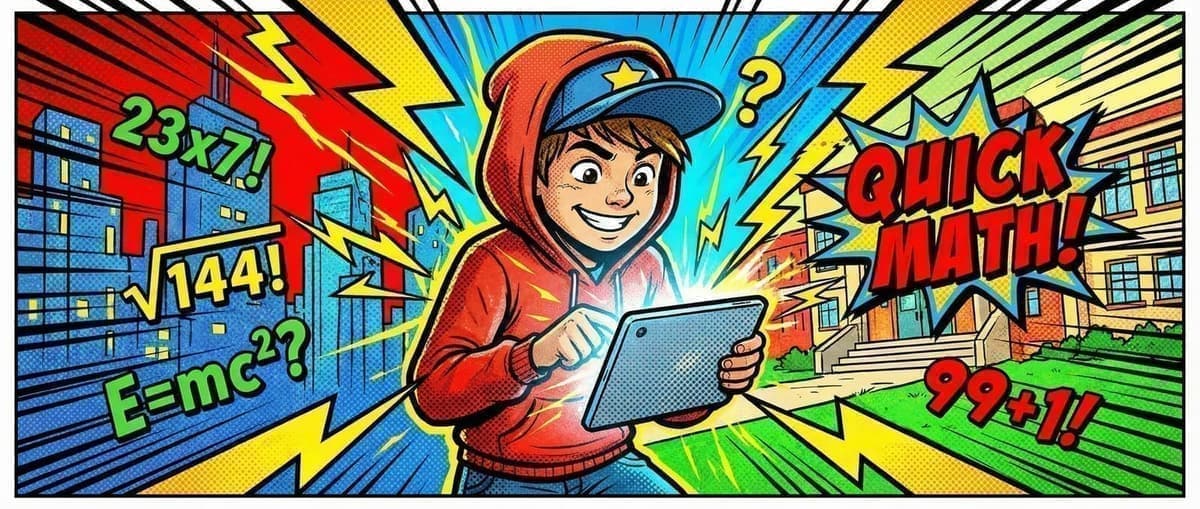
Quick Math
Test your mental math speed
About the Game
Quick Math is for anyone who wants faster mental math without long practice sessions. Choose a difficulty and operation, then race through ten problems to build speed and accuracy. The short rounds make it easy to play, improve, and try again. Use it to warm up before homework, sharpen skills for tests, or just keep your brain sharp. You will see how small gains in accuracy quickly turn into faster times. It is a simple, focused game that rewards consistency and makes math practice feel like a win. Use the Quick Math to get a clear result you can act on right away.
How to Calculate Manually
- 1Select your difficulty level (number range)
- 2Choose the math operation you want to practice
- 3Click Start to begin the challenge
- 4Answer 10 questions as quickly as possible
- 5Try to beat your best time!
Ready to Test Your Speed?
Answer 10 questions as fast as you can!
Examples
Easy (1-10) Addition
Perfect for warming up or kids learning basic math.
Medium (1-100) Multiplication
Great for improving times tables and mental math speed.
Hard (1-1000) Division
Challenge yourself with complex mental math and accuracy.
Tips & Strategies
Quick tip. Start with easier levels to build confidence and speed
Quick tip. Practice one operation at a time to master it
Use mental math tricks: for multiplication by 9. multiply by 10 and subtract the number
Quick tip. Regular practice improves both speed and accuracy
Division tip: estimate by rounding numbers first. then refine
Things Worth Knowing
- •Mental math speed follows the 10,000 hour rule: professional mental calculators who can solve 2-digit multiplication in under 3 seconds have practiced an average of 10,000-15,000 hours; the same principle as mastering chess, music, or any complex skill requiring pattern recognition and automaticity.
- •Calculator use actually weakens mental math: studies show regular calculator users take 35-40% longer to solve simple problems mentally than non-users, and fMRI scans show reduced activity in calculation-related brain regions; "use it or lose it" applies directly to mental math circuits.
- •The "rounding method" is 10x faster: instead of calculating 27+18 directly, experts round to 30+20=50, then subtract 3+2=5 to get 45; this compensation method is used by mental calculators worldwide and reduces calculation time from 4-5 seconds to under 2 seconds.
- •Eye movements reveal calculation strategy: eye-tracking shows expert calculators look at numbers for only 0.3-0.5 seconds vs 2-3 seconds for beginners; they use chunking (seeing "47" as a unit, not "4" and "7") and working memory rather than visual processing.
- •Competition mental math records: the world record for adding 100 random 10-digit numbers is 3 minutes 37 seconds; that is an average of 2.17 seconds per 10-digit addition, demonstrating that human calculation speed can approach calculator speeds with training.