
Number Ninja
Master mental math one belt at a time - from first sums to algebra.
About the Game
Slash your way to math mastery
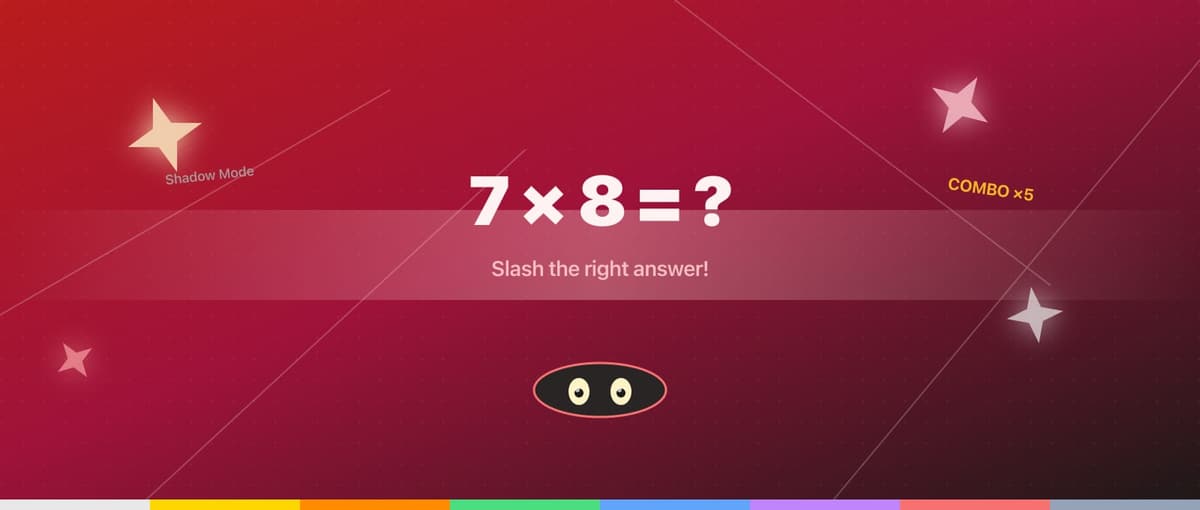
Number Ninja is a fast-paced arcade game where shurikens fly across the screen - each one carrying a possible answer to a math question. Your job? Click the shuriken with the correct answer before it escapes off the screen.
With every correct slash, you earn points and build a combo streak. String five correct answers together and you'll unlock Shadow Mode - a slow-motion bonus round where points pour in. Miss or slash the wrong target and you lose one of your three lives.
It's simple to pick up, genuinely exciting to play, and quietly doing the hard work of drilling mental math into long-term memory - one satisfying slash at a time.
Number Ninja - click shurikens showing the correct answer to a math equation
Instructions
HOW TO PLAY
Number Ninja takes less than a minute to learn. Here's all you need to know:
Read the Equation
Spot the Answers
Slash It
Earn Your Belt
Progression
THE BELT JOURNEY
Progress is tracked through a traditional martial arts belt system - a structure kids find naturally motivating. Each new belt introduces a more advanced math topic, and a brief belt ceremony rewards the achievement before the next challenge begins.
| Belt | Math topic | Approx. age / grade |
|---|---|---|
White | Addition with numbers 1–10 | Ages 5–6 · Kindergarten |
Yellow | Addition & subtraction up to 20 | Ages 6–7 · Grade 1 |
Orange | Multiplication by 2, 5, and 10 | Ages 7–8 · Grade 2 |
Green | Full times tables 1–12 | Ages 8–9 · Grade 3 |
Blue | Division facts | Ages 9–10 · Grade 4 |
Purple | Mixed operations (+, −, ×) | Ages 10–11 · Grade 5 |
Red | Fraction addition (same denominator) | Ages 11–12 · Grade 6 |
Black | Introductory algebra - solving for x | Ages 12+ · Grade 7 |
Tips & Strategies
Start at White Belt even if your child is older. it builds confidence and lets them warm up before the harder belts.
Play in short sessions. 10–15 minutes a day is more effective than one long sitting, especially for younger learners.
Let them fail. Missing a life is part of the game. Encourage kids to think about what the correct answer was before starting the next round.
Use it to target weak spots. If a child struggles with times tables, focus on Orange and Green Belt rounds specifically.
Celebrate belt-ups. even casually acknowledging a new belt reinforces that effort and practice lead to real progress.
Things Worth Knowing
- •⚡ Mental Math Speed - The time pressure forces kids to retrieve answers from memory rather than counting on fingers - exactly the kind of drill that builds genuine arithmetic fluency.
- •🎯 Accuracy Under Pressure - Decoy answers placed close to the correct one train careful thinking. Kids can't just recognise a "ballpark" - they have to know the exact answer.
- •🔁 Spaced Repetition - The wave and belt structure means each topic is revisited across multiple rounds, reinforcing recall in the same way flashcard systems do - but far more engagingly.
- •📈 Progressive Challenge - Difficulty scales automatically with skill level. Children are never bored by problems that are too easy, nor frustrated by a wall that's too hard - the belt system keeps the challenge in the "just right" zone.
- •🏆 Intrinsic Motivation - Belts, combos, and Shadow Mode give kids clear goals and immediate rewards. Earning a new belt feels meaningful - and naturally encourages one more try.
- •🧠 Working Memory Training - Holding the equation in mind while scanning moving targets and filtering decoys is excellent exercise for working memory - a foundational skill for all mathematics.